Recent Publication Highlight
LifeTein Stearylated octaarginine was cited in a recent Biomedicines publication studying lipid nanoparticle characterization, stability, and efficacy. The paper reports that “Stearylated octaarginine was purchased from LifeTein LLC,” supporting the use of LifeTein Stearyl-R8 in advanced lipid nanoparticle and intracellular delivery research.
View the 2026 Biomedicines publication →
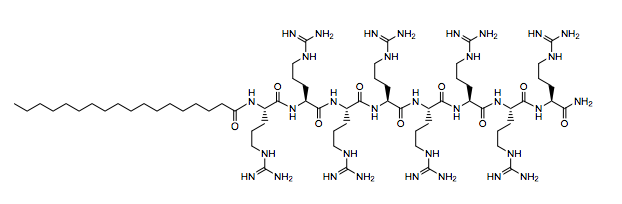
Stearyl-R8: Lipidated Octaarginine Cell-Penetrating Peptide
Stearyl-R8, also known as stearylated octaarginine or Stearyl-RRRRRRRR-NH2, is a lipid-modified arginine-rich cell-penetrating peptide (CPP). The octaarginine sequence provides a highly cationic guanidinium-rich domain, while the stearyl group increases hydrophobic membrane interaction.
This combination makes Stearyl-R8 useful for intracellular delivery studies, lipid nanoparticle formulation, oligonucleotide delivery, nanoparticle surface functionalization, and membrane-interaction research.
Enhanced Delivery via Lipidated Polyarginine Peptides
Lipid-modified polyarginine peptides such as Stearyl-R8 are designed to combine the strong electrostatic interaction of arginine-rich CPPs with the membrane affinity of a hydrophobic lipid tail. The stearyl group promotes association with lipid bilayers and nanoparticle surfaces, while the R8 sequence supports cellular interaction and intracellular delivery applications.
Recent literature continues to use Stearyl-R8 in delivery-system development. In a 2026 Biomedicines study on lipid nanoparticle characterization, stability, and efficacy, stearylated octaarginine from LifeTein was used as a component in lipid nanoparticle research. This supports Stearyl-R8 as a publication-backed reagent for researchers developing CPP-assisted and lipid-based delivery platforms.
Mechanism of Cellular Uptake
Arginine-rich CPPs interact strongly with negatively charged cell-surface components, including heparan sulfate proteoglycans and phospholipid membranes. The guanidinium groups of arginine residues can form multivalent electrostatic and hydrogen-bonding interactions that facilitate membrane association.
Cellular uptake may involve multiple pathways, including macropinocytosis, clathrin-mediated endocytosis, and other endocytic routes. Hydrophobic lipid modification can further increase membrane affinity and may improve association with lipid-based carriers or nanoparticle formulations.
Applications in Nucleic Acid and Nanoparticle Delivery
Stearyl-R8 is widely used in delivery-system research because it combines cationic complexation potential with hydrophobic membrane anchoring. Common research applications include:
- siRNA and oligonucleotide delivery research
- Lipid nanoparticle and liposome formulation studies
- Nanoparticle surface modification
- Intracellular delivery of nucleic acids, peptides, or functional cargos
- CPP-assisted formulation optimization
Advantages of Stearyl-R8
- Lipidated octaarginine CPP with strong membrane interaction
- Useful for intracellular delivery and nanoparticle formulation studies
- Highly cationic R8 sequence supports interaction with anionic cargos and membranes
- Stearyl group enhances hydrophobic association with lipid bilayers
- Available from LifeTein as a publication-cited research reagent
Used in published research and ready for immediate delivery. Contact LifeTein for bulk quantities, custom fluorescent labeling, conjugation services, or related CPP design support.
Molecular Design Considerations
Arginine density and length
The R8 sequence provides a compact, highly cationic CPP motif. Octaarginine and related oligoarginine sequences are commonly used to support cellular interaction and intracellular delivery.
Hydrophobic modification
The stearyl group increases hydrophobicity and membrane association, making Stearyl-R8 especially useful in lipid-based delivery systems and nanoparticle formulations.
Formulation flexibility
Stearyl-R8 can be used as a free peptide, a formulation component, or as part of nanoparticle-based delivery systems. It may also be combined with fluorescent labels or other functional modifications for tracking and assay development.
Related CPP products
LifeTein also offers related cell-penetrating peptides, including FITC-Stearyl-R8, Cys(Npys)-(Arg)9, TAT peptides, penetratin variants, and other cell-permeable peptide products.
References:
1. Tonges, L., Lingor, P., Egle, R., Dietz, G.P., Fahr, A. and Bahr, M. (2006). Stearylated octaarginine and artificial virus-like particles for transfection of siRNA into primary rat neurons. RNA 12: 1431-1438.
2. Trayford, C., Wilhalm, A., Habibovic, P. et al. One-pot, degradable, silica nanocarriers with encapsulated oligonucleotides for mitochondrial-specific delivery. Research Square Preprint, 21 August 2023. Stearyl octaarginine (STR-R8) was purchased from LifeTein. https://doi.org/10.21203/rs.3.rs-3231179/v1
3. Effect of Short-Anchored PEGylated Lipids on Lipid Nanoparticle Characterization Profiles, Stability, and Efficacy. Biomedicines 2026, 14(5), 1002. The study cites stearylated octaarginine purchased from LifeTein LLC. https://www.mdpi.com/2227-9059/14/5/1002
See more cell-penetrating peptides and CPP products available from LifeTein.
|