Product Name | Antennapedia Peptide, Cys N-term |
Product Quantity | 1mg |
Catalog Number | LT8101 |
Molecular Weight | 2348.92 |
Formula | C107H174N36O20S2 |
Sequence | CRQIKIWFQNRRMKWKK-NH2, Cys-Arg-Gln-Ile-Lys-Ile-Trp-Phe-Gln-Asn-Arg-Arg-Met-Lys-Trp-Lys-Lys-NH2, C-terminal Amidation |
Purity | >98% |
Catalog # | LT8101 |
Price | $99 In stock |
CAS # | 329306-46-9 |
Stability and Storage | Lyophilized peptides are stable at room temperature for 6 months and - 20 °C for 2 years. |
Shipping | Shipped at ambient temperature. |
Reconstitution | Soluble in water or DMSO |
Product Description | 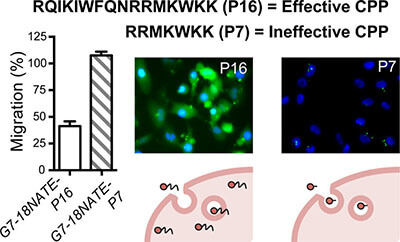
The DNA binding domain of the Drosophila transcription factor (Antennapedia), a 60 amino acid protein, has the ability to penetrate biological membranes. The 16-mer peptide (RQIKIWFQNRRMKWKK), residues 43-58, known as penetratin, from antennapedia preferentially targets the Class I pathway. The peptide has the same translocating properties as the entire protein and can facilitate the cytoplasmic uptake of CTL epitope 9-mer peptides. For C-RQIKIWFQNRRMKWKK, the extra cysteine is used for the downstream conjugation. |
Scientific Background | Antennapedia Peptide, Cys N-term is a 17-residue synthetic peptide with the sequence Cys-Arg-Gln-Ile-Lys-Ile-Trp-Phe-Gln-Asn-Arg-Arg-Met-Lys-Trp-Lys-Lys. C-terminal amidation removes the terminal carboxylate charge. The sequence contains 1 cysteine residue, providing potential thiol/disulfide chemistry when the thiol is available; contains 4 Lys and 3 Arg residues, contributing cationic character; contains 3 aromatic residues that can contribute to hydrophobic or aromatic interactions. These sequence-derived properties describe the reagent chemically; no specific receptor, enzyme, pathway, disease association, or biological activity is assigned without product-specific experimental evidence. |
Research Applications | - thiol-selective conjugation or immobilization studies
- LC-MS/HPLC analytical method development
- sequence-specific assay controls
|
Experimental Notes | Sequence-derived chemical properties support reagent selection and experimental planning but do not establish biological function. Solubility, aggregation, adsorption, conjugation efficiency, and assay performance should be validated under the intended experimental conditions. |