
Fluorescent labeling with Atto dyes has become a practical option for researchers who need bright, stable, and spectrally well-separated probes for peptide imaging and assay development. Atto dyes are a commercially available family of synthetic fluorophores that span much of the visible and near-infrared spectrum. They are often selected when conventional labels such as FITC, Cy3, or Cy5 do not provide sufficient photostability, pH tolerance, or signal consistency for a given experiment. Because peptides are small and chemically versatile, they can be conjugated to Atto dyes through several well-established chemistries, enabling applications in fluorescence microscopy, flow cytometry, FRET, and single-molecule detection. LifeTein, for example, offers custom synthesis of peptides labeled with Atto dyes such as Atto 465, 488, 495, 550, and 647, allowing researchers to match the dye to their instrument and assay requirements.
Key Takeaways
- Atto dyes are a broad family of synthetic fluorophores known for high photostability, good brightness, and reduced pH sensitivity compared with many conventional labels.
- Common Atto dyes used in peptide work include Atto 488 (green), Atto 550 (orange-red), and Atto 647N (far-red), covering multiple laser lines and filter sets.
- Atto dyes can be attached to peptides at the N-terminus, C-terminus, or through lysine or cysteine side chains, depending on the conjugation chemistry.
- For FRET, Atto dyes can serve as donors or acceptors; pair selection depends on spectral overlap and the Förster radius required for the distance range being studied.
- Control samples, including donor-only and acceptor-only peptides, are essential for correcting spectral bleed-through and direct acceptor excitation.
- Custom labeling services, such as those from LifeTein, can incorporate Atto dyes into peptides with spacer options to reduce steric interference.
Overview of Atto Dyes
What Are Atto Dyes?
Atto dyes are a series of fluorescent labels originally developed for demanding fluorescence applications. They are not a single dye but a family of compounds with different excitation and emission maxima. Their molecular structures are generally rigid, which helps reduce non-radiative decay and improves photostability. Many Atto dyes also show relatively little sensitivity to pH changes between mildly acidic and mildly basic conditions, making them useful in complex biological buffers.
Why Use Atto Dyes for Peptide Labeling?
Peptides are often labeled to track binding, uptake, localization, or conformational change. The label must be bright enough to detect low copy numbers, stable enough for time-lapse imaging, and small enough not to disrupt peptide function. Atto dyes address several of these needs. For example, Atto 488 is often used as a greener alternative to FITC, while Atto 550 is frequently compared with Cy3 and TAMRA. Atto 647N is used in far-red channels where low background and good photostability are important.
Find out more about fluorescent peptides here.
Spectral Selection and Common Atto Dyes
Green-Emitting Dyes
Atto 488 has excitation and emission maxima near 501 nm and 523 nm, respectively. It is compatible with the 488 nm laser line and standard FITC filter sets. It is commonly chosen for flow cytometry, immunofluorescence, and live-cell imaging where a stable green signal is needed.
Orange-Red and Far-Red Dyes
Atto 550 excites near 554 nm and emits near 576 nm. It is often used as a substitute for Cy3 or TAMRA when greater photostability is desired. Atto 647N excites near 644 nm and emits near 669 nm, making it suitable for 633 nm or 640 nm laser lines. It is used in far-red imaging, including super-resolution microscopy, where low background and stable emission are beneficial. Other dyes such as Atto 465 and Atto 495 offer alternative spectral positions for multiplexing.
Conjugation Strategies
Amine-Reactive Labeling
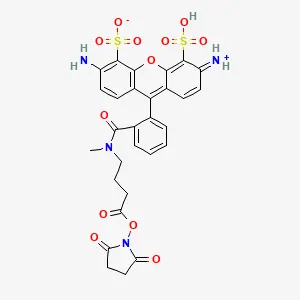
The most common method for attaching Atto dyes to peptides is through NHS ester chemistry, which targets primary amines on the N-terminus or lysine side chains. This approach is straightforward but can produce heterogeneous labeling if multiple amines are present.
Thiol-Reactive Labeling
For site-specific labeling, maleimide derivatives of Atto dyes can be reacted with cysteine residues. This method gives better control over label position and is often preferred when the peptide’s activity depends on a specific region remaining unmodified.
Spacers and Purification
Because Atto dyes are relatively bulky, a spacer such as Ahx or a short PEG linker can be inserted between the dye and the peptide to reduce steric interference. After conjugation, labeled peptides are typically purified by HPLC and verified by mass spectrometry.
Applications in FRET and Imaging
FRET Pair Selection
Atto dyes are widely used in FRET because they can be paired to cover different distance ranges. For example, Atto 488 and Atto 647N have a Förster radius around 51 Å, while Atto 550 and Atto 647N have an R₀ near 65 Å. The choice depends on the expected distance change and the spectral overlap between donor and acceptor.
Live-Cell and Super-Resolution Imaging
Atto-labeled peptides are used in live-cell imaging to follow receptor internalization, membrane binding, and intracellular trafficking. Far-red Atto dyes such as Atto 647N are also used in super-resolution techniques because they resist photobleaching during prolonged illumination.
Practical Considerations
Controls and Validation
FRET experiments require donor-only and acceptor-only controls to correct for bleed-through and direct excitation. Labeling efficiency and peptide integrity should be confirmed by HPLC and mass spectrometry.
Storage
Atto-labeled peptides should be stored lyophilized at -20°C, protected from light. Reconstituted solutions should be kept cold and used promptly to avoid degradation.
Find out more about peptide synthesis here.
Frequently Asked Questions (FAQ)
Are Atto dyes better than conventional fluorophores?
They are not universally better, but they often offer greater photostability and less pH sensitivity than dyes such as FITC or some cyanines. The best choice depends on the instrument, laser lines, and assay conditions.
Can Atto dyes be used for FRET?
Yes. Atto dyes can serve as donors or acceptors in FRET pairs. Pair selection should be based on spectral overlap and the required Förster radius.
How are Atto dyes attached to peptides?
They are commonly attached through NHS ester chemistry for amines or maleimide chemistry for cysteines. Spacers can be added to reduce steric effects.
Are Atto-labeled peptides available commercially?
Yes. Custom synthesis providers such as LifeTein offer peptides labeled with Atto dyes, including options for labeling position and spacer chemistry.