


A branched peptide is one in which a second chain, or a non-peptide group, is attached through an amino acid side chain rather than through the backbone. That single structural change is behind several unrelated things: multiple antigenic peptides that raise antibodies without a carrier protein, acylated drug candidates that last a week in circulation, and bi-epitopic constructs that carry two sequences on one molecule. The branch point is almost always a lysine side-chain amine.
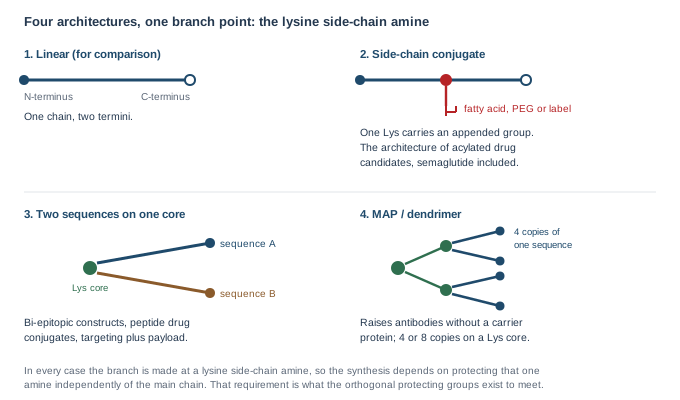
The term covers more ground than it first appears to, and the four cases below are built the same way but sold for different reasons.
| Architecture | What is attached | Why it is used |
|---|---|---|
| Side-chain conjugate | A fatty acid, PEG chain, dye, biotin or drug payload on one lysine | Half-life extension, labeling, targeted delivery. The structure of the acylated GLP-1 analogues. |
| Bi-epitopic branch | Two different peptide sequences on one lysine core | Presenting two epitopes together, or a targeting sequence plus a payload |
| MAP and dendrimers | Four or eight copies of one sequence on a branched lysine core | Raising antibodies without conjugating to a carrier protein1 |
| Branched cyclic | A side chain joined back to the backbone or to another side chain | Conformational constraint and protease resistance |
Three effects account for most of the uses, and they are worth separating because a design usually exploits one of them rather than all three.
The branch is not free. Every branch point roughly doubles the number of couplings that have to succeed, and a failure on one arm gives a product that differs from the target by a whole sequence rather than by one residue. Branched peptides are therefore harder to purify and harder to characterise than linear ones of the same total length, and the analysis matters as much as the synthesis.