


Building a branch means freeing one amino acid side chain while every other reactive group in the molecule stays protected. Standard Fmoc chemistry has only two levels of protection, and neither of them can do that, so the branch point needs a third protecting group chosen to be removable by chemistry that touches nothing else.
In ordinary Fmoc synthesis, the α-amine carries Fmoc and comes free with piperidine at every cycle, while the side chains carry acid-labile groups — tBu, Boc, Pbf — that come off together in the final TFA cleavage. Those two levels are enough to assemble a linear chain. They are not enough to open one specific side chain partway through, because removing the acid-labile set removes all of it and takes the peptide off the resin at the same time.
A branch therefore needs a lysine whose side chain carries a group that survives piperidine at every cycle, survives until it is wanted, and then comes off under conditions that leave both of the other sets intact.
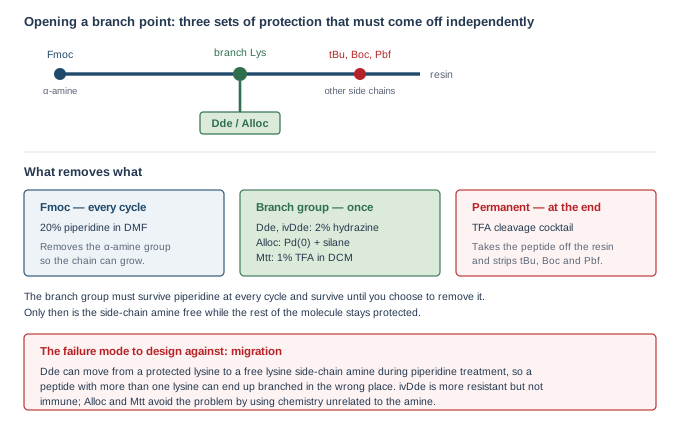
The approach dates from work that introduced Dde specifically to make branched peptides: a lysine protected as the branching motif allowed a 34-residue di-epitopic peptide to be assembled by continuous-flow solid phase synthesis, using a group orthogonal to both Fmoc and Boc.1
| Group | Removed by | Strengths | What to watch |
|---|---|---|---|
| Dde | 2% hydrazine in DMF | Mild, quick, no metal catalyst | Can migrate to a free lysine side chain during piperidine treatment3 |
| ivDde | 2% hydrazine in DMF, more slowly | More hindered, so markedly more resistant to migration2 | More resistant, not immune; migration has still been reported |
| Alloc | Pd(0) with a silane or other scavenger | Chemistry unrelated to amines, so no migration route | Needs a palladium catalyst and careful scavenging; residual metal must be considered |
| Mtt | 1% TFA in dichloromethane | No metal, no hydrazine | Acid-labile, so the margin against the permanent groups is narrower; needs care on acid-sensitive sequences |
Dde does not always stay where it was put. An unprotected lysine ε-amine elsewhere in the peptide can acquire the Dde group from a protected one, and the transfer happens during the piperidine treatment used for Fmoc removal and in the washes that follow.3 The published investigation also found that an unprotected α-amine cannot take Dde from an ε-amine, so the migration is specifically between side chains, and that it can occur in DMF alone by direct nucleophilic attack.3
The consequence for a branched synthesis is serious and quiet: the branch ends up on the wrong lysine. The product has the right mass, because nothing has been gained or lost, and the error is visible only by a method that locates the attachment. That is why branched peptides with more than one lysine are built with ivDde or Alloc rather than Dde, and why a mass spectrum alone is not sufficient evidence that a branched peptide is what was ordered.
What this means when ordering. Tell us every lysine in the sequence, not only the branch point. If the peptide contains other lysines, the protecting-group strategy has to change, and an ε-amine that will be free in the final product is a particular constraint. This is usually decided before the first coupling, not after.
Once the side-chain amine is free, the second arm is built on it by ordinary Fmoc chemistry. Two practical points follow from the geometry rather than the chemistry:
Mass spectrometry confirms the composition but not the connectivity, and for a branched peptide those are different questions — a correctly branched product and a mis-branched one are isomers. Useful evidence comes from combining methods: HPLC to show a single product, amino acid analysis to confirm the overall composition and the peptide content, and where the attachment point itself is in question, enzymatic or chemical fragmentation followed by analysis of the pieces. See reading a peptide mass spectrum for what the mass data can and cannot settle.