
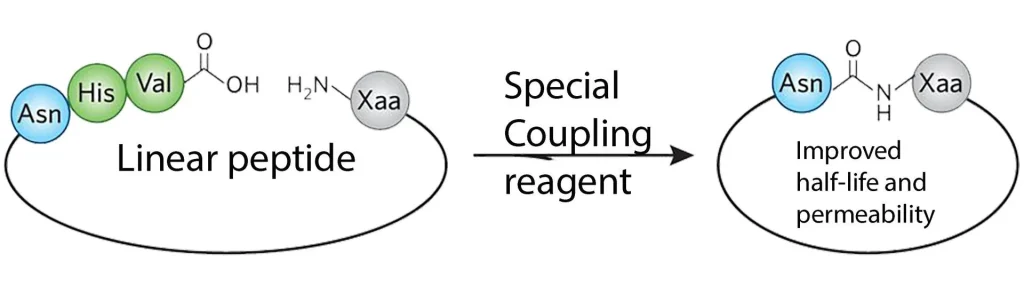
Head-to-tail cyclic peptides represent a structurally distinct class of peptidomimetics in which the N-terminus and C-terminus of a linear peptide are covalently linked, creating a continuous, closed backbone ring. This cyclization strategy is fundamentally different from side-chain-to-side-chain or disulfide-bridge cyclization because it eliminates both terminal ends simultaneously, removing the principal recognition sites for exopeptidases and imposing global conformational constraints on the entire peptide backbone. Consequently, head-to-tail cyclic peptides frequently exhibit enhanced enzymatic stability, improved target selectivity, and prolonged biological half-life compared with their linear counterparts, making them attractive scaffolds for drug discovery and diagnostic development.
Key Takeaways
- Head-to-tail cyclization links the N- and C-termini through an amide bond, eliminating both exopeptidase-sensitive ends and imposing global backbone rigidity.
- The resulting macrocycles often show very high metabolic stability, improved potency, and greater selectivity than linear analogs.
- Synthesis can be challenging due to oligomerization and cyclization efficiency, but optimized protocols—including single-step amide cyclization—have improved yields and compatibility with unnatural amino acids.
- LifeTein routinely prepares head-to-tail cyclic peptides and has developed high-yield cyclization methods that preserve sensitive residues and support complex architectures.
Structural and Functional Consequences of Backbone Closure
Elimination of Exopeptidase Recognition Sites
The most immediate consequence of head-to-tail cyclization is the removal of the free N-terminal amine and C-terminal carboxylate. Exopeptidases, which process peptides from their ends, require these charged termini for substrate recognition. By closing the backbone, head-to-tail cyclic peptides become largely resistant to exopeptidase-mediated degradation, a major pathway of peptide clearance in plasma and tissue. Internal endopeptidase cleavage sites may remain, but the overall metabolic stability of the macrocycle is typically far superior to that of the linear precursor.
Global Conformational Restriction
Cyclization also restricts the conformational space accessible to the peptide backbone. The closed ring reduces the number of low-energy conformations, often favoring defined turns, loop-like structures, or compact folds stabilized by intramolecular hydrogen bonds. This pre-organization can enhance binding affinity by reducing the entropic penalty of adopting a bioactive conformation upon target engagement. At the same time, the constrained scaffold can improve selectivity by disfavoring interactions with off-target receptors that require a different backbone geometry.
Find out more about peptide synthesis here.
Synthetic Strategies and Practical Considerations
Amide Bond Formation for Ring Closure
Head-to-tail cyclization is typically achieved through amide bond formation between the C-terminal carboxyl group and the N-terminal amine of a fully protected linear precursor. The reaction can be performed in solution after cleavage from the solid support or, in some strategies, on-resin. A persistent challenge is intermolecular oligomerization, in which the reactive ends of two peptide molecules couple instead of intramolecular ring closure. Careful control of concentration, coupling reagents, and protecting group schemes is therefore essential.
LifeTein’s Single-Step Cyclization Approach
LifeTein has reported a single-step preparation of the amide cyclization that achieves high yield while avoiding aggressive reaction conditions. Importantly, this method is compatible with unnatural amino acids and sensitive functional groups, allowing cyclization to be performed after the incorporation of residues intended to enhance stability, activity, or detection. The resulting macrocycles are conformationally stable and contain multiple intramolecular hydrogen bonds, consistent with a well-folded cyclic structure.
Residue Compatibility
Certain sequences are particularly amenable to head-to-tail closure, including those containing Asp (D), Glu (E), Gln (Q), or Asn (N) at positions that facilitate cyclization. LifeTein’s experience with these challenging targets enables the routine preparation of head-to-tail cyclic peptides across a range of sequences and modification requirements.
Applications and Advantages in Peptide Research
Improved Pharmacological Profiles
The combination of exopeptidase resistance, conformational restriction, and retained side-chain functionality makes head-to-tail cyclic peptides attractive for applications in which linear peptides fail due to rapid clearance or poor selectivity. Cyclic scaffolds have been explored as antiviral agents, enzyme inhibitors, and receptor modulators, where the constrained backbone can provide a larger and more defined interaction surface than a flexible linear chain.
Compatibility with Downstream Modifications
Because head-to-tail cyclization preserves the side chains of internal residues, the resulting macrocycle can still be functionalized with fluorophores, affinity tags, or stabilizing substitutions after ring closure. LifeTein’s cyclization methodology is designed to tolerate such modifications without damaging sensitive residues, enabling the construction of highly functionalized amide-based macrocycles.
Find out about high-speed RUSH synthesis.
Frequently Asked Questions
What distinguishes head-to-tail cyclization from disulfide cyclization?
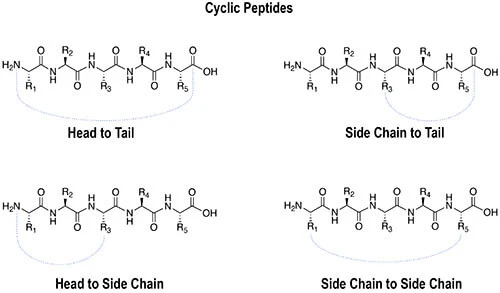
Head-to-tail cyclization closes the peptide backbone through an amide bond between the N- and C-termini, eliminating both terminal ends. Disulfide cyclization links two cysteine side chains, leaving the backbone termini free. The two strategies can be combined in the same peptide when appropriate.
Why are head-to-tail cyclic peptides often more stable than linear peptides?
The closed backbone removes the exopeptidase recognition sites at the N- and C-termini, and the constrained conformation can reduce accessibility to endopeptidases. The result is typically very high metabolic stability compared with the linear precursor.
What is the main synthetic challenge in head-to-tail cyclization?
Intermolecular oligomerization competes with intramolecular ring closure. Careful control of reaction conditions and the use of optimized cyclization protocols are required to favor the desired monomeric macrocycle.
Can unnatural amino acids be incorporated into head-to-tail cyclic peptides?
Yes. Optimized cyclization methods, such as those developed at LifeTein, are compatible with unnatural residues and sensitive functional groups, allowing the macrocycle to be tailored for stability or activity.
Does head-to-tail cyclization affect target binding?
It can improve binding by pre-organizing the peptide into a bioactive conformation and increasing the effective interaction surface. However, the outcome is sequence-dependent, and cyclization may also reduce affinity if the linear peptide requires terminal contacts for binding.
References
Thite, T., Iyer, K. A., Jain, P., Sasso, J. M., Tenchov, R., Murmu, S., Surendranath, M., Maind, A., Balande, U. T., & Zhou, Q. A. (2026). Cyclic Peptides in Modern Drug Discovery: Trends and Therapeutic Directions. Journal of Medicinal Chemistry, 69(15), 17770–17799. https://doi.org/10.1021/acs.jmedchem.6c01522