
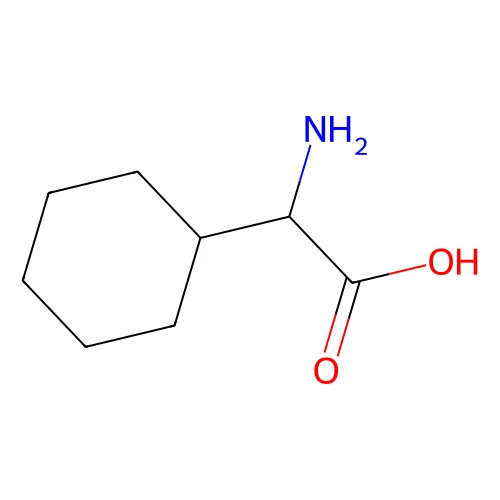
Cyclohexylglycine (Chg) is a non-proteinogenic amino acid that has emerged as a powerful building block in the design of peptide-based therapeutics. Structurally, it resembles phenylalanine but features a fully saturated cyclohexyl ring in place of the aromatic phenyl group, directly attached to the α-carbon. This seemingly subtle difference, the replacement of an aromatic system with a bulky, aliphatic carbocycle, confers a unique combination of steric hindrance, lipophilicity, and conformational rigidity that makes Chg an invaluable tool for peptide chemists seeking to enhance metabolic stability, modulate secondary structure, and improve target affinity. Its strategic incorporation has enabled the development of clinically successful peptides such as the complement C5 inhibitor Zilucoplan, underscoring its translational relevance.
Key Takeaways
- Cyclohexylglycine (Chg) is a non-proteinogenic amino acid featuring a bulky, hydrophobic cyclohexyl side chain that imparts steric hindrance and conformational constraints to peptides.
- Its incorporation significantly enhances metabolic stability by shielding the peptide backbone from proteolytic enzymes, often extending plasma half-life by more than 19-fold.
- Chg acts as a conformation-directing residue, promoting the formation of β-turns and 3₁₀-helices that can be critical for receptor binding and selectivity.
- The primary synthetic challenge is steric hindrance during coupling, which necessitates the use of potent reagents such as HATU and double-coupling strategies to avoid deletion sequences.
- Fmoc-L-Chg-OH (CAS 161321-36-4) is commercially available, and custom synthesis services from providers like LifeTein enable researchers to incorporate this residue into complex peptide sequences.
- Chg has been successfully employed in clinically approved therapeutics (Zilucoplan) and in the design of antimicrobial agents active against MRSA and VRE.
Chemical and Structural Properties of Cyclohexylglycine
Defining the Cyclohexylglycine Structure
Cyclohexylglycine, also known as 2-amino-2-cyclohexylacetic acid, has the molecular formula C₈H₁₅NO₂ and a molecular weight of 157.21 g/mol. Its defining feature is the direct attachment of a cyclohexyl group to the α-carbon, with no intervening methylene bridge, a structural distinction from the related residue cyclohexylalanine (Cha). This compact, rigid architecture eliminates the rotational freedom of the side chain, imposing significant conformational restraints on the peptide backbone.
Isomeric Forms
Chg exists as two enantiomers: L-cyclohexylglycine and D-cyclohexylglycine. The D-isomer is particularly valued for its enhanced resistance to proteolytic cleavage, as the D-configuration is not recognized by endogenous proteases. The hydrochloride salt of D-cyclohexylglycine (H-D-Chg-OH·HCl) is a commonly used building block for Fmoc-based solid-phase peptide synthesis (SPPS).
Find out more about peptide synthesis here.
Biological Significance and Mechanisms of Action
Enhanced Metabolic Stability
The primary rationale for incorporating Chg into peptides is to improve their in vivo half-life. The bulky cyclohexyl group physically obstructs the approach of proteolytic enzymes to adjacent peptide bonds, providing a steric shield that is effective against both exopeptidases and endopeptidases. Quantitative data from structurally related residues suggest that substitution of a key phenylalanine with a cyclohexyl-containing analog can result in a greater than 19-fold increase in plasma half-life.
Conformational Modulation
Beyond stability, Chg functions as a conformation-directing powerhouse. Its steric bulk at the α-carbon restricts backbone rotation, favoring the formation of β-turns and 3₁₀-helical structures. This pre-organization can enhance binding affinity by locking the peptide into its bioactive conformation, thereby reducing the entropic penalty of target engagement.
Synthetic Challenges and Solutions
The Steric Hindrance Barrier
The same bulk that makes Chg so valuable also makes it difficult to incorporate. The cyclohexyl group hinders the approach of activated amino acids to the growing peptide chain, leading to low coupling efficiency and the formation of deletion sequences if standard protocols are used.
Optimized Coupling Protocols
To overcome these challenges, researchers employ:
- Potent coupling reagents: HATU or HBTU, often with the additive HOAt or Oxyma Pure, are recommended over standard carbodiimides.
- Double coupling: Repeating the coupling step with fresh reagents ensures complete acylation.
- Ninhydrin monitoring: Qualitative tests after each coupling confirm the absence of free amines.
Fmoc-L-Chg-OH is commercially available, and specialized providers like LifeTein offer custom synthesis services that incorporate unusual amino acids such as Chg into challenging sequences, ensuring high purity and correct stereochemistry.

Therapeutic Applications
Zilucoplan: A Clinical Success Story
The most prominent example of Chg in a clinically approved drug is Zilucoplan (Zilbrysq®) , a macrocyclic peptide inhibitor of complement component C5 approved for generalized myasthenia gravis. Chg is incorporated at position 14 of the peptide sequence, contributing to its metabolic stability and binding affinity.
Antimicrobial and Enzyme Inhibitor Design
Chg-containing peptides have demonstrated activity against MRSA and VRE with MIC values of 2–4 µg/mL. The residue also enables the design of potent DPP-IV inhibitors and HCV protease inhibitors with improved cellular activity.
Find out about high-speed RUSH synthesis.
Frequently Asked Questions (FAQ)
What is the difference between cyclohexylglycine and cyclohexylalanine?
Cyclohexylglycine (Chg) has the cyclohexyl ring directly attached to the α-carbon, whereas cyclohexylalanine (Cha) contains an additional methylene bridge. This makes Chg more sterically constrained and rigid, while Cha is slightly more flexible.
Why does cyclohexylglycine enhance peptide stability?
The bulky cyclohexyl group provides steric hindrance that physically blocks proteolytic enzymes from accessing adjacent peptide bonds, thereby protecting the peptide from degradation and extending its half-life.
Can cyclohexylglycine be incorporated using standard SPPS?
Yes, but with optimized protocols. The steric hindrance necessitates the use of potent coupling reagents (HATU, HBTU) and double-coupling strategies to achieve efficient incorporation. Fmoc-L-Chg-OH is commercially available for this purpose.
Is D-cyclohexylglycine more stable than the L-isomer?
Yes. The D-configuration is not recognized by endogenous proteases and, combined with the steric bulk of the cyclohexyl side chain, provides enhanced resistance to enzymatic cleavage.