Almost every custom peptide we make carries at least one modification. The question is rarely whether to modify a sequence, but which change to make, where to put it, and what it will cost you elsewhere in the molecule. An unmodified peptide is usually cleared from circulation within minutes, and chemical modification is the established route to a usable pharmacokinetic profile — which is why half-life extension has its own substantial review literature.1,2
This index is organised by what you are trying to achieve, not by chemistry class. Pick the goal, follow the link, and the page behind it goes into the chemistry, the design decisions and the published work in detail. Every modification named here is one we make routinely.
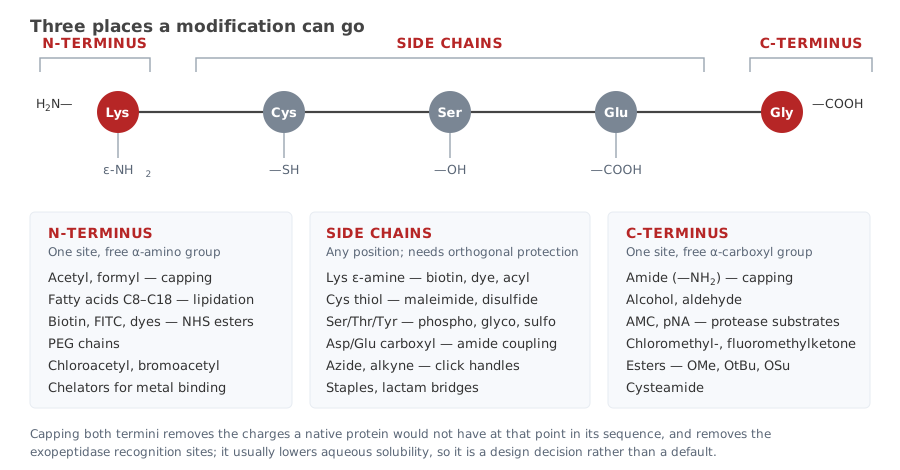
What we modify, what it costs, and how to look a modification up.
Resisting proteases, slowing renal clearance, and extending time in circulation.
Constraining a flexible sequence into the conformation that actually binds.
Fluorescent labels, dye selection, quenchers and the spacer question.
Affinity handles, and the chemistry that attaches a peptide to a surface or a partner.
Presenting a short sequence so the immune system treats it as an antigen.
Synthetic peptides carrying the modification at a defined, homogeneous position.
The reactive handles and ligation chemistries behind every conjugate we build.
Cell-penetrating sequences, lipid carriers and the conjugates that use them.
Labelled standards, and reading a modified peptide's spectrum correctly.
What to look up once the modified peptide is on the bench.
Not sure which modification you need? Send us the sequence and what you want the peptide to do in the experiment. Our chemists will tell you which modifications are compatible with that sequence, which are not, and what each would change. We send a quote within 24 hours.
All LifeTein products are supplied for laboratory research use only. They are not for human or veterinary use, and not for diagnostic or therapeutic use.