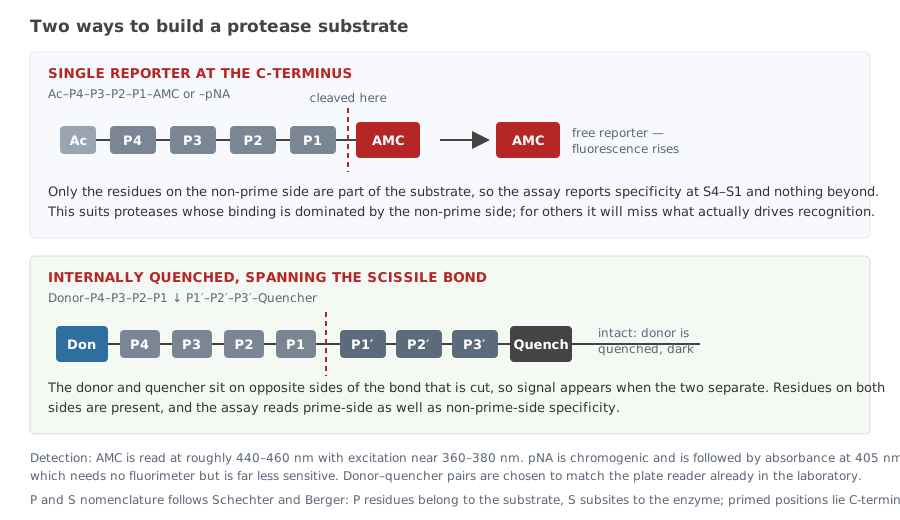
A protease assay needs a peptide that turns a cleavage event into something a plate reader can see. The usual way to do that is to attach a reporter group to the C-terminus through the bond you want the enzyme to cut: while the reporter is attached it is silent, and when the enzyme releases it the signal appears. The two classical reporters are AMC, which is fluorogenic, and pNA, which is chromogenic.
That design has one consequence that decides whether it will work for your enzyme, and it is worth understanding before you order.
| Format | Read by | Where it fits |
|---|---|---|
| pNA p-nitroanilide |
Absorbance at 405 nm | Needs only a plate reader with a 405 nm filter. Substantially less sensitive than a fluorogenic format, so it suits abundant, active enzymes and teaching or screening work rather than trace detection. |
| AMC 7-amino-4-methylcoumarin |
Fluorescence, roughly 440–460 nm emission with excitation near 360–380 nm | The default fluorogenic choice, and the format behind most published kinetic constants. Blue emission means more interference from compound libraries and from autofluorescent media. |
| AFC 7-amino-4-trifluoromethylcoumarin |
Fluorescence, shifted to longer wavelengths than AMC | Useful when AMC's blue channel is already occupied, or to run two proteases in one well. |
| ACC 7-amino-4-carbamoylmethylcoumarin |
Fluorescence, similar channel to AMC | Carries a second attachment point, which is what makes solid-phase synthesis of large positional-scanning libraries practical.2 |
| Donor–quencher pair internally quenched |
Fluorescence, pair-dependent | The only format that reports prime-side residues. Required for enzymes whose specificity depends on what sits downstream of the cut. |
In a P4-P3-P2-P1-AMC substrate the reporter stands in for the residue that would otherwise occupy P1′. Positional-scanning libraries built on a C-terminal reporter are therefore well suited to proteases that draw most of their binding interactions from the non-prime residues, and poorly suited to those that derive specificity from the prime side.3
In practice this means two things. If your enzyme is a trypsin- or caspase-like protease with strong non-prime preferences, a C-terminal reporter is the right and simplest choice. If it is a metalloproteinase or any enzyme known to read sequence on both sides of the scissile bond, an internally quenched substrate will tell you something a single-reporter substrate cannot, and a single-reporter substrate may simply fail to turn over.
The approach of screening fluorogenic peptide libraries to map specificity without prior knowledge of a natural substrate was established with coumarin leaving groups,1,2 and the same chemistry underlies individual substrates made to order today.
Substrates and inhibitors are not the same molecule.
Our catalog lists chloromethylketone (CMK), fluoromethylketone (FMK) and aldehyde (CHO) C-termini alongside AMC and pNA, and they are easy to confuse with reporters. They are not reporters and they generate no signal. A peptide aldehyde binds the catalytic residue reversibly as a transition-state analogue; CMK and FMK alkylate it irreversibly. These are inhibitor and activity-based-probe formats — the warheads that activity-based probes are built on3 — and ordering one when you wanted a substrate gives you a peptide that silences your enzyme instead of measuring it.
If you are not sure which you need, say what the experiment has to measure and we will tell you which format fits.
For a panel — one substrate per candidate site, or a residue walked through a position — we synthesise the set together so that purity and analysis are consistent across it.
Tell us the enzyme and the reader. Send the sequence with the cleavage site marked, the reporter you have in mind, and the instrument the assay runs on. If the format will not report what you need, we will say so before quoting. We send a quote within 24 hours.
All LifeTein products are supplied for laboratory research use only. They are not for human or veterinary use, and not for diagnostic or therapeutic use.