
This page complements our main Cell-Penetrating Peptide (CPP) Synthesis and Conjugation page by collecting practical delivery examples, product-linked CPP formats, educational materials, and example strategies for peptide-mediated intracellular delivery.
The main CPP page focuses on service positioning and scientific overview. This page is more example-driven and includes product-linked CPP formats, simple mixing strategies for nucleic acid delivery, and a broader selection of commonly discussed CPP sequences and delivery models.
| Educational content | Video presentation and design-oriented reading material |
| Practical formats | CPP examples with product links and common delivery-oriented modifications |
| Simple mixing | Example non-covalent mixing format for RNA or DNA delivery studies |
| Reference content | Representative CPP sequences, delivery examples, and uptake models |
How to Design Cell-Penetrating Peptides?
Click here to browse the full transcript of “Cell-Penetrating Peptides: Design, Synthesis, and Applications.”
Read more: A full list of cell-penetrating peptides.
Download the full list HERE.
Main service page
For the main science and service overview, see Cell-Penetrating Peptide (CPP) Synthesis and Conjugation.
We maintain a selection of in-stock cell-penetrating peptides that can be used directly or adapted for conjugation with peptides, proteins, fluorescent probes, oligonucleotides, or nanoparticles. See the in-stock CPP list.
One especially useful format is Cys(Npys)-(Arg)9, which contains an activated cysteine residue and can selectively react with a free thiol on a cysteine-containing peptide or other thiol-bearing cargo.
The S(Npys) group in this peptide can react with a free thiol group to form an unsymmetrical disulfide bond. This format is useful when a cargo should be transported into cells and later released in the reducing intracellular environment.
In addition to covalent conjugation, some CPP delivery studies use simple non-covalent mixing strategies. This is especially common for nucleic acid delivery systems.
Example method for simple mixing
For instance, in a representative MPG-mediated gene delivery workflow, complexes of the peptide carrier and DNA were prepared by mixing 500 μl of medium with 100 ng of DNA complexed with MPG at a charge ratio of 5:1. After incubating the samples at 37°C for 30 minutes, the mixture was added to cells at about 60% confluence.
This type of workflow is one example of how CPPs can be used as non-covalent carriers for nucleic acid cargo, especially in early-stage delivery studies.

For broader background on peptide-mediated delivery systems, see the review article from Nature.
CPP |
Cells / Model |
Representative Effect |
Reference |
|
HIV TAT The cysteamide stabilizes the DNA-carrier complexes. |
HeLa, Cos-7, HS68, NIH-3T3 |
Examples of cellular uptake of single- and double-stranded oligonucleotides and reporter knockdown in model systems |
Simeoni et al. |
|
Cys(Npys)-(Arg)9: C(Npys)RRRRRRRRR-NH2 Stearyl-R8
Stearyl-R8 Polyarginine peptides have been widely used in siRNA and nucleic acid delivery studies. |
EGFP-expressing hippocampal neurons and related delivery models |
Representative reporter reduction and intracellular delivery behavior |
Tönges et al. |
|
Antennapedia / Penetratin family
RQIKIWFQNRRMKWKK |
Derived from Drosophila Antennapedia homeodomain |
Representative amphipathic CPP class used for intracellular transport studies |
Christiaens B. et al. |
|
Penetratin-Arg derivatives
RQIRIWFQNRRMRWRR |
Antennapedia-derived CPP family |
Representative fluorescent and modified CPP formats |
Ye, J. et al. |
Name |
Origin |
Sequence / Format |
Tat (48-60) |
HIV-1 protein |
GRKKRRQRRRPPQ or related Tat-derived variants |
Cys(Npys)-(Arg)9 |
Arginine-rich delivery format |
|
Oligoarginine |
Arginine-rich CPP |
Rn |
Transportan |
Galanin-mastoparan |
GWTLNSAGYLLGKINLKALAALAKKIL |
P-beta MPG peptides |
gp41-SV40 |
GALFLGFLGAAGSTMGAWSQPKKKRKV |
Pep-1 |
Trp-rich motif-SV40 |
KETWWETWWTEWSQPKKKRRV |
STR-R8 |
Arginine-rich lipidated CPP |
Stearyl-RRRRRRRR-amide |
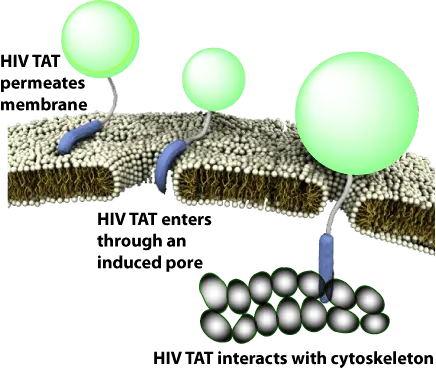
CPPs such as HIV Tat and polyarginine peptides can enter cells through multiple uptake routes, including endocytic and non-endocytic pathways. Their delivery behavior can change depending on sequence composition, hydrophobicity, charge density, cargo type, and experimental conditions.
For example, adding a hydrophobic group to a highly cationic peptide can substantially change how the peptide interacts with membranes and how it transports cargo. Polyarginine peptides, lipidated arginine-rich peptides, and Tat-derived sequences have all been used in delivery studies involving peptides, nucleic acids, and other cargos.