Product Name | Biotin-Ahx-LPETGS |
Product Quantity | 5mg |
Catalog Number | 6142 |
Category | Peptide |
Sequence | 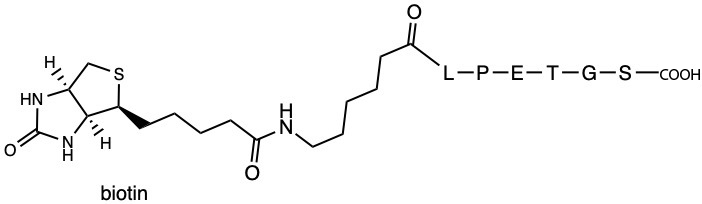
Biotin-Ahx-LPETGS-COOH, Check the original amidated version here. |
Purity | >95% |
Modifications | Biotin, Ahx linker, free acid; The majority of Staphylococcus aureus virulence- and colonization-associated surface proteins contain a pentapeptide recognition motif (LPXTG). This motif can be recognized and cleaved by sortase A (SrtA) which is a membrane-bound transpeptidase. LPTEG-tagged probes and proteins can be conjugated using sortase A in a single step to glycines naturally exposed at the cell surface. |
Notes | 
Significance and functions of the LPETGS motif: - Protein Targeting: The LPETGS motif serves as a signal sequence that directs proteins to specific cellular organelles. For example, it is recognized by the signal recognition particle (SRP) during the cotranslational targeting of proteins to the endoplasmic reticulum, where they are synthesized and folded.
- ER Localization: Proteins containing the LPETGS motif are often translocated into the endoplasmic reticulum, a crucial organelle involved in protein synthesis, modification, and quality control. This motif aids in the proper localization of these proteins within the ER.
- Mitochondrial Targeting: In some cases, the LPETGS motif is involved in the targeting of proteins to the mitochondria, which are responsible for energy production within the cell. This motif plays a role in ensuring that the proteins are directed to the mitochondrial outer membrane.
- Protein Folding and Quality Control: Proteins that contain the LPETGS motif may undergo specific folding and quality control processes within the ER. This helps ensure that only properly folded and functional proteins are allowed to exit the ER and reach their final cellular destinations.
- Biomedical Implications: Understanding the LPETGS motif's role in protein targeting and localization is of great significance in biomedical research. Researchers study this motif to gain insights into various diseases and conditions where protein trafficking and localization are disrupted, such as certain types of congenital disorders and neurodegenerative diseases.
|
Scientific Background | Biotin-Ahx-LPETGS is a 8-residue synthetic peptide with the sequence Ala-Met-Ile-Asp-Ala-Thr-Glu-Asp. Biotin provides an affinity handle for streptavidin-based capture or detection; an Ahx spacer separates the peptide from an attached label or affinity handle. The sequence contains 2 Asp and 1 Glu residues, contributing anionic character near neutral pH; has a relatively high hydrophobic-residue fraction that can influence aqueous solubility and surface adsorption. These sequence-derived properties describe the reagent chemically; no specific receptor, enzyme, pathway, disease association, or biological activity is assigned without product-specific experimental evidence. |
Research Applications | - streptavidin-based capture or detection
- binding and pull-down assay development
- LC-MS/HPLC analytical method development
- sequence-specific assay controls
|
Experimental Notes | Sequence-derived chemical properties support reagent selection and experimental planning but do not establish biological function. Solubility, aggregation, adsorption, conjugation efficiency, and assay performance should be validated under the intended experimental conditions. |