Product Name | VC-PAB-MMAE-LPETGG |
Product Quantity | 2 mg |
Catalog Number | 35816 |
Category | Peptide |
Sequence | MMAE-PAB-Val-Cit-(thioether linker)-Ahx-LPETGG Peptide C-Ahx-LPETGG conjugated with MMAE-PAB-Val-Cit-Maleimide via Maleimide-thiol reaction. |
Purity | >95% |
Peptide Info | 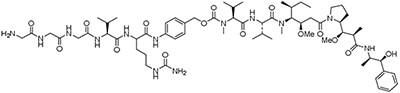
Linker-Toxin SET, this set is made by Monomethyl auristatin E (MMAE) conjugated to the lysosomally cleavable Gly3-vc-PAB linker. MMAE, a potent tubulin inhibitor, is a toxin payload in the antibody-drug conjugate. The sortase recognition sequence, LPXTG (for Staphylococcus aureus sortase A) or LPXTA (for Streptococcus pyogenes sortase A), can be appended to a variety of probes, such as fluorophores, biotin, or even to other proteins. The protein to be labeled acts as a nucleophile by attacking the intermediate formed between the probe containing the LPXTG/A motif and the sortase enzyme. Molecular Formula: C101H161N19O27S; Formula Weight: 2105.57 |
Notes |
Other related LPETG products: |
Cat. No | Product Name |
5467 | Biotin-Ahx-LPETGS-NH2 |
6142 | Biotin-Ahx-LPETGS-COOH |
5716 | Biotin-AALPETG*G, G* is 2-hydroxyacetic acid |
6271 | FITC-Ahx-LPETGS |
6272 | Rhodamine B-Ahx-LPETGS |
6148 | Biotin-Ahx-LPETG-NH2 |
5747 | Biotin-ALPETGG |
5989 | Cy5-Cys-HHHHHHHHHLPETGG |
35816 | VC-PAB-MMAE-LPETGG |
Scientific Background | VC-PAB-MMAE-LPETGG is a 6-residue synthetic peptide with the sequence Leu-Pro-Glu-Thr-Gly-Gly. an Ahx spacer separates the peptide from an attached label or affinity handle; maleimide provides a thiol-reactive conjugation handle. The sequence is Gly/Pro-rich, a composition that can influence local backbone flexibility. These sequence-derived properties describe the reagent chemically; no specific receptor, enzyme, pathway, disease association, or biological activity is assigned without product-specific experimental evidence. |
Research Applications | - bioorthogonal or thiol-selective conjugation studies
- LC-MS/HPLC analytical method development
- sequence-specific assay controls
|
Experimental Notes | Sequence-derived chemical properties support reagent selection and experimental planning but do not establish biological function. Solubility, aggregation, adsorption, conjugation efficiency, and assay performance should be validated under the intended experimental conditions. |