


PNA binds its target well enough that affinity is rarely what limits a cell experiment. Getting the PNA inside the cell is. The standard remedy is to synthesise the PNA with a carrier peptide attached, and the useful fact about that decision is that the peptide is chosen by the cell you are treating, not by the PNA sequence. A carrier that works in E. coli is not the carrier you want for a HeLa experiment, and the published comparisons are specific enough to design from.
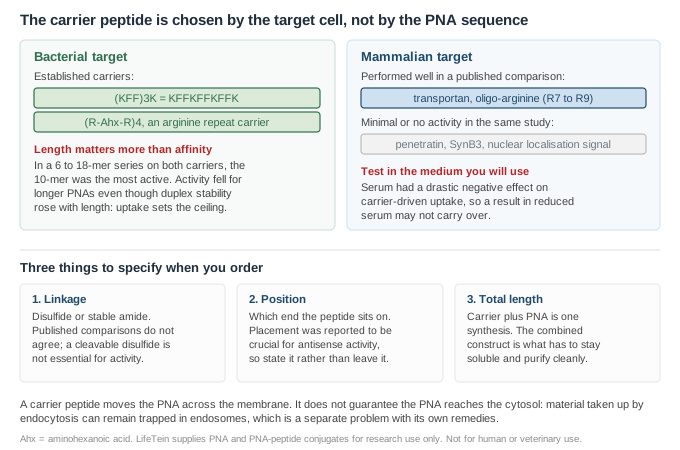
The foundational result is specific and still the basis of most antibacterial PNA work: 9- to 12-mer PNAs, particularly when attached to the cell wall and membrane-active peptide KFFKFFKFFK, improved antisense potency in E. coli by about two orders of magnitude while retaining target specificity1. In the same work, an anti-acpP PNA at 2 µM cleared E. coli K12 from noninvasively infected HeLa cultures without apparent toxicity to the human cells1.
The length constraint in that early work turned out to be real and was later characterised directly. Across a 6- to 18-mer series carried on both (KFF)3K and an arginine-repeat carrier, the 10-mer was the most active antisense antimicrobial in both wild-type E. coli MG1655 and the envelope-mutant AS192. Activity fell for PNAs shorter or longer than 10 bases even though duplex stability with the RNA target rose with length, and the authors attribute the optimum to size-limited passage across the inner membrane rather than to target binding2.
That is an unusual and useful result to design from: for a bacterial target, a longer PNA is not a safer PNA. Uptake sets the ceiling, so the instinct to add bases for affinity works against you.
For mammalian cells the choice is wider and the published head-to-head comparison is the place to start. Seven carriers — transportan, oligo-arginine (R7–9), pTat, penetratin, KFF, SynB3 and a nuclear localisation signal — were conjugated to a splice-correcting PNA by several different chemistries and compared in the same assay3. The pTat and KFF conjugates showed significantly lower efficacy, and the penetratin, SynB3 and NLS conjugates showed only minimal or no activity3.
Two further findings from that study are worth carrying into any experimental plan. Serum had a drastic negative effect on carrier-driven cellular uptake, so an encouraging result obtained in reduced serum may not survive the move to normal culture conditions3. And no simple relationship between linker type and antisense activity could be deduced from the data3 — which bears directly on the next question.
Penetratin performing poorly in that comparison does not mean the penetratin scaffold is unusable; it means unmodified penetratin was not the right carrier. Adding six arginines to the N-terminus of penetratin gives R6-penetratin, and a PNA conjugate of that peptide gave substantially stronger splice correction than the earlier constructs from the same laboratories4. Modifying a known carrier is often more productive than searching for a new one.
The argument for a reducible disulfide is straightforward: if the conjugate reaches the cytosol, the reducing environment cleaves the bridge and releases free PNA. The argument is reasonable and the evidence for it is weaker than it is usually assumed to be.
In a direct comparison, a disulfide-linked R6-penetratin–PNA conjugate was slightly but reproducibly more active than the stably linked thioacetyl version, and the authors concluded that the type of linkage was not a principal factor governing splice correction activity4. A separate study reached a compatible conclusion from the other direction: stably linked conjugates were also efficient at correcting aberrant splicing, so a cleavable disulfide between carrier and PNA is clearly not essential5. Taken with the absence of any simple linker–activity relationship in the seven-carrier comparison3, the practical position is that linkage chemistry is a variable to test rather than a decision to agonise over.
A stable amide linkage has one concrete advantage worth weighing: the construct is made in a single continuous synthesis, with no separate conjugation and repurification step, and it will not reduce in a serum-containing medium before it reaches the cell.
This variable receives less attention than it deserves. In a study that coupled an 18-mer splice-correcting PNA to a range of peptides, the placement of the attached peptide was found to be crucial for attaining antisense activity5. A conjugate that fails is not necessarily the wrong peptide; it may be the right peptide at the wrong end. If a first construct gives no effect and the controls are clean, reversing the order is a cheaper next experiment than changing carriers.
| Bacterial work | (KFF)3K or an arginine-repeat carrier; keep the PNA near 10 bases |
| Mammalian work | transportan or oligo-arginine; R6-penetratin if a penetratin scaffold is wanted |
| Linkage | stable amide by default, disulfide if you want to test release; evidence does not strongly favour either |
| Position | specify which terminus; it has been reported to be decisive |
| Test conditions | include the serum concentration you intend to use |
A carrier peptide solves membrane crossing. It does not by itself deliver the PNA to the cytosol, because material taken up by endocytosis can remain sequestered in endosomes. That is a separate problem with its own remedies, and it is covered in endosomal escape for PNA conjugates.
Send the PNA sequence, the carrier peptide sequence if you have chosen one, which terminus it goes on, and whether you want a stable or disulfide linkage. If you have not chosen a carrier, tell us the organism or cell line and we will suggest one from the published work above.
We synthesise the peptide and the PNA as a single construct where the chemistry allows it, which removes a separate conjugation and purification step. We will review the combined sequence for solubility before synthesis — a carrier adds length, and the construct that has to stay in solution is the whole conjugate, not the PNA alone — and suggest a lysine or AEEA addition if the composition calls for one. Purification and mass confirmation are included.
Sequences supplied by customers are treated as confidential and are never disclosed or reused.
All LifeTein products are supplied for laboratory research use only. They are not for human or veterinary use, and not for diagnostic or therapeutic use.