

The appeal of click chemistry for PNA is not the reaction itself but what it removes from the schedule. Attaching a new tag the conventional way means making a monomer that carries it, which is a synthesis project in its own right before any probe gets built. Putting a small azide or alkyne handle into the oligomer instead means one precursor serves for every tag you later decide to attach. That is the argument, and the published PNA work bears it out — alongside two decisions that decide whether it works in practice.
The economics are the point. A tag can be attached either during solid-phase oligomerisation or afterwards, in solution or on the resin, and the post-synthetic route reduces the overall synthetic effort while adding a step that is open to structural diversification1.
The range of what can be attached this way is wide. A toolbox of alkyne- and azide-modified PNA monomers has been incorporated site-specifically into oligomers and then functionalised with tags ranging from sugars and amino acids to biotin and fluorophores, using copper-catalysed cycloaddition, strain-promoted cycloaddition and Staudinger ligation2.
Multiple attachment in a single step is the other advantage. Four alkynyl-Gd(III)-DOTA moieties were conjugated simultaneously to a PNA oligomer carrying a domain of azide residues; the resulting triplex with polyriboadenylic acid gave higher relaxivities at any field strength than the single-stranded probe at the same gadolinium concentration1. Attaching four separate tags by four separate conventional couplings would be a very different undertaking.
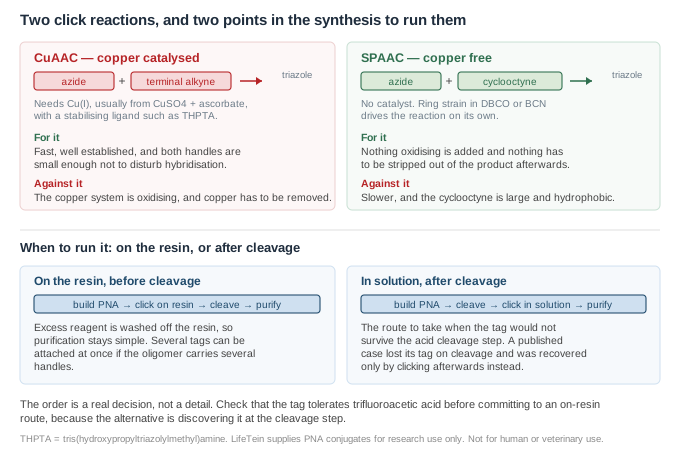
The copper-catalysed azide–alkyne cycloaddition is the default. Both handles are small, which matters for a hybridisation probe, and the reaction is fast and thoroughly characterised; the chemistry across nucleic acids generally is reviewed comprehensively elsewhere3. The cost is the catalyst system.
That cost has been measured rather than assumed. Using quantitative PCR to count oxidatively induced lesions in a 3.5 kbp double-stranded DNA under CuAAC conditions, damage proved significant under nearly all conditions tested4. At 50 µM copper and above, fewer than one DNA molecule in 5,000 remained intact after two minutes; raising the THPTA ligand-to-copper ratio from 2:1 to 10:1 more than halved the damage frequency but still left roughly 98% of the DNA damaged at two minutes4. Adding 10% DMSO was far more effective than ligand excess, leaving most of the DNA intact at five minutes and up to a third undamaged at twenty-five minutes, a suppression of up to about a hundred-fold4.
Two qualifications matter for reading that across to PNA. The assay measures strand lesions in a DNA duplex, and PNA has an amide backbone rather than a sugar–phosphate one, so the specific scission chemistry does not transfer directly. But the nucleobases are shared, the oxidising environment is the same, and residual copper in a purified conjugate is a separate problem of its own if the material is going into cells. The sensible reading is not that CuAAC is unusable on PNA — the published PNA work uses it routinely — but that the conditions are worth specifying rather than defaulting.
The strain-promoted alternative removes the catalyst entirely: a cyclooctyne such as DBCO or BCN reacts with an azide on ring strain alone. Solid-phase synthesis of DNA conjugates by strain-promoted cycloaddition was developed precisely because copper-mediated oxidative degradation can be problematic and copper contamination of the final product raises cytotoxicity and hydrolysis concerns5. The trade is kinetics and bulk: the reaction is slower and a cyclooctyne is a large hydrophobic group to hang on a molecule that already has solubility to worry about.
| Use CuAAC when | the handles must stay small, the conjugate will be purified away from copper, and speed matters |
| Use SPAAC when | the construct or its tag is oxidation-sensitive, or residual copper would be a problem downstream |
| Either way | specify the conditions; they are not interchangeable between projects |
This is the decision most likely to cost a synthesis if it is made by default, and there is a clean published illustration of why.
In work conjugating ferrocene derivatives to N-terminally functionalised PNA, the click reactions were run on the solid phase and worked well, including with azidomethylferrocene — but the ferrocenylmethyl group was lost from the conjugate on acid cleavage from the resin6. The desired product was obtained instead by a post-synthesis conversion of the alkyne-PNA oligomer in solution6. The reaction was never the problem; the order was.
On-resin click has real advantages when the tag tolerates it. Excess reagent is washed off the support rather than separated chromatographically, and several handles on one oligomer can be addressed in a single operation. Side-specific insertion of one or two ferrocene moieties into PNA oligomers on the solid phase has been demonstrated7, and the four-fold Gd(III)-DOTA conjugation described above was also carried out on resin1.
The rule is simple: establish whether the tag survives trifluoroacetic acid before committing to an on-resin route. If it does not, or if you do not know, click in solution on the finished oligomer.
Two positions are routine. A terminal handle is introduced as the last residue — a hexynoic acid gives a terminal alkyne at the N-terminus, and azidoacetic acid serves as an azide surrogate in the same position. A handle on a nucleobase, carried on a modified monomer, places the tag internally and allows several along one sequence; clickable PNA probes built on this principle have been used for imaging applications2.
Terminal placement is the safer default for a hybridisation probe, because the tag sits outside the duplex. Internal placement is what you want when the tag has to report on hybridisation itself, or when several copies are needed.
If the tag you want is a peptide, click is one of two routes and not automatically the better one. A carrier peptide and PNA can often be built as a single continuous synthesis with no conjugation step at all, which is covered in CPP–PNA conjugate design. Click earns its place when the two parts cannot be made together, or when the same PNA precursor has to serve several different peptides.
Send the PNA sequence, the tag, and where the handle should sit. If you already have the partner molecule in azide or alkyne form, say which, because that fixes which handle goes on the PNA. Tell us whether the conjugate is going into cells — that is what decides whether copper-free is worth the slower reaction.
We will advise on the on-resin versus in-solution question for your specific tag rather than applying a house default, review the construct for solubility with the tag in place, and supply HPLC-purified material confirmed by mass spectrometry. If you want the clickable precursor on its own, so your laboratory can attach several different tags from one batch, we can supply that instead.
Sequences supplied by customers are treated as confidential and are never disclosed or reused.
All LifeTein products are supplied for laboratory research use only. They are not for human or veterinary use, and not for diagnostic or therapeutic use.