


An antisense PNA does not work the way a phosphorothioate gapmer works, and designing one as though it did is the usual reason it fails. A DNA-based antisense oligonucleotide forms a hybrid that recruits RNase H, which cuts the message; the oligonucleotide is then free to find another copy. A PNA–RNA hybrid is not a substrate for RNase H. The message survives, and the PNA inhibits only for as long as it physically occupies its site. That single difference drives every design decision that follows.
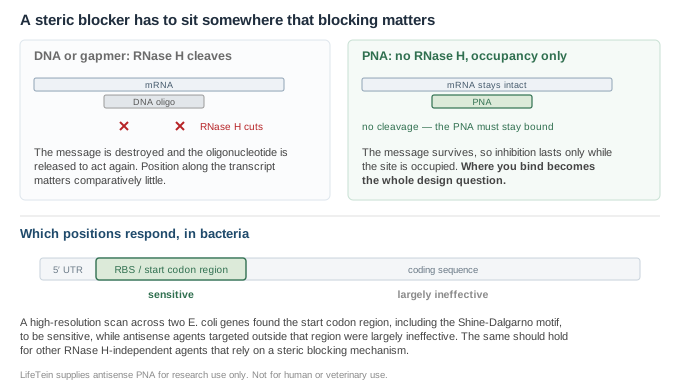
This was established directly for both binding modes. Testing duplex-forming and triplex-forming PNAs against RNA, neither structure was a substrate for RNase H1. PNA is therefore in the same class as morpholino and 2′-modified oligomers: inhibition depends entirely on steric hindrance rather than on recruiting a nuclease2.
Two consequences follow, and they pull in opposite directions. The target transcript is preserved, which is useful if you want to block a function without destroying the RNA — and essential if the readout depends on the transcript still being there. But inhibition is stoichiometric rather than catalytic: one PNA molecule occupies one site, and unoccupied copies of the message are translated normally.
If occupancy is the mechanism, the site has to be one where occupancy prevents something. In practice that means the translation initiation region.
In the same study that showed the absence of RNase H activity, a 15-mer duplex-forming PNA blocked translation in cell-free extracts in a dose-dependent manner when the target was 5′-proximal to the AUG start codon1. The point was then established systematically: a high-resolution scan across the start codon regions of the E. coli β-lactamase gene and the essential acpP gene found that the start codon region, including the Shine-Dalgarno motif, was sensitive, whereas antisense agents targeted outside this region were largely ineffective3. The authors note that this should hold for most bacterial genes and for other RNase H-independent agents relying on a steric blocking mechanism3.
This is the opposite of the intuition carried over from RNase H-dependent antisense, where a site anywhere in the transcript can work because the enzyme does the cutting. For a PNA, a beautifully designed oligomer against the middle of a coding sequence can be inert. Choose the site before optimising anything else.
The difference between what works in a tube and what works in a cell is the practical obstacle, and it is large. Targeting the start codon regions of the E. coli β-galactosidase and β-lactamase genes, dose-dependent and specific gene inhibition was observed in vitro at low nanomolar PNA concentrations, and in vivo at low micromolar concentrations4.
That roughly thousand-fold gap is not a binding problem. It is a delivery problem: PNA is neutral and does not cross membranes efficiently on its own. The standard answer is to conjugate a carrier peptide, and bactericidal antisense effects have been demonstrated with peptide–PNA conjugates5. For mammalian work the same limitation dominates: development of therapeutic applications has lagged largely because of insufficient bioavailability and difficulties with tissue-specific delivery, with high doses needed to overcome poor cellular uptake and endosomal entrapment6.
| Mechanism | Steric block; no RNase H recruitment1,2 |
| Target transcript | Preserved, not degraded |
| Stoichiometry | One PNA per site; not catalytic |
| Best target region | Translation initiation: start codon and ribosome binding site3 |
| Main obstacle | Delivery, not affinity4,6 |
| Usual remedy | Conjugation to a cell-penetrating or bacterial-penetrating peptide5 |
| Decision | Guidance |
|---|---|
| Target region | Start codon and ribosome binding site for bacterial translation; splice junctions where the aim is splice modulation rather than translation block |
| Length | Short enough to stay soluble and specific; PNA affinity means long oligomers are rarely needed, and longer sequences aggregate |
| Sequence constraints | The usual PNA limits on purine content, runs of G and self-complementarity apply and are often the binding constraint in practice |
| Delivery | Decide early whether a carrier peptide is needed, because it changes the construct rather than the protocol |
| Controls | A scrambled or mismatched PNA of matched composition; a non-target gene readout to show the effect is sequence specific |
Accessibility is the variable that is hardest to predict. Messenger RNA is folded and protein-bound, and a site that is ideal on paper may be occluded in the cell. Where a first design gives no effect and the controls are clean, a second site within the same initiation region is usually a better next step than a longer version of the first oligomer.
Send the target sequence with the start codon marked, and tell us the organism and whether the PNA needs a carrier peptide. We synthesise PNA–peptide conjugates in a single construct, which avoids a separate conjugation step and the purification that goes with it. We will also review the sequence for solubility before synthesis and suggest a lysine or AEEA addition if the composition calls for one.
Sequences supplied by customers are treated as confidential and are never disclosed or reused.
All LifeTein products are supplied for laboratory research use only. They are not for human or veterinary use, and not for diagnostic or therapeutic use.