


Targeting double-stranded DNA rather than single-stranded nucleic acid requires a different structure: two PNA strands and one DNA strand, with the second PNA bound in the major groove by Hoogsteen pairing. That second strand has a chemistry problem. Reading a guanine in the Hoogsteen mode requires a protonated cytosine, which means the complex only forms properly in mildly acidic conditions — not the conditions of any experiment you want to run. Pseudoisocytosine is the substitution that removes the problem, and it is the reason bis-PNA clamps work at physiological pH at all.
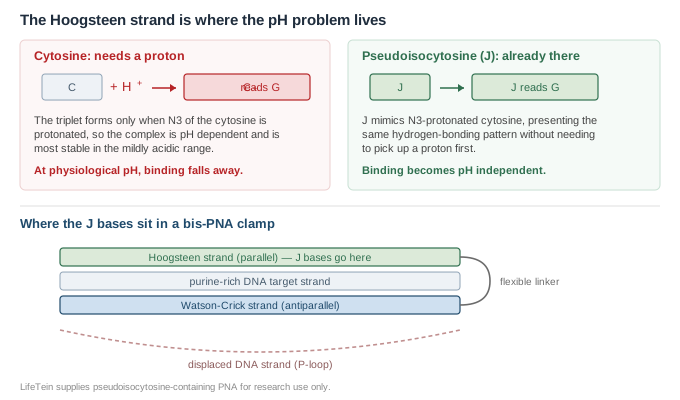
In a homopyrimidine triplex the Hoogsteen strand reads a guanine through a C+•G–C triplet, in which the cytosine must carry a proton on N3. That requirement is the whole difficulty: protonation is favourable in mildly acidic conditions and unfavourable at neutral pH, so triplex formation falls away exactly where biology happens. The requirement for cytosine protonation is a recognised bottleneck for triple-helix formation generally, not only for PNA1.
Pseudoisocytosine, written J, mimics N3-protonated cytosine. It presents the hydrogen-bonding pattern that a protonated cytosine would present, but permanently, without having to acquire a proton from the surrounding solution.
This was established directly. In the work that introduced it, bis-PNAs were made with a first strand of sequence TCTCTTT and a second strand of either TTTCTCT or TTTJTJT, where J is pseudoisocytosine2. When the J base was placed in the strand parallel to the DNA complement — the Hoogsteen strand — the DNA binding was pH independent, and the bis-PNAs were also superior to monomeric PNAs for targeting double-stranded DNA by strand invasion2. Later work confirmed the mechanism from the kinetic side: replacing all cytosines in one strand of a bis-PNA with J bases, which do not require protonation to form triplexes, leaves only a weak pH dependence of the rates and specificity of complex formation3.
The substitution is now standard practice rather than an exotic option. Pseudoisocytosine is described as indispensable for pH-independent recognition of DNA guanine in the Hoogsteen mode of triplex-forming bis-PNAs, and is routinely employed for that purpose1.
| What J replaces | Cytosine, in the Hoogsteen strand only |
| What it fixes | The requirement for N3 protonation, and therefore the pH dependence |
| Where it does not go | The Watson-Crick strand, where ordinary cytosine pairs normally |
| Target requirement | A homopurine tract on one strand of the duplex |
| Resulting structure | A PNA–DNA–PNA strand-invasion triplex with the opposite DNA strand displaced as a P-loop3 |
A bis-PNA is two PNA strands joined by a flexible linker. One forms an antiparallel Watson-Crick duplex with the purine-rich DNA strand; the other runs parallel and forms the Hoogsteen triplex, and the linker holds the two ends in proximity so that both can engage the same site1. The strand that is not bound by the PNA is displaced, and the resulting structure is a P-loop: a PNA2–DNA triplex together with the displaced DNA strand3.
Two further variations are worth knowing about when specifying a design. Adding positive charge to the construct increases affinity, and cationic bis-PNAs carrying J bases in the Hoogsteen strand have been shown to combine that enhanced affinity with very high sequence specificity4. Shortening the Hoogsteen part while extending the Watson-Crick part produces a tail-clamp PNA, which relaxes the requirement for a long homopurine tract1.
The target constraint is the one to check before anything else. Hoogsteen pairing in this mode reads purines, so a bis-PNA clamp needs a homopurine stretch on one strand of the duplex. If your site of interest does not contain one, a conventional clamp is not the right tool, and a tail-clamp design or a different approach entirely is the conversation to have.
| Specify | Why it matters |
|---|---|
| The duplex target sequence, both strands | We need to confirm a homopurine tract exists and identify which strand the Watson-Crick portion reads |
| Which positions are J | Normally every cytosine in the Hoogsteen strand; if you want a C retained anywhere, say so explicitly |
| Linker preference | The linker length affects how the two strands reach the same site |
| Any charge additions | Lysine residues raise affinity and also help solubility4 |
| Label or conjugate | Fluorophore, biotin or a peptide, if the clamp is to be detected or delivered |
LifeTein synthesises pseudoisocytosine-containing PNA, including bis-PNA clamp designs. Send the duplex target with both strands and tell us the application; we will confirm whether the site supports a clamp, propose which positions carry J, and flag any solubility additions the sequence is likely to need before synthesis rather than after.
Sequences supplied by customers are treated as confidential and are never disclosed or reused.
All LifeTein products are supplied for laboratory research use only. They are not for human or veterinary use, and not for diagnostic or therapeutic use.