


Clamp design pulls in two directions. Discrimination wants a short oligomer, because one mismatch in twelve units destabilises a duplex far more than one mismatch in twenty. Solubility and synthesis also want it short. But the clamp still has to bind tightly enough at the annealing temperature to hold the site through every cycle. Most of the design work is finding where those pull against each other for your particular sequence.
The usual advice is to centre the mismatch, carried over from DNA probe design. The published PNA data is less tidy than that.
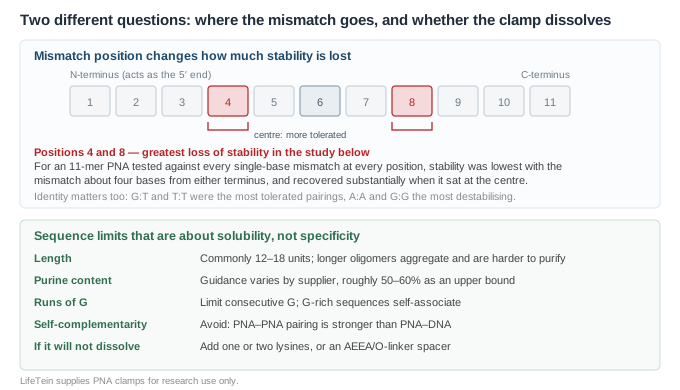
In a systematic study, an 11-mer PNA was tested against complementary DNA carrying every possible single-base mismatch at every position. Stability was at a minimum — a loss of 20 °C or more in melting temperature — when the mismatch sat about four bases from either terminus, and it regained substantial stability when the mismatch was at the centre of the duplex1. The identity of the mispaired bases mattered independently: G:T and T:T were the most tolerated pairings, while A:A and G:G were the most destabilising1.
Two things follow. The first is that for a clamp of this length, placing the variant a few bases in from one end rather than dead centre is worth testing, which is the opposite of the inherited rule. The second is that the result comes from one probe of one length, so it is a reason to test two placements rather than a formula to apply blindly. If your variant creates a G:T or T:T mispairing on the wild-type clamp, expect weaker discrimination and plan the annealing temperature accordingly.
Clamps are typically 12 to 18 units. Shorter clamps discriminate better because a single mismatch is a larger fraction of the duplex; longer clamps bind more tightly but tolerate the mismatch better, which is precisely what you do not want.
Predicting where a given sequence will melt is not a matter of applying DNA rules. PNA/DNA duplex stability does not follow the same rules as DNA/DNA, and an empirical formula for PNA/DNA melting temperature has been published that takes the purine content of the PNA strand into account2. Useful as a starting point; the number that matters in practice is the one you measure in your own reaction.
| Orientation | Antiparallel is strongly preferred. The PNA N-terminus corresponds to the 5′ end of an oligonucleotide, which is the convention used when specifying a sequence to order |
| Typical length | 12 to 18 units |
| Variant placement | Worth testing a few bases in from a terminus as well as centred1 |
| Tm estimate | Use a PNA-specific formula, not a DNA one2 |
| Decisive parameter | Annealing temperature, established empirically on your own template |
A second set of rules has nothing to do with specificity and everything to do with whether the oligomer dissolves and survives synthesis. PNA is less soluble in water than DNA, and the problem worsens with increasing length and purine content, particularly guanine3. Purine-rich sequences aggregate; G-rich ones self-associate.
Published design guidance differs on the exact thresholds, which is worth knowing before you treat any single number as a rule. Suppliers variously recommend keeping purine content below about 50%, or below 60%, and limit purine runs to roughly six or seven in any stretch of ten units, with separate advice to avoid long runs of G. Self-complementarity should be avoided in all of them, because PNA–PNA pairing is stronger than PNA–DNA3. For aqueous applications such as PCR the constraints are tighter than for FISH in formamide-containing buffer3.
These are guidelines from different suppliers, not a standard, and they disagree at the margins. Treat them as a description of where problems start rather than a specification. The underlying fact is the one to remember: purines and length drive aggregation, and the usual remedy is to add one or two lysine residues or an AEEA spacer, which improves solubility without compromising hybridisation3.
| Decision | Consideration |
|---|---|
| Clamp overlapping a primer site | The stronger blocking mode, because the reaction is stopped before extension begins. Requires the variant to be close enough to a usable primer position. |
| Clamp inside the amplicon | Used when the variant is too far from a primer site. The clamp must resist a polymerase that is already extending, so suppression is generally less complete. |
| Amplicon length | Short amplicons are more robust on degraded or fixed template, where both alleles are fragmented. |
| Clamp and primer overlap | Enough overlap to exclude the primer, without the clamp extending so far that a mismatch becomes a small fraction of a long duplex. |
Send the wild-type sequence with the variant position marked, and your primer positions if they are already fixed. We will review the sequence for purine content, runs of G and self-complementarity before synthesis and tell you if a lysine or AEEA addition is advisable, rather than discovering it when the vial will not dissolve. If you want to test two variant placements, both can be made in the same batch.
Sequences supplied by customers are treated as confidential and are never disclosed or reused.
All LifeTein products are supplied for laboratory research use only. They are not for human or veterinary use, and not for diagnostic or therapeutic use.