


The problem clamping solves is one of ratio, not of detection. A mutant allele present at one copy in a thousand is perfectly detectable in principle; the difficulty is that the other 999 copies amplify at the same rate and bury it. A PNA clamp changes the competition at the start of the reaction by binding the sequence you do not want, so that the polymerase spends its cycles on the sequence you do.
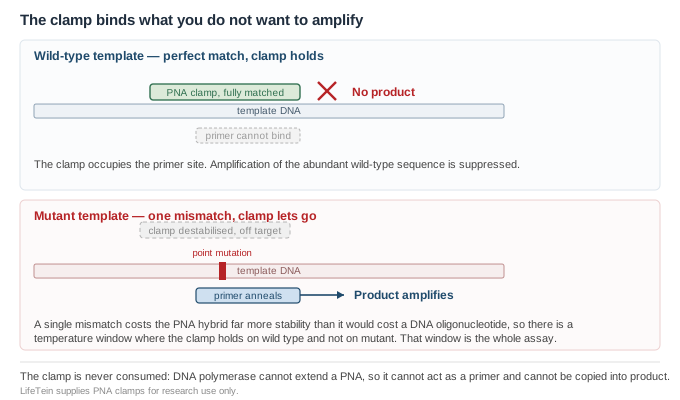
The method was described in 1993 and rests on two facts about PNA. The first is affinity and specificity for a complementary sequence that exceed those of the corresponding DNA oligonucleotide. The second is that PNA cannot function as a primer for DNA polymerases1.
That second point is what makes a clamp a clamp rather than a competitor. A DNA oligonucleotide bound at the same site would be extended by the polymerase and copied into product, consuming it and defeating the purpose. A PNA cannot be extended, so it is not consumed; it occupies the site and the reaction moves on without it. The clamp is a blocker in the strict sense.
The first point supplies the discrimination. The destabilising effect of a single mismatch is much larger in a PNA hybrid than in a DNA duplex, and it is not a fixed quantity: in a systematic study of an 11-mer PNA against every possible single-base mismatch at every position, the loss in melting temperature exceeded 20 °C at the least tolerated placements, and depended on both position and the identity of the bases involved2. Because that penalty is large, there is a usable range of temperature over which a perfectly matched clamp is still bound and a singly mismatched one is not.
| Mode | Where the clamp sits | What it blocks |
|---|---|---|
| Primer-site competition | Overlapping one primer binding site | The primer cannot anneal, so no extension begins. This is the mode drawn above and the one most assays use. |
| Elongation arrest | Inside the amplicon, between the primers | Primers anneal normally but the polymerase stalls at the bound clamp, so no full-length product accumulates. |
Primer-site competition is usually the stronger of the two, because it stops the reaction before any extension happens rather than relying on the clamp to resist a polymerase that is already moving. Elongation arrest is the option when the mutation of interest sits too far from a usable primer site.
| What the clamp targets | The wild-type sequence — the one you want suppressed |
| What escapes | Any template whose sequence differs from the clamp, including mutations the clamp was not designed against |
| Clamp length | Typically 13 to 18 bases; short enough that one mismatch is a large fraction of the duplex |
| Is it consumed? | No. PNA cannot be extended by DNA polymerase1 |
| Critical parameter | Annealing temperature, which sets whether the mismatch discrimination is realised |
The practical question is how much the ratio actually improves. In 114 consecutive non-small cell lung cancer tumour samples analysed for K-Ras codon 12 and 13 mutations, the sensitivity of the analysis without and with PNA was 10% and 1% of tumour DNA respectively. Direct sequencing found mutations in 11 of 114 tumours, and clamped PCR found 10 additional cases, raising the total to 21 of 1143. In the adenocarcinoma subgroup the detected mutation frequency rose from 7 of 55 by direct sequencing to 15 of 55 by clamped PCR3.
Lower limits have been reported in other settings. A review of clamping assays notes detection of mutated KRAS at 0.03% relative to wild-type DNA in one reported method4, and a clamping-assisted melting-curve approach has been described with a sensitivity in the range of 0.1 to 0.01%5. A clamping assay for KRAS in colorectal carcinoma reported 0.7% sensitivity and 96.7% specificity against Sanger sequencing and pyrosequencing6.
Those figures span two orders of magnitude, and the spread is the useful information. Clamping sensitivity is a property of a complete assay — clamp sequence, primer placement, annealing temperature, template quality and read-out — not a property of the clamp molecule. A number quoted for one assay does not transfer to another. Treat published sensitivities as evidence of what is achievable, and establish your own on your own dilution series.
Send us the wild-type sequence you need suppressed, together with the position of the variant you are trying to see and your primer positions if they are already fixed. We synthesise and purify the PNA and supply the analytical data for the batch. Annealing temperature and the degree of suppression have to be established on your own template, since both depend on the rest of the assay.
Sequences supplied by customers are treated as confidential and are never disclosed or reused.
All LifeTein products are supplied for laboratory research use only. They are not for human or veterinary use, and not for diagnostic or therapeutic use. The clinical studies cited on this page are included as scientific background and are not claims about LifeTein products.