


A microRNA is a short target, around 22 nucleotides, which makes it an unusually good match for PNA. A single oligomer can cover the entire mature sequence, and the mechanism needed is one PNA happens to be good at: binding tightly and getting in the way. The design decision that actually matters is how much of the microRNA to cover, and that turns on a trade-off between potency and specificity rather than on chemistry.
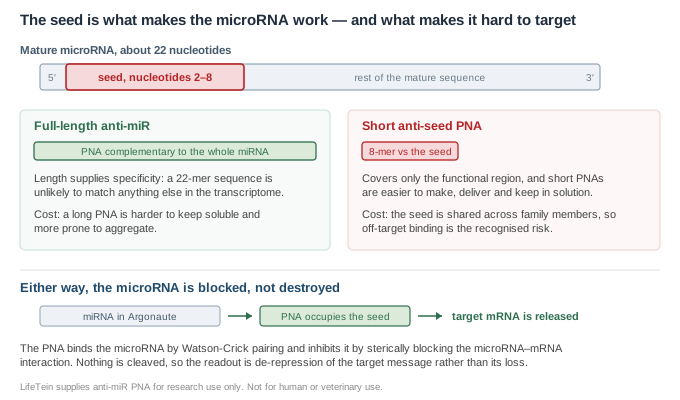
An anti-miR PNA binds the mature microRNA by Watson-Crick pairing and inhibits it by sterically blocking the microRNA–mRNA interaction1. As with antisense PNA against a message, nothing is cleaved. The practical consequence is that the readout is de-repression of the microRNA's target genes rather than disappearance of the microRNA itself, although reduced measurable microRNA levels are commonly reported as well.
Where the anti-miR acts is worth knowing. Evidence indicates that anti-miRs act primarily on mature microRNAs already engaged with Argonaute proteins, through seed-region pairing2. The inhibitor competes for a microRNA that is loaded and working, rather than preventing loading in the first place.
The functional specificity of a microRNA comes from a short stretch at its 5′ end. The seed region — described in the literature as nucleotides 2 to 8, or 2 to 7, depending on the convention used — is what pairs with sites in the target transcript and is recognised as the primary determinant of targeting specificity2.
That creates two legitimate designs. Most anti-miR reagents target the full-length microRNA1; a 22-nt PNA complementary to mature miR-210 and a 23-mer against miR-155 are both published examples3,4. The alternative is to target only the seed, and short PNAs of around 8 units directed at the miR-155 seed have been shown to work1.
The trade-off is explicit in the literature and worth weighing before you order. Shorter anti-seed designs are more easily delivered and formulated, but clinical translation of seed-targeting strategies could be hampered by off-target effects arising from non-specific binding to other coding and non-coding RNAs1. The seed is shared across members of a microRNA family, so an anti-seed oligomer is inherently less able to distinguish one family member from another. If your question is about a specific microRNA rather than a family, full-length is the safer starting point.
Anti-miR work is one of the places where PNA's delivery problem is least severe, because simple cationic additions are often enough. In the miR-155 study, a lysine-flanked PNA was efficiently internalised by activated primary B cells unaided, reducing endogenous miR-155 at concentrations of 1 to 10 µM, and inhibition in primary B cells was achieved in the absence of any transfection agent4. Electroporation of the same construct gave around 60% knockdown of miR-1554.
Where more is needed, an arginine-rich cell-penetrating peptide is the usual addition; an octaarginine peptide has been used to drive uptake of anti-miR PNA probes. Conjugating the peptide during synthesis rather than afterwards avoids a separate coupling and purification step.
| Target | The mature microRNA, typically about 22 nucleotides |
| Mechanism | Steric block of the microRNA–mRNA interaction; no cleavage1 |
| Site of action | Mature microRNA engaged with Argonaute, via seed pairing2 |
| Full-length design | Higher specificity; harder to keep soluble |
| Anti-seed design | Short and easily delivered; higher off-target risk1 |
| Delivery | Lysine additions can suffice; arginine-rich CPP where they do not4 |
| Control | What it rules out |
|---|---|
| Scrambled PNA of matched base composition | Effects caused by the chemistry, charge or delivery vehicle rather than the sequence. Published practice is to check that the scramble has no full complementarity to any human transcript |
| A functional readout, not only microRNA levels | Since nothing is cleaved, de-repression of a validated target transcript is the more direct evidence of inhibition |
| A second, unrelated microRNA measured in parallel | Family-level or general off-target effects, which matter most for anti-seed designs |
| Dose-response rather than a single concentration | Distinguishes genuine inhibition from a threshold artefact |
Expect some off-target activity and look for it rather than assuming its absence. In the miR-155 study the PNA also induced additional changes in gene expression beyond the intended target4. That is a normal finding for this class of reagent, not a sign that the experiment failed.
Send the mature microRNA sequence and tell us whether you want full-length or anti-seed coverage; if you are undecided we will make both from the same synthesis so the comparison is clean. We supply the matched scrambled control alongside the active sequence, and we can build the lysine additions or an arginine-rich peptide into the construct rather than conjugating afterwards.
Sequences supplied by customers are treated as confidential and are never disclosed or reused.
All LifeTein products are supplied for laboratory research use only. They are not for human or veterinary use, and not for diagnostic or therapeutic use.