Product Description | 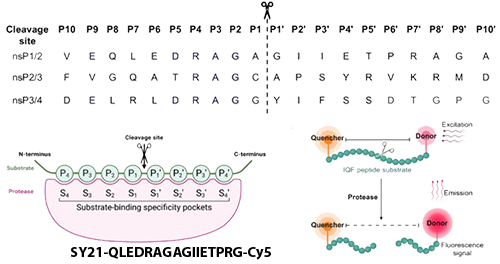 Chikungunya virus (CHIKV) is a mosquito-borne alphavirus causing debilitating fever, joint pain, and neurological complications. Lacking approved antivirals, researchers have identified the virus’s nonstructural protein 2 (nsP2) protease as a vital target-this cysteine protease orchestrates the cleavage of the viral polyprotein and is essential for productive infection. A critical insight from the 2024 study in PNAS was the creation of an internally quenched peptide based on the CHIKV nsP2-mediated cleavage junction-QLEDRAGA/GIIETPRG. This substrate underpinned a high‑throughput FRET-based enzymatic assay for screening covalent inhibitors, facilitating the discovery of RA‑0002034, a nanomolar inhibitor that covalently modifies the protease’s catalytic cysteine and demonstrates potent antiviral effects. What Makes This Sequence Special? Biological Significance - Exact mimic of the nsP2 1/2 cleavage site—ensuring physiological relevance.
- Enables direct monitoring of native protease activity via fluorescence.
Assay Performance - When uncleaved, quencher suppresses fluorescence.
- Upon protease cleavage, Cy5 fluorescence is unmasked, yielding a clear, quantifiable signal ideal for high-throughput assays.
Therapeutic Discovery Platform - Used to screen over 6,000 covalent fragments, leading to a powerful inhibitor with IC₅₀ in the low nanomolar range.
- Supported kinetic characterization (k_inact/K_I), LC‑MS confirmation, and antiviral validation in cell models.
The QSY21-QLEDRAGAGIIETPRG-Cy5 peptide is a purpose-built, scientifically validated reagent for profiling CHIKV nsP2 protease activity. As demonstrated by its pivotal role in identifying a potent covalent inhibitor, this substrate is a powerful tool for early-stage antiviral drug discovery, especially against CHIKV and potentially other alphaviruses. Use it in FRET-based assay platforms to accelerate your protease inhibitor screening projects. SY21 (often written as SY-21) is a non-fluorescent dark quencher dye, commonly regarded as an equivalent or analog of the well-known QSY®-21. It has a broad and strong absorption spectrum primarily in the far-red to near-infrared range, with a peak absorption around 661 nm. Effective quenching occurs from approximately 580–680 nm, with some sources extending this range to 590–720 nm. This wide absorption band enables SY21 to effectively accept energy from various donor fluorophores through Fluorescence Resonance Energy Transfer (FRET). As an excellent acceptor/quencher in FRET-based systems, SY21 absorbs excitation energy from nearby fluorescent donors and dissipates it as heat instead of re-emitting light. This process effectively "turns off" (quenches) the donor's fluorescence when the two are in close proximity. Consequently, SY21 is ideal for high signal-to-noise ratio experiments, where a very dark background is desired until a biological event, such as cleavage or separation, occurs. References: 1. Ghoshal, A., Tse, E.G., Hossain, M.A. et al. A covalent chemical probe for Chikungunya nsP2 cysteine protease with antialphaviral activity and proteome-wide selectivity . Sci Rep 15, 7264 (2025), https://doi.org/10.1038/s41598-025-91673-x. 2. E.M. Merten, J.D. Sears, T.M. Leisner, P.B. Hardy, A. Ghoshal, M.A. Hossain, K.H. Asressu, P.J. Brown, E.G. Tse, M.A. Stashko, K. Li, J.L. Norris-Drouin, L.E. Herring, A.L. Mordant, T.S. Webb, C.A. Mills, N.K. Barker, Z.J. Streblow, S. Perveen, C.H. Arrowsmith, R.M. Couñago, J.J. Arnold, C.E. Cameron, D.N. Streblow, N.J. Moorman, M.T. Heise, T.M. Willson, K.I. Popov, & K.H. Pearce, Identification of a cell-active chikungunya virus nsP2 protease inhibitor using a covalent fragment-based screening approach, Proc. Natl. Acad. Sci. U.S.A. 121 (42) e2409166121, https://doi.org/10.1073/pnas.2409166121 (2024). |