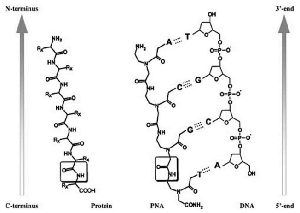
This PNA probe (GGCAAGTCTTCTTCGGA) is specifically designed for
PCR clamping of plant plastid 16S rRNA genes. It selectively suppresses
host-derived DNA amplification, enabling improved detection of microbial sequences
in plant-associated samples.
Key Features
- Sequence-specific blocking of plant plastid 16S rRNA
- Strong PNA–DNA binding for effective PCR inhibition
- No extension by DNA polymerase
- Single-base mismatch discrimination
- Compatible with PCR, qPCR, and NGS workflows
Mechanism of PCR Clamping
This PNA probe binds to its complementary sequence within the plastid 16S rRNA region,
overlapping primer binding sites. The resulting PNA–DNA duplex:
- Blocks primer annealing
- Prevents DNA polymerase elongation
- Suppresses host DNA amplification
Due to the neutral backbone of PNA, binding affinity is significantly higher than DNA–DNA interactions,
allowing the probe to effectively outcompete PCR primers.
Applications
- Plant microbiome sequencing
- 16S rRNA gene amplification (host suppression)
- Environmental DNA (eDNA) analysis
- Mutation enrichment and selective amplification
Validated Use Case
The sequence GGCAAGTCTTCTTCGGA is widely used as a
plant plastid 16S rRNA blocker. It is commonly paired with:
| PNA Sequence |
Target |
| GGCAAGTCTTCTTCGGA |
Plastid 16S rRNA |
| GGCTCAACCCTGGACAG |
Mitochondrial 16S rRNA |
| CGAGGGCACGTCTGCCTGG |
ITS2 (nuclear rRNA) |
Using these PNA blockers significantly reduces host DNA contamination and improves detection of microbial diversity.
Recommended Usage
- PNA concentration: 0.5–2 μM
- Add directly to PCR reaction mix
- Optimize annealing temperature due to higher PNA Tm
|