Mechanism of Action 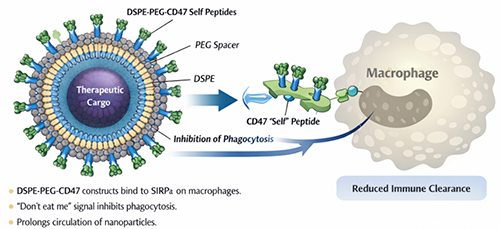
CD47 is a natural cell-surface protein that signals “self” to macrophages through binding to SIRPα. Nanoparticles displaying CD47 or CD47-derived self-peptides can delay macrophage-mediated clearance. In practical nanomedicine workflows, the peptide is presented on the particle surface to reduce phagocytic recognition and improve in vivo persistence. For lipid-based formulations, DSPE-PEG-CD47 conjugates can be incorporated via click chemistry, depending on the particle system. This makes the construct useful for LNP research, stealth liposome design, and targeted circulation studies. Applications in Nanomedicine Lipid Nanoparticles and Liposomes DSPE-PEG-CD47 peptide conjugates are suitable for functionalizing liposomes and LNPs when reduced macrophage clearance is desired. These formats are relevant for mRNA, siRNA, small-molecule, and imaging payload delivery. Macrophage Uptake and Biodistribution Studies The construct is useful for evaluating how self-peptide display affects particle uptake by RAW264.7 cells, primary macrophages, or other phagocyte models. It can also be used in biodistribution studies comparing stealth-modified and unmodified particles. Immune Evasion Surface Engineering Researchers use CD47-mimetic surface ligands to create anti-phagocytic coatings for nanoparticles, biomaterials, and delivery systems. DSPE-PEG-CD47 is a practical lipid-facing format for this type of membrane-compatible surface presentation. |