Peptide Modifications
LifeTein provides a wide range of peptide modification, labeling, and biomolecule peptide conjugation services for research, diagnostics, assay development, and peptide therapeutic discovery.
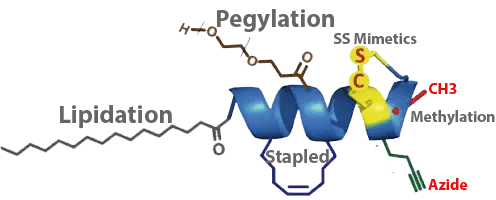
Our peptide chemistry toolbox includes terminal modifications, peptide backbone modifications, fluorescent and affinity labeling, PEGylation, lipidation, cyclization, carrier protein conjugation, peptide–oligonucleotide conjugation, and many specialized post-translational modification (PTM) mimics.
Service Overview
| Main applications |
Peptide therapeutics, assay probes, fluorescent imaging, pull-down assays, biomolecule conjugation, PTM studies, epigenetics, and targeted delivery |
| Common formats |
N-terminal and C-terminal modifications, side-chain labeling, cyclic peptides, carrier protein conjugates, peptide–drug conjugates, peptide–DNA / RNA conjugates |
| Difficult modifications |
Histone acylation mimics, sulfotyrosine peptides, glycopeptides, stapled peptides, lipidated peptides, and custom linker-bearing peptides |
| Related services |
Peptide–oligonucleotide conjugates, click chemistry, carrier proteins, MAP peptides |
Peptide chemistry toolbox for peptide therapeutics: modifications of the peptide backbone, lipidation, attaching polymers, or modulating the primary, secondary, tertiary, or quaternary structure.
Peptide Antibody Conjugation Service:
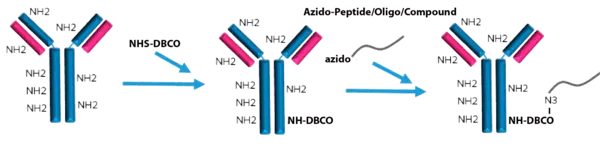
LifeTein provides peptide–macromolecule bioconjugation service. The service allows conjugation of oligonucleotides, fluorescent dyes, chromogenic enzyme substrates, drugs, toxins, or carrier proteins to peptides. The peptide can be conjugated to these molecules through reactive groups such as amine, thiol, or carboxylate.
Val-Cit-PAB-MMAE (CAS # 646502-53-6, Molecular Formula: C68H105N11O15, Molecular Weight: 1316.63) is a precursor of antibody drug conjugates. It contains a maleimidocaproyl (MC) spacer, a protease-sensitive Val-Cit dipeptide, a PABC linker, and an MMAE payload. MC-Val-Cit-PAB-MMAE can be attached to selected peptides.
LifeTein’s service portfolio includes peptide oligo conjugates for gene inhibition, siRNA delivery, cellular entry, protein–protein interaction, nucleic acid–protein interaction, and drug delivery; peptide–antibody conjugates for drug therapy, diagnostics, and microarray detection; biotin peptide conjugates for immunoassay or pull-down assay; and synthetic polymer conjugates for PEGylation, dendrimers, nanoparticles, or gold particles.
LifeTein Click Chemistry Features and Benefits
- Stable - forms a triazole linkage
- Biocompatible - occurs efficiently under mild conditions
- Chemoselective - no reaction with common -NH2, -SH, or -COOH groups under the proper conditions
- Effective - suitable for aqueous-media conjugation workflows
- Flexible - short or extended spacer options available
Applications
- Oligo peptide conjugates: DNA conjugates, RNA conjugates, siRNA conjugates
- Peptide–antibody conjugation
- Dendritic peptides
- Peptide–drug conjugates
- Peptide–protein conjugation
- Peptide–small molecule conjugation
Added difficult modifications
In addition to your original list, the page below now includes harder and more specialized PTM-style modifications from your spreadsheet, including lysine propionylation, malonylation, nicotinylation, isonicotinylation, hexanoylation, butyrylation, isobutyrylation, 2-hydroxyisobutyrylation, R/S-3-hydroxybutyrylation, dopamine modification, and serotonylation, along with several commonly requested advanced peptide formats such as sulfotyrosine peptides, glycopeptides, glutathionylated cysteine, and stapled peptides.
Click here to download the LifeTein Peptide Modification Full List
- {Ac}, Acetylation (Free) - can increase metabolic stability and help mimic native N-terminal capping.
- {For}, Formylation
- {Fmoc}, 9-Fluorenylmethyloxycarbonyl
- {Suc}, Succinyl; {MeO-Suc}
- {Cl-Ac}, Chloroacetyl
- {Mal}, Maleimide
- {CBZ}, Benzyloxycarbonyl
- {Br-Ac}, Bromoacetyl
- Nitrilotriacetyl
- {Boc}, tert-Butoxycarbonyl
- {HPP}, 4-Hydroxyphenylpropionic acid
- {LA}, Lipoic acid
- {mPEG2000}, {mPEG3000}, {mPEG5000}, Mal-PEG12
- {Alloc}, Allyloxycarbonyl
- {Boc}, tert-Butoxycarbonyl
- {But}, Butyric acid
- {Hex}, Hexanoic acid
- {Oct}, Octanoic acid
- {Dec}, Decanoic acid
- Fatty acid modification: Caprylic acid (C8), Capric acid (C10), Lauric acid (C12), Myristic acid (C14), Palmitic acid (C16), or Stearic acid (C18)
- Caprylic acid
- {Pal}, Palmitic acid
- {Ste}, Stearic acid
- {Myr}, Myristic acid
- {Lau}, Lauric acid
- More...
1. Short-Chain Fatty Acids (Usually fewer than 6 carbon atoms)
| Name |
Carbon Atoms |
Formula |
Saturation |
| Formic acid | C1 | HCOOH | Saturated |
| Acetic acid | C2 | CH₃COOH | Saturated |
| Propionic acid | C3 | CH₃CH₂COOH | Saturated |
| Butyric acid | C4 | CH₃(CH₂)₂COOH | Saturated |
| Valeric acid | C5 | CH₃(CH₂)₃COOH | Saturated |
2. Medium-Chain Fatty Acids (6 to 12 carbon atoms)
| Name |
Carbon Atoms |
Formula |
Saturation |
| Caproic acid | C6 | CH₃(CH₂)₄COOH | Saturated |
| Caprylic acid | C8 | CH₃(CH₂)₆COOH | Saturated |
| Capric acid | C10 | CH₃(CH₂)₈COOH | Saturated |
| Lauric acid | C12 | CH₃(CH₂)₁₀COOH | Saturated |
3. Long-Chain Fatty Acids (13 to 21 carbon atoms)
| Name |
Carbon Atoms |
Formula |
Saturation |
| Myristic acid | C14 | CH₃(CH₂)₁₂COOH | Saturated |
| Palmitic acid | C16 | CH₃(CH₂)₁₄COOH | Saturated |
| Stearic acid | C18 | CH₃(CH₂)₁₆COOH | Saturated |
| Oleic acid | C18:1 | CH₃(CH₂)₇CH=CH(CH₂)₇COOH | Monounsaturated |
| Linoleic acid | C18:2 | CH₃(CH₂)₄(CH=CHCH₂)₂(CH₂)₆COOH | Polyunsaturated |
| Arachidic acid | C20 | CH₃(CH₂)₁₈COOH | Saturated |
4. Very-Long-Chain Fatty Acids (22 or more carbon atoms)
| Name |
Carbon Atoms |
Formula |
Saturation |
| Behenic acid | C22 | CH₃(CH₂)₂₀COOH | Saturated |
| Lignoceric acid | C24 | CH₃(CH₂)₂₂COOH | Saturated |
| Cerotic acid | C26 | CH₃(CH₂)₂₄COOH | Saturated |
- {NH2}, Amidation (Free)
- {CHO}, Peptide Aldehydes
- {OL}, Alcohol Peptide
- {CMK}, Chloromethylketone
- {AMC}, 7-Amino-4-Methylcoumarin
- {pNA}, p-Nitroaniline
- {-ONP}, para-Nitrophenol
- {-OSu}, Hydroxysuccinimide ester
- ED, {AFC}, -OMe, -OtBu
- {FMK}, Fluoromethylketone
- {Cya}, Cysteamide
- More...
- {D-Ala}
- {D-Arg}
- {D-Asp}
- {D-Asn}
- {D-Cys}
- {D-Glu}
- {D-Gln}
- {D-His}
- {D-Allo-Ile}
- {D-Leu}
- {D-Lys}
- {D-Met}
- {D-Pro}
- {D-Phe}
- {D-Ser}
- {D-Tyr}
- {D-Thr}
- {D-Trp}
- {D-Val}
- More...
- {Cys(Cam)}
- {D-Cys(Cam)}
- {Cys(Acm)}
- {Cys(tBu)}
- {Cys(StBu)}
- {Cys(Nitrosothiols)}
- {Cys(Pyrene-Maleimide)}
- {Gamma-Glu}
- {D-Gamma-Glu}
- {Beta-Asp}
- {D-Beta-Asp}
- {Met(O)}
- {D-Met(O)}
- {Lys(Ac)}
- {Ac-Lys}
- {Lys(Dde)}
- {Gly(allyl)}
- {D-Gly(allyl)}
- {Cpg}, Cyclopentylglycine
- {Tle}
- {Ser(Octanoic acid)}
- {Ser(Lipoic acid)}
- {D-Ser(Octanoic acid)}
- {3-Ala(2-thienyl)-OH}
- {3-Ala(3-thienyl)-OH}
- {Aib}
- {Abu}
- {D-Abu}
- {Hyp}
- {Phg}
- {D-Phg}
- {Nva}
- {D-Nva}
- {Nle}
- {D-Nle}
- {Cit}
- {D-Cit}
- {Orn}
- {D-Orn}
- {Pen}
- {D-Pen}
- {Cha}
- {D-Cha}
- {Chg}
- {D-Chg}
- {Dab}
- {Dap}
- {Pra}
- {D-Pra}
- {Allo-Thr}
- {D-Allo-Thr}
- {Tyr(SO3H)}, Sulfotyrosine
- Glycosylated Ser / Thr / Asn residues (glycopeptide formats)
- {Cys(GSH)}, Glutathionylated cysteine
- More...
- Cyanine 3, Cyanine 5, Cyanine 5.5, Cyanine 7, Cyanine 7.5, BDP 581/591, cy3, cy5, Texas Red, More details
- Alexa Fluor 350, Alexa Fluor 405, Alexa Fluor 488, Alexa Fluor 532, Alexa Fluor 546, Alexa Fluor 555, Alexa Fluor 568, Alexa Fluor 594, Alexa Fluor 647, Alexa Fluor 680, Alexa Fluor 750
- Qdot 525, Qdot 565, Qdot 605, Qdot 655, Qdot 705, Qdot 800
- Biotin (N terminus)
- DeThioBiotin
- EDBiotin (C terminus)
- Lys(Biotin) (middle)
- Lys(Biotin) (C terminus)
- Lys(Biotin) (N terminus)
- Lys(LC-Biotin) (middle)
- Lys(LC-Biotin) (C terminus)
- Biotin-LC (N terminus)
- FITC (N terminus)
- Lys(FITC) (middle)
- Lys(FITC) (C terminus)
- Lys(FITC) (N terminus)
- FITC-LC (N terminus)
- 5-FAM (N terminus)
- 6-FAM (N terminus)
- Lys(5-FAM) (middle)
- Lys(5,6-FAM)
- Lys(5-FAM) (C terminus)
- Lys(5-FAM) (N terminus)
- 5-FAM-LC (N terminus)
- Dansyl (N terminus)
- EDDansyl (C terminus)
- Lys(Dansyl) (middle)
- Lys(Dansyl) (C terminus)
- Lys(Dansyl) (N terminus)
- Dansyl-LC (N terminus)
- TAMRA (N terminus)
- 5(6)-TAMRA
- EDTAMRA (C terminus)
- Lys(TAMRA) (middle)
- Lys(TAMRA) (C terminus)
- Lys(TAMRA) (N terminus)
- TAMRA-LC (N terminus)
- Lys(Dnp) (middle)
- D-Lys(Dnp) (middle)
- Dab(Dnp) (middle)
- Dap(Dnp) (middle)
- EDDnp (C terminus)
- MCA (N terminus)
- Lys(MCA) (middle)
- Lys(MCA) (C terminus)
- Lys(MCA) (N terminus)
- 3-Indolylacetic acid (N terminus)
- Cys(Npys) (N terminus)
- PyBA- (N terminus), 1-pyrenebutyric acid
- Lys(PyBA)
- Fa- (N terminus), 3-[2-furyl]acrylic acid
- Rhodamine B- (N terminus)
- Lys(Rhodamine B)
- More...
- {Gly}, 2 Carbons
- {Beta-Ala}, 3 Carbons
- {GABA}, 4 Carbons
- {Ava}, 5 Carbons
- {Ahx}, 6 Carbons
- {AEA}, Aminoethoxyacetic Acid
- {Mini-PEG}, 9 Carbons
- {Mini-PEG2}, 13 Carbons
- {Mini-PEG3}, 16 Carbons
- {ANP Linker}
- Val-Cit-PAB and related cleavable linker formats
- More details
Post-translational modifications of histone proteins, such as acetylation, methylation, and phosphorylation, play essential roles in regulating chromatin dynamics. Mono-, di-, or tri-methylated peptides are widely used to study protein–protein interactions and PTM recognition.
- {Cys(Me)}, SMC
- {ADMA}, {Arg(Me)2} asymmetrical
- {SDMA}, {Arg(Me)2} symmetrical
- {Arg(Me)}
- {Thr(Me)}
- {Ser(Me)}
- {Lys(Me)}
- {Lys(Me2)}
- {Lys(Me3)}
- {L-1-Me-Trp}
- {L-2-Me-Trp}
- {D-2-Me-Trp}
- {Tyr(Me)}
- {Tyr(Et)}
- {D-Tyr(Et)}
- {Orn(Me)3}
- {N-Me-Gly}, Sar
- {N-Me-Ser}
- {N-Me-Tyr}
- {N-Me-Thr}
- {N-Me-Asp}
- {N-Me-Glu}
- {N-Me-Ala}
- {N-Me-Phe}
- {N-Me-Leu}
- {N-Me-Ile}
- {N-Me-Val}
- {N-Me-Met}
- {N-Me-Nle}
- {N-Me-Nva}
- (propionyl)K
- (malonyl)K
- (nicotinyl)K
- (isonicotinyl)K
- (hexanoylation)K
- (butyryl)K
- (isobutyryl)K
- (2-Hydroxyisobutyryl)K
- (R-3OHBu)K / (β-HydroxyButyryl)K
- (S-3OHBu)K
- (crotonyl)K
- (succinyl)K
- (glutaryl)K
- (lactyl)K
- (dopamine)Q
- (serotonyl)Q
- More...
- {pSer}
- {D-pSer}
- {pTyr}
- {D-pTyr}
- {pThr}
- {D-pThr}
- 2, 3 or 4 phosphorylation sites in the sequence
- More...
- Up to 10 Free Aliquots (Why Aliquot?)
- Free HPLC Data
- Free MS Data
- Free Certificate Of Analysis (COA)
- Convert from TFA Salt to Acetate Salt or Hydrochloride Salt
- Amino Acid Analysis
- N Elemental Analysis
- Solubility Test
- Bioburden
- Water Content
- Bacterial Endotoxins
- Sulfated peptides
- Glycopeptides
- Glutathionylated peptides
- Lipidated peptides
- More...
Please click here to get a peptide synthesis service quote now.