


Cy7 is a near-infrared label used where the peptide has to be followed through tissue rather than observed in a dish. Tissue scatters and absorbs far less at these wavelengths, and there is almost no autofluorescence to compete with.
| Excitation maximum | 750 nm |
| Emission maximum | 773 nm |
| Laser line | 750 nm |
| Dye class | Cyanine |
| Reactive form | NHS ester; maleimide for cysteine |
| Linkage | Amide, or thioether to cysteine |
| Attachment | N-terminus, lysine, or an added cysteine |
| pH dependence | Very low2 |
| Typical use | Whole-animal imaging, biodistribution, NIR FRET |
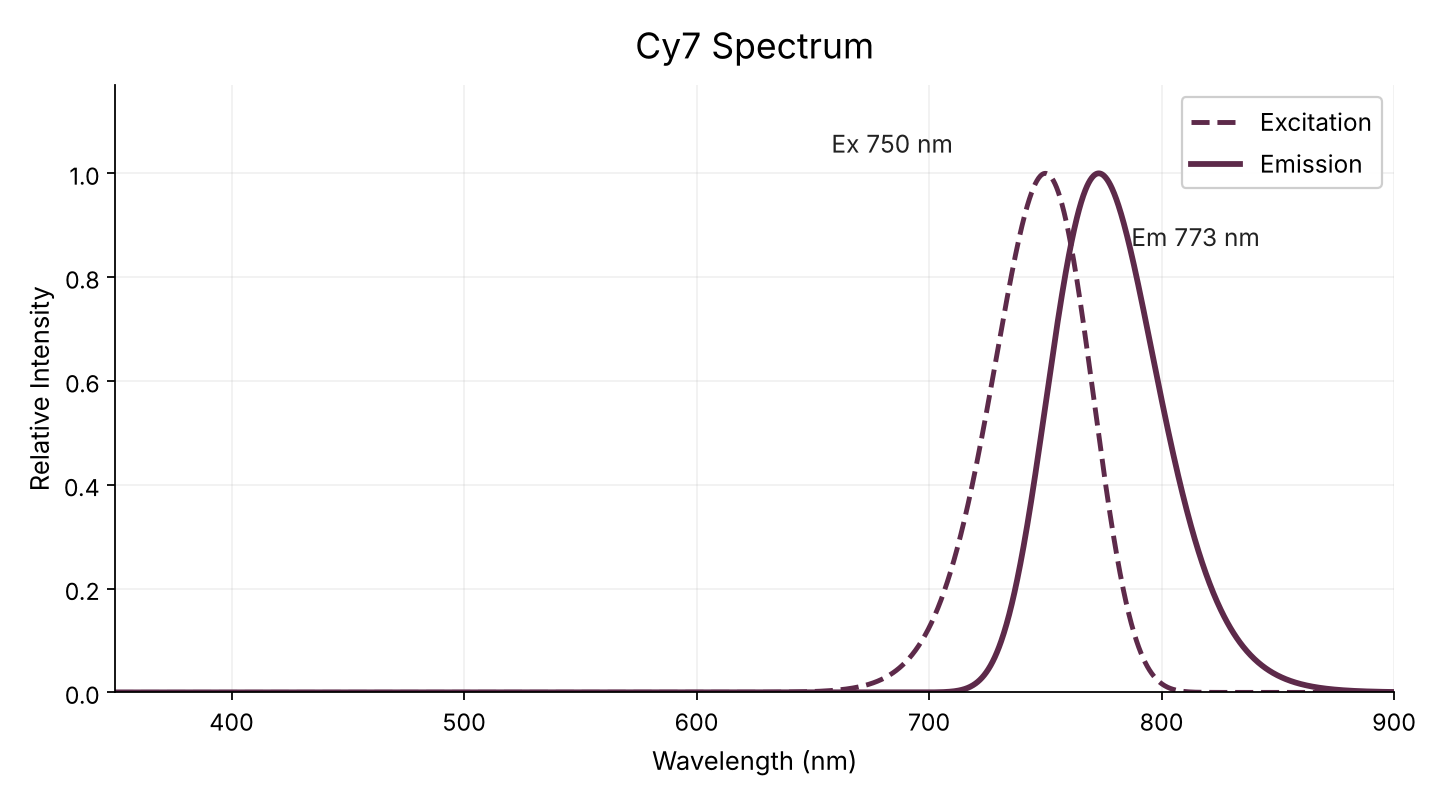
The practical advantage of the near infrared is twofold: tissue is more transparent, and endogenous fluorophores emit very little there. A Cy7-labelled peptide can therefore be detected at lower concentration in a living animal than a visible-wavelength label could, which is what makes the dye worth its cost for biodistribution work.
Cy5.5 and Cy7 or Cy7.5 can be used as a donor and acceptor in the near infrared, so a FRET construct can be read through tissue. The same arrangement in the visible range would be absorbed before it reached the detector.
Near-infrared cyanines are the least photostable of the dyes offered here and are the most sensitive to light during handling. Labelled peptides should be kept dark and in single-use aliquots. Instrument availability is also a real constraint: a standard confocal or flow cytometer will not have the lasers or filters for Cy7.
| Situation | Choice | Why |
|---|---|---|
| Whole-animal imaging and biodistribution | Cy7 or Cy7.5 | Tissue is most transparent in this window |
| Cell or tissue-section imaging | Cy5 or Cy5.5 | Standard instruments cover those channels |
| Longest wavelength available | Cy7.5 | Absorbance 788 nm, emission 808 nm3 |
| Long acquisitions | Not a near-infrared cyanine | These are the fastest to photobleach |
Tell us what the peptide has to do in the assay as well as its sequence. Where the dye sits often matters more to the result than which dye it is, and a label placed in a binding motif can remove the activity being measured.