


Cy5.5 sits between Cy5 and Cy7, with an absorbance maximum of 675 nm and an emission maximum of 694 nm.3 It is the first dye in the series that is genuinely useful for imaging through tissue, because both its excitation and emission fall inside the window where blood and water absorb least.
| Excitation maximum | 675 nm |
| Emission maximum | 694 nm |
| Laser line | 673 nm, 685 nm |
| Dye class | Cyanine |
| Absorbance / emission | 675 / 694 nm3 |
| Reactive form | NHS ester; maleimide for cysteine |
| Linkage | Amide, or thioether to cysteine |
| pH dependence | Very low2 |
| Typical use | Whole-animal and deep-tissue imaging; far-red FRET |
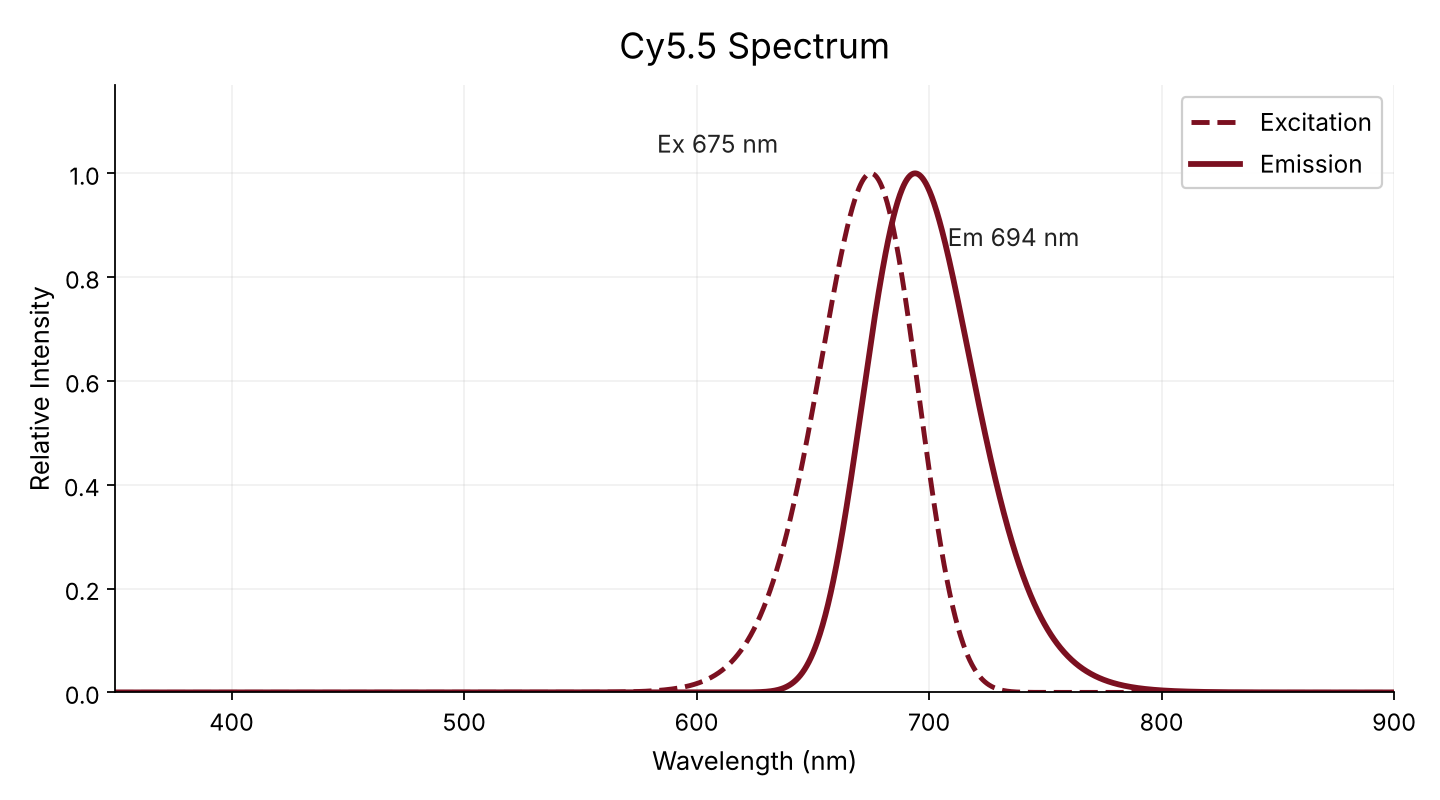
Haemoglobin absorbs strongly below about 650 nm and water begins to absorb above about 900 nm. Between those limits lies the window used for optical imaging in tissue, and Cy5.5 is the point in the cyanine series where both the excitation and the emission sit inside it. For a peptide intended as a targeting agent in an animal model rather than a label in a dish, that is the practical reason to choose it over Cy5.
Cy5.5 is often paired with a dark quencher so that an injected peptide is non-fluorescent until it is cleaved by the protease of interest. Because the pair works in the near infrared, the resulting signal can be read through tissue rather than only in extracted samples.
Published maxima for Cy5.5 differ by several nanometres between suppliers and between derivatives — the bis-NHS ester is reported nearer 683/703 nm. These dyes are environmentally sensitive, and different solvents and conjugates give different values.4,5 Confirm the filter set against the specific conjugate rather than against a generic figure.
| Situation | Choice | Why |
|---|---|---|
| Imaging through tissue or in a live animal | Cy5.5 | Excitation and emission both inside the optical window |
| Cell culture or flow cytometry | Cy5 or Alexa Fluor 647 | Standard far-red channels are already on the instrument |
| Deeper penetration still | Cy7 or Cy7.5 | Emission moves further into the near infrared |
| Long acquisitions | A more photostable far-red dye | Cyanines bleach faster than the Alexa Fluor and ATTO dyes |
Tell us what the peptide has to do in the assay as well as its sequence. Where the dye sits often matters more to the result than which dye it is, and a label placed in a binding motif can remove the activity being measured.