


Cy7.5 is the longest-wavelength dye LifeTein offers for peptides, with an absorbance maximum of 788 nm and an emission maximum of 808 nm.3 It is chosen for one reason: depth of detection in living tissue.
| Excitation maximum | 788 nm |
| Emission maximum | 808 nm |
| Laser line | 785 nm |
| Dye class | Cyanine |
| Absorbance / emission | 788 / 808 nm3 |
| Reactive form | NHS ester; maleimide for cysteine |
| Linkage | Amide, or thioether to cysteine |
| pH dependence | Very low2 |
| Typical use | In vivo imaging, biodistribution, NIR FRET acceptor |
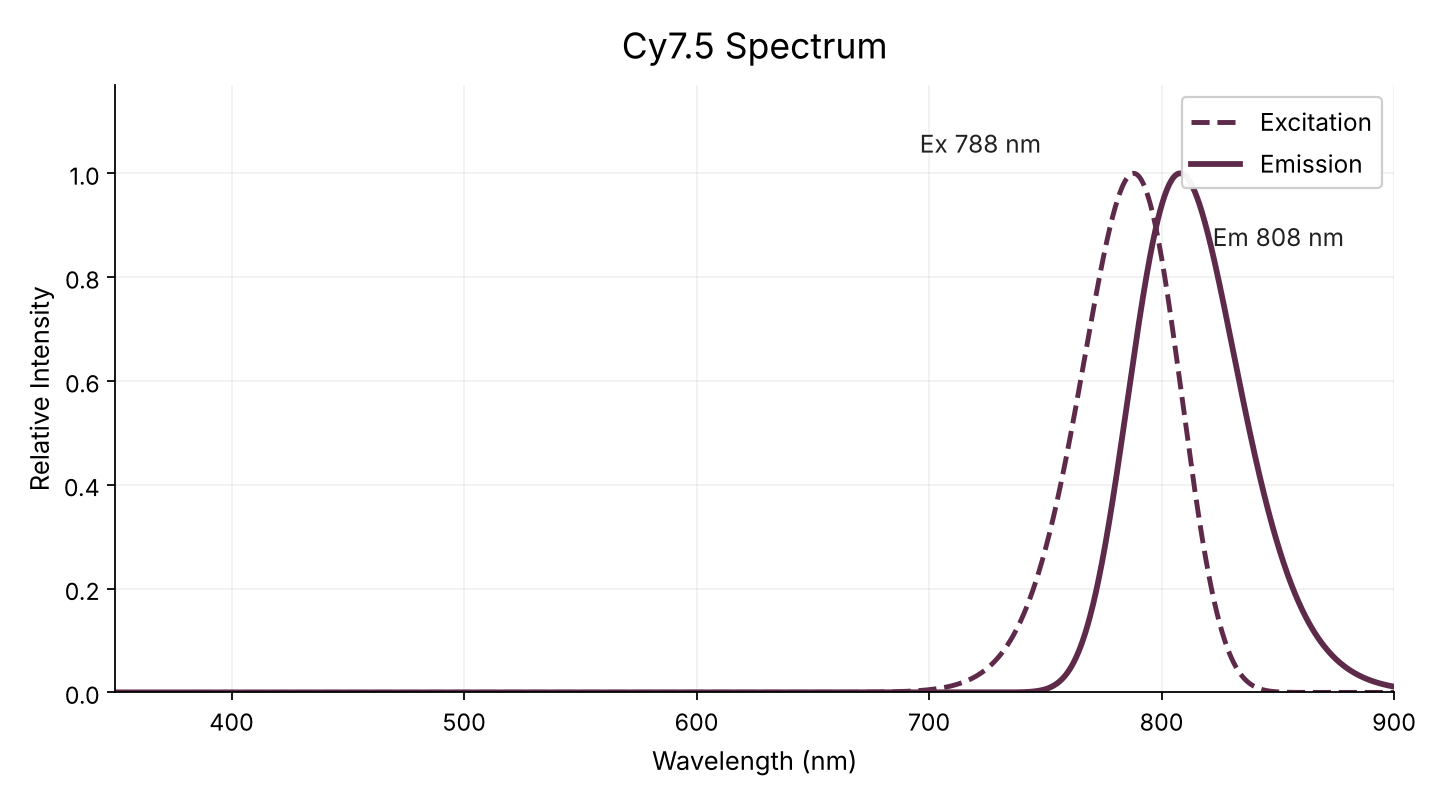
Between roughly 650 and 900 nm, haemoglobin and water both absorb weakly, and that window is what makes optical imaging through tissue possible at all. Cy7.5 sits near its far edge, so of the dyes listed here it gives the greatest penetration and the lowest tissue background.
Cy5.5 emission overlaps Cy7.5 absorption, so the two form a FRET pair that works entirely in the near infrared. A peptide linker between them can therefore be used as a protease reporter that is read through tissue rather than in a lysate.
Reported maxima vary between derivatives: the free acid is quoted nearer 785/801 nm and the NHS ester nearer 788/808 nm.3,4 Detection needs an instrument configured for the near infrared, which is a smaller constraint in a dedicated in vivo imager than on a shared confocal. Like the other near-infrared cyanines, it photobleaches readily and should be handled in the dark.
| Situation | Choice | Why |
|---|---|---|
| Greatest tissue penetration | Cy7.5 | Longest wavelength offered here |
| Whole-animal imaging on existing Cy7 filters | Cy7 | Well-established channel on in vivo imagers |
| Cell-level imaging | Cy5 or Alexa Fluor 647 | Near-infrared channels are rarely fitted to cell imagers |
| NIR FRET acceptor | Cy7.5 with a Cy5.5 donor | Both dyes sit inside the optical window |
Tell us what the peptide has to do in the assay as well as its sequence. Where the dye sits often matters more to the result than which dye it is, and a label placed in a binding motif can remove the activity being measured.