
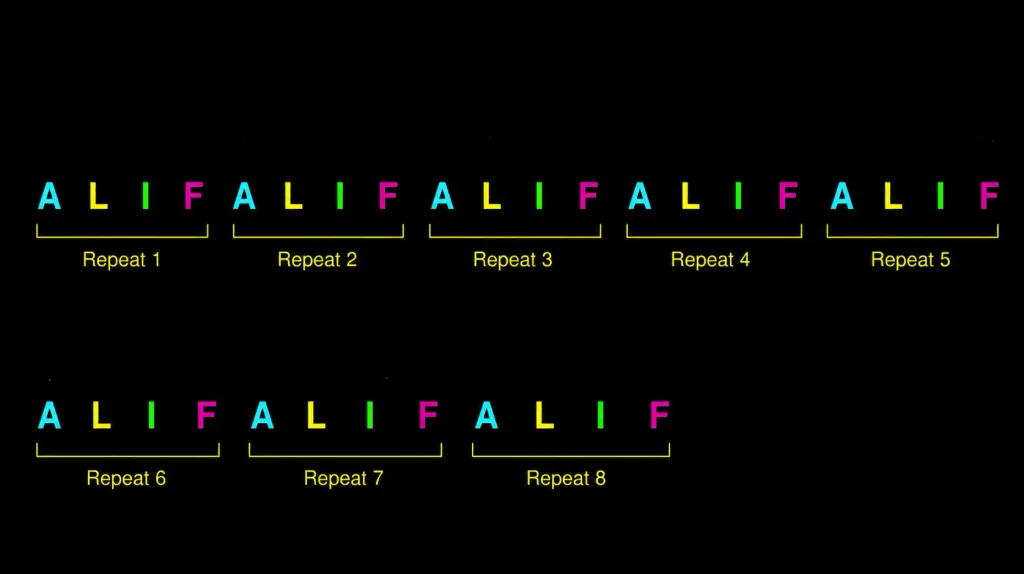
Solid-phase peptide synthesis (SPPS) has revolutionized the production of peptides, yet it remains plagued by a persistent challenge: sequence-dependent aggregation and poor coupling efficiency. While peptide length is often cited as a limiting factor, the true bottleneck frequently lies not in the number of residues, but in the nature of the amino acid sequence itself. Certain patterns of amino acid repeats create formidable obstacles that can render synthesis nearly impossible, leading to low yields, complex impurity profiles, and purification nightmares. Understanding these problematic motifs is essential for successful peptide design and synthesis.
Key Takeaways
- Sequence, not length, is often the primary determinant of synthesis difficulty; a 70-residue peptide with problematic repeats can be far more challenging than a 150-residue peptide with a favorable sequence.
- Hydrophobic stretches rich in valine, leucine, isoleucine, and phenylalanine promote on-resin aggregation through non-covalent interactions, severely hindering reagent access.
- β-sheet forming repeats, particularly alternating hydrophobic and glycine residues, create rigid, hydrogen-bonded structures that “lock” the growing chain and reduce coupling efficiency.
- Repeats of sterically hindered residues such as proline, N-methylated amino acids, and α,α-disubstituted amino acids like Aib exhibit slow coupling kinetics due to reduced nucleophilicity and steric bulk.
- Polyalanine and polyglycine stretches are notoriously difficult due to their strong propensity to form insoluble aggregates and extended conformations.
- LifeTein and other specialized providers employ advanced strategies—including pseudoproline derivatives, backbone protection, and AI-assisted sequence analysis—to overcome these challenges.
The Root Cause: On-Resin Aggregation
The Mechanism of Aggregation During SPPS
The most common and insidious problem in difficult peptide synthesis is on-resin aggregation. As the peptide chain grows, individual chains anchored to the solid support can interact with each other through intermolecular hydrogen bonding, leading to the formation of stable secondary structures, most notably β-sheets. This aggregation has severe consequences: the peptide-resin complex becomes poorly solvated, reagents are physically excluded from reactive sites, and coupling and deprotection reactions proceed incompletely. The result is a cascade of failure—low crude purity, deletion sequences (n-1, n-2, etc.), and broad or split HPLC peaks that complicate purification. The physical manifestation can sometimes be observed as a shrinking of the resin matrix.
Find out more about peptide synthesis here.
The Most Problematic Amino Acid Repeats
Hydrophobic Stretches: Valine, Leucine, Isoleucine, and Phenylalanine
Sequences rich in hydrophobic, β-branched amino acids such as valine, leucine, isoleucine, and phenylalanine are among the most notorious for causing aggregation. These residues possess bulky, non-polar side chains that drive non-covalent association through hydrophobic interactions, effectively gluing the growing peptide chains together. A peptide containing more than 50% hydrophobic residues, especially in contiguous stretches, is a strong candidate for synthesis failure. This phenomenon is so well-recognized that companies like LifeTein have developed specialized platforms specifically optimized for such hydrophobic and aggregation-prone sequences. Without intervention, these sequences often require recoupling steps that provide only marginal improvement.
β-Sheet Forming Repeats: The Glycine-Hydrophobic Combination
Certain patterns of amino acids are particularly adept at promoting β-sheet secondary structure on the resin. Glycine, despite its small size and lack of a side chain, plays a critical role: it is known to induce β-sheet packing when combined with non-polar amino acids. Repeats such as -Gly-Val-Gly-Val- or -Ala-Val-Ala-Val- create a repeating pattern of hydrogen bond donors and acceptors that strongly favors the formation of extended, sheet-like structures. These rigid, inter-chain hydrogen-bonded networks effectively “lock” the peptide chain, preventing reagents from accessing the reactive N-terminus.
Polyalanine and Polyglycine Stretches: Extreme Cases of Aggregation
Homopolymeric repeats represent some of the most extreme challenges in peptide synthesis. Polyalanine sequences, even as short as 10-12 residues, are notoriously difficult due to their strong propensity to aggregate and form helical or sheet structures on the resin. Studies using high-resolution magic angle spinning NMR have directly demonstrated that aggregation of polyalanine sequences is the origin of synthetic difficulties. Similarly, polyglycine segments longer than nine residues form insoluble aggregates due to their strong preference for an extended conformation in solution. These homopolymeric stretches are frequently encountered in amyloidogenic peptides and protein repeats, making their synthesis a major hurdle. LifeTein has successfully synthesized such challenging targets, including amyloid beta and amylin sequences, using optimized protocols.
Sterically Hindered and Slow-Coupling Repeats
Proline-Rich Sequences
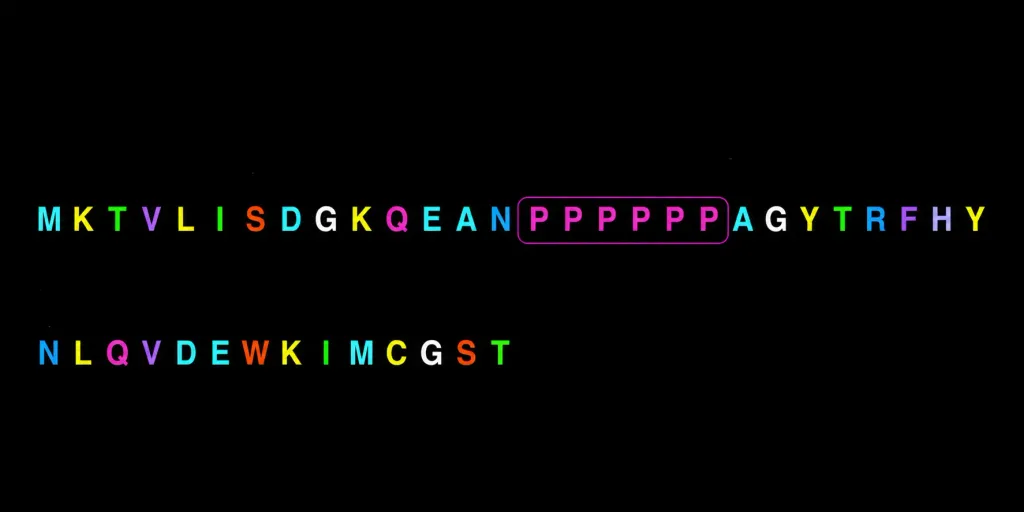
Proline presents unique difficulties due to its secondary amine (imino acid) structure. This lack of a free N-H hydrogen reduces its nucleophilicity, leading to slower coupling kinetics. Furthermore, proline’s rigid cyclic structure introduces steric hindrance that can impede the approach of activated amino acids. When proline residues are repeated in succession—as in many cell-penetrating peptides and structural motifs—these challenges are magnified. The synthesis of polyproline sequences is particularly challenging, with premature aggregation and poor control over molecular weight being common issues. To mitigate this, specialized strategies such as pseudoproline building blocks have been developed to disrupt aggregation and improve coupling efficiency.
Repeats of N-Methylated and α,α-Disubstituted Amino Acids
The incorporation of N-methylated amino acids introduces significant synthetic obstacles. The secondary amine of these residues is less nucleophilic than a primary amine, making the coupling reaction inherently slow and inefficient. This challenge is particularly pronounced when multiple N-methylated residues are present in a sequence, as each coupling becomes a potential bottleneck. Similarly, α,α-disubstituted amino acids like α-aminoisobutyric acid (Aib) are notorious for their steric bulk, which hinders the approach of coupling reagents and often results in incomplete reactions. For these extremely challenging couplings, more potent uranium or aminium reagents such as HATU, HCTU, or COMU are often required, and even then, recoupling may be necessary.
Repeats of Cysteine, Methionine, and Tryptophan
While often overlooked, peptides containing multiple cysteines, methionines, or tryptophans can be extraordinarily difficult to synthesize. Cysteine-rich sequences introduce disulfide pairing complexity and folding heterogeneity, even when the linear chain is correctly assembled. This can result in multiple conformers that appear as split HPLC peaks and complicate purification. Similarly, methionine is susceptible to oxidation during synthesis and cleavage, while tryptophan can undergo side reactions under acidic conditions.
Strategies for Overcoming Difficult Repeats
Advanced Synthetic Methodologies
Overcoming difficult sequences requires a multi-pronged approach. Pseudoproline (ψpro) building blocks have proven highly effective at disrupting aggregation by introducing a temporary conformational constraint that prevents β-sheet formation. Similarly, backbone protection strategies, such as the use of O-acyl isopeptides, can shield the peptide backbone from intermolecular hydrogen bonding. Resin choice is also critical: more polar or flexible resins, such as DEG-PS, have been shown to improve synthesis efficiency for challenging sequences. LifeTein’s PeptideSyn™ system optimizes reaction conditions, enabling the synthesis of difficult peptides in less time. For extremely long or problematic sequences, fragment condensation or native chemical ligation approaches may be employed.
AI-Assisted Sequence Analysis
A more recent and powerful strategy is the use of AI-assisted sequence analysis to predict and mitigate synthesis problems before they occur. LifeTein applies AI to identify sequence features associated with difficult synthesis, such as highly hydrophobic stretches, aggregation-prone motifs, repetitive residues, multiple cysteines, and other patterns that may complicate coupling or purification. This allows for informed design choices, such as the addition of solubilizing tags, the repositioning of modifications, or the substitution of problematic residues, before wet-lab work begins.
Try Our Sequence Analyzer Tool
Frequently Asked Questions (FAQ)
Which amino acid repeats are most problematic in peptide synthesis?
The most problematic repeats include hydrophobic stretches of valine, leucine, isoleucine, and phenylalanine; β-sheet forming patterns involving glycine and hydrophobic residues; homopolymeric sequences like polyalanine and polyglycine; proline-rich motifs; and repeats of sterically hindered residues such as N-methylated amino acids and Aib.
Why do hydrophobic repeats cause synthesis failure?
Hydrophobic residues drive non-covalent aggregation through hydrophobic interactions, effectively gluing the growing peptide chains together. This reduces solvation, excludes reagents from reactive sites, and leads to incomplete couplings and deletion sequences.
How does proline make peptide synthesis difficult?
Proline is a secondary amine (imino acid) with reduced nucleophilicity, leading to slower coupling kinetics. Its rigid cyclic structure also introduces steric hindrance. When repeated, these effects are magnified, making polyproline sequences particularly challenging.
What strategies exist for synthesizing peptides with difficult repeats?
Key strategies include the use of pseudoproline building blocks to disrupt aggregation, backbone protection to prevent hydrogen bonding, optimized resin selection, more potent coupling reagents like HATU or COMU, and AI-assisted sequence analysis to predict and mitigate problems before synthesis begins.
References
Freiburghaus, V., Jeandin, A., Frankiewicz, Ł., Yang, J., & Hartrampf, N. (2025). Development of ArgTag for Scalable Solid-Phase Synthesis of Aggregating Peptides. ACS Chemical Biology, 20(11), 2733–2740. https://doi.org/10.1021/acschembio.5c00662
Young, J. D., Huang, A. S., Ariel, N., Bruins, J. B., Ng, D., & Stevens, R. L. (1990). Coupling efficiencies of amino acids in the solid phase synthesis of peptides. Peptide research, 3(4), 194–200.
Yang, Y. (2016). Redundant Amino Acid Coupling Side Reactions. In Side Reactions in Peptide Synthesis (pp. 235–256). Elsevier. https://doi.org/10.1016/b978-0-12-801009-9.00010-0