


The usual complaint is that wild-type template still amplifies. Before changing anything, it is worth knowing that this is partly expected: bound PNA does not inhibit PCR completely, it reduces amplification efficiency1, and the method does not require complete blocking of every target site in every cycle in order to work2. A small suppression per cycle compounds across cycles. The question is whether you are getting the suppression the design allows, and in most failed assays the answer turns on the cycling profile rather than on the clamp.
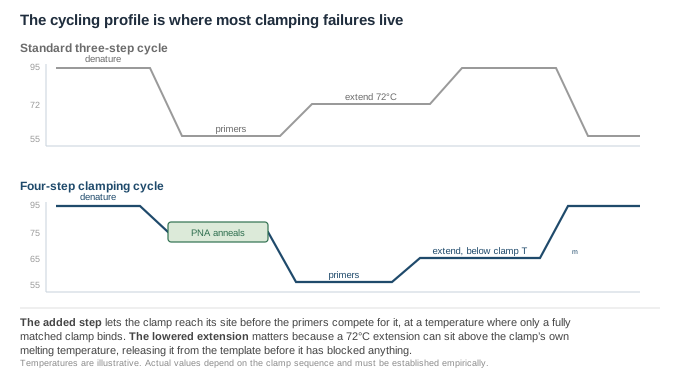
The single most common omission is running a clamping reaction on a conventional three-step cycle. The method as published expands the normal three-step cycle with a dedicated PNA annealing step, set at a temperature where only the fully complementary PNA can bind to its target site2. Without it, the clamp and the primers compete for the site at the same temperature, which is not the competition the assay was designed around.
The originator's own guidance when suppression is insufficient is direct: lower the temperature of the PNA annealing step and use the highest concentration of PNA2.
This one is easy to miss because the number looks standard. A conventional extension at 72 °C may sit above the melting temperature of the clamp on its target, in which case the clamp comes off before it has blocked anything.
In one published assay the melting temperature of the PNA on wild-type template was 69 °C, and the authors noted that at the 72 °C conventionally used for extension, less than half of those templates were associated with the PNA. They found an extension temperature of 60 °C, together with an opposite primer placed 97 nucleotides from the PNA, was required to obtain full suppression of wild-type PCR3. Dropping further, to 55 or 50 °C, slowed amplification of wild type and mutant alike3 — so lower is not simply better.
If you change one thing after reading this page, compare your extension temperature with the predicted melting temperature of your clamp. An extension step above the clamp Tm defeats the design no matter how good the clamp is, and it is invisible on the thermocycler printout because the number looks like every other PCR.
In the work that first applied clamping to ras mutations, the parameters that mattered most were identified explicitly: the total number of PCR cycles, the oligonucleotide annealing temperature, and the amount of template DNA added4. Template load is the one people forget. More wild-type template means more sites to block with the same amount of clamp.
Published working concentrations vary widely with the assay, which is a reason to titrate rather than copy. One study found 2.84 μM sufficient to inhibit any detectable Ki-ras amplification from wild-type DNA, while showing that even at 14.2 μM there was no reduction in amplification of unrelated genes, which demonstrates the inhibition is sequence-specific rather than general4. A later optimisation for a JAK2 variant reported inhibition of wild-type amplification at 6 μM clamp, and detection of one variant allele in a background of 5000 wild-type alleles5.
| Symptom | Most likely cause | What to change |
|---|---|---|
| Wild type amplifies almost as well as without the clamp | No dedicated PNA annealing step | Add the fourth step after denaturation2 |
| Suppression partial and irreproducible | Extension temperature at or above clamp Tm | Lower the extension step below the clamp Tm3 |
| Suppression weakens with more input DNA | Clamp is limiting relative to target sites | Raise clamp concentration or lower template input4 |
| Mutant signal also suppressed | Clamp concentration too high, or annealing temperature too low | Titrate down; the clamp still binds mismatched target to some degree |
| Escaped product is neither wild type nor the target variant | Polymerase misincorporation creating clamp-mismatched templates | Use a high-fidelity polymerase6 |
| Nothing amplifies at all, clamp or no clamp | Template quality or inhibition | Not a clamping problem; check the DNA |
A clamped reaction selects for any template that differs from the clamp. That includes templates that differ because the polymerase made an error. An early misincorporation within the clamp-binding region produces a molecule the clamp no longer matches, and the assay then amplifies it preferentially — exactly as it is designed to do. The result is a false positive that is indistinguishable from a real low-abundance variant unless the product is sequenced.
This is a recognised problem with a published remedy: a PNA clamp PCR assay for K-ras codons 12 and 13 was developed around a high-fidelity DNA polymerase specifically to reduce the frequency of polymerase-induced errors6. If your assay is reporting variants at frequencies near its detection floor, polymerase fidelity is worth examining before the result is believed.
| Change one thing | Cycling profile first, then clamp concentration, then template load |
| Always run | A no-clamp control, in every run |
| Establish | A dilution series of known mutant fraction on your own template |
| Confirm | Sequence the escaped product before reporting a variant |
| Expect | Partial, not absolute, suppression per cycle1,2 |
Send us the sequence and we will check purine content, runs of G and self-complementarity, and tell you whether a lysine or AEEA addition would help it stay in solution. If the design needs the variant moved to a different position within the clamp, both versions can be made in the same batch so the comparison is not confounded by synthesis differences.
Sequences supplied by customers are treated as confidential and are never disclosed or reused.
All LifeTein products are supplied for laboratory research use only. They are not for human or veterinary use, and not for diagnostic or therapeutic use.