Exenatide Acetate (Exendin-4)

Product Name
Exenatide Acetate (Exendin-4)
Product Quantity
1mg
Catalog Number
LT8172
Category
Peptide
Sequence
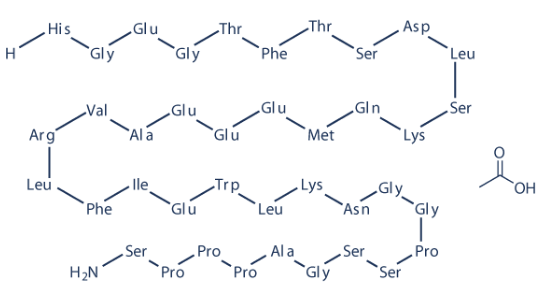
HGEGTFTSDLSKQMEEEAVRLFIEWLKNGGPSSGAPPPS-NH2, amidation
Purity
>95%
Chemistry
  • Sequence: NH2- His - Gly - Glu - Gly - Thr - Phe - Thr - Ser - Asp - Leu - Ser - Lys - Gln - Met - Glu - Glu - Glu - Ala - Val - Arg - Leu - Phe - Ile - Glu - Trp - Leu - Lys - Asn - Gly - Gly - Pro - Ser - Ser - Gly - Ala - Pro - Pro - Pro - Ser -CONH2
  • CAS registry number: 914454-01-6
  • Formular: C186H286N50O62S
  • Molecular Weight: 4246.62
Product Description
Exenatide Acetate (Exendin-4)

Exenatide Acetate, also known as Exendin-4, is a significant therapeutic agent used in the management of type 2 diabetes mellitus. It is a glucagon-like peptide-1 (GLP-1) analog and functions by activating the GLP-1 receptor. This activation leads to an increase in insulin secretion, a decrease in glucagon secretion, and a slowing of gastric emptying, all of which contribute to improved glycemic control.

Structure

Exenatide's chemical formula is C184H282N50O60S, and it has an average molecular weight of 4186.6 Da. Its sequence is denoted as HGEGTFTSDLSKQMEEEAVRLFIEWLKNGGPSSGAPPPS, indicating its complex peptide structure.

Application

Exenatide is used primarily as an adjunct to diet and exercise to enhance glycemic control in patients with type 2 diabetes. It is available in both immediate and extended-release formulations, the latter being suitable for patients aged 10 years and older, while the immediate-acting form is approved only for adults.

The drug is administered subcutaneously and is known for its ability to modulate the body's natural response to glucose, preventing both hyper- and hypoglycemia. It achieves this by increasing insulin secretion, reducing glucagon release, and slowing gastric emptying.

Exenatide's pharmacokinetic properties include reaching peak plasma concentration in about 2.1 hours and a half-life of approximately 2.4 hours. It is mainly eliminated through glomerular filtration, followed by proteolysis and then excretion in the urine.

This peptide demonstrates the potential of protein-based therapies in managing chronic conditions like diabetes, showcasing the advancement in biotechnological applications in medicine.

Scientific Background

Exenatide Acetate (Exendin-4) is a synthetic research peptide in the exendin / GLP-1 receptor ligand family. Exendin-4 is a peptide agonist of the GLP-1 receptor, whereas the N-terminally truncated exendin(9-39) peptide is a well-established GLP-1 receptor antagonist. Functional expression studies directly demonstrated this agonist/antagonist relationship, and receptor-binding studies showed that exendin peptides interact strongly with the extracellular ligand-binding domain of GLP-1R. Exendin fragments and modified analogs are therefore widely used as mechanistic GLP-1 receptor probes.

Research Applications
  • GLP-1 receptor agonist assays
  • GLP-1 receptor antagonist studies
  • receptor-binding competition experiments
  • class B GPCR ligand-recognition studies
  • analytical peptide controls
Experimental Notes

For fragments, substituted analogs, labeled peptides, stereochemical variants, or terminally modified forms, experimental behavior should be evaluated for the exact construct rather than assumed to match the native parent peptide. Sequence-dependent solubility, aggregation, adsorption, oxidation, and stability should be considered when establishing reconstitution, storage, and assay conditions.

Selected References
  1. Cloning and functional expression of the human islet GLP-1 receptor: exendin-4 agonism and exendin-(9-39) antagonism
  2. Exendin-4 and exendin-(9-39)-amide interactions with the GLP-1 receptor
  • 2 Units in Stock
Ask a Question

$350.00 $99.00Save: 72% off

Add to Cart: