Product Name | Cyclo RGD peptide, CRGDKGPDC-NH2, disulfide bridges:C1-C9, iRGD |
Product Quantity | 4 mg |
Catalog Number | LT12024 or LT216216 |
Molecular Weight | 947.07 |
Formula | C35H58N14O13S2 |
Sequence | CRGDKGPDC-NH2, disulfide bridges:C1-C9 |
Purity | 96.03%. Batch 2 HPLC purity: 99.72%. 50MG available. QC Data: HPLC, MASS |
Product Description | 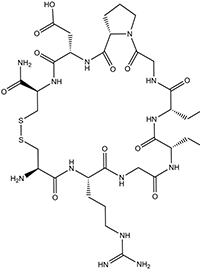
Peptides containing an arginine-glycine-aspartic acid (RGD) motif (RGD peptides) are known to recognize and bind to the integrin receptors. A disulfide-based cyclic RGD peptide, c(CRGDKGPDC) (iRGD), which interacts with the integrin and neurophilin-1 receptors, was shown to facilitate deeper penetration of imaging agents and anticancer medicines compared with the original RGD peptide. |
Scientific Background | Cyclo RGD peptide, CRGDKGPDC-NH2, disulfide bridges:C1-C9, iRGD is a 9-residue synthetic peptide with the sequence Cys-Arg-Gly-Asp-Lys-Gly-Pro-Asp-Cys. C-terminal amidation removes the terminal carboxylate charge. The sequence contains 2 cysteine residues, providing potential thiol/disulfide chemistry when the thiol is available. These sequence-derived properties describe the reagent chemically; no specific receptor, enzyme, pathway, disease association, or biological activity is assigned without product-specific experimental evidence. |
Research Applications | - thiol-selective conjugation or immobilization studies
- LC-MS/HPLC analytical method development
- sequence-specific assay controls
|
Experimental Notes | Sequence-derived chemical properties support reagent selection and experimental planning but do not establish biological function. Solubility, aggregation, adsorption, conjugation efficiency, and assay performance should be validated under the intended experimental conditions. |