


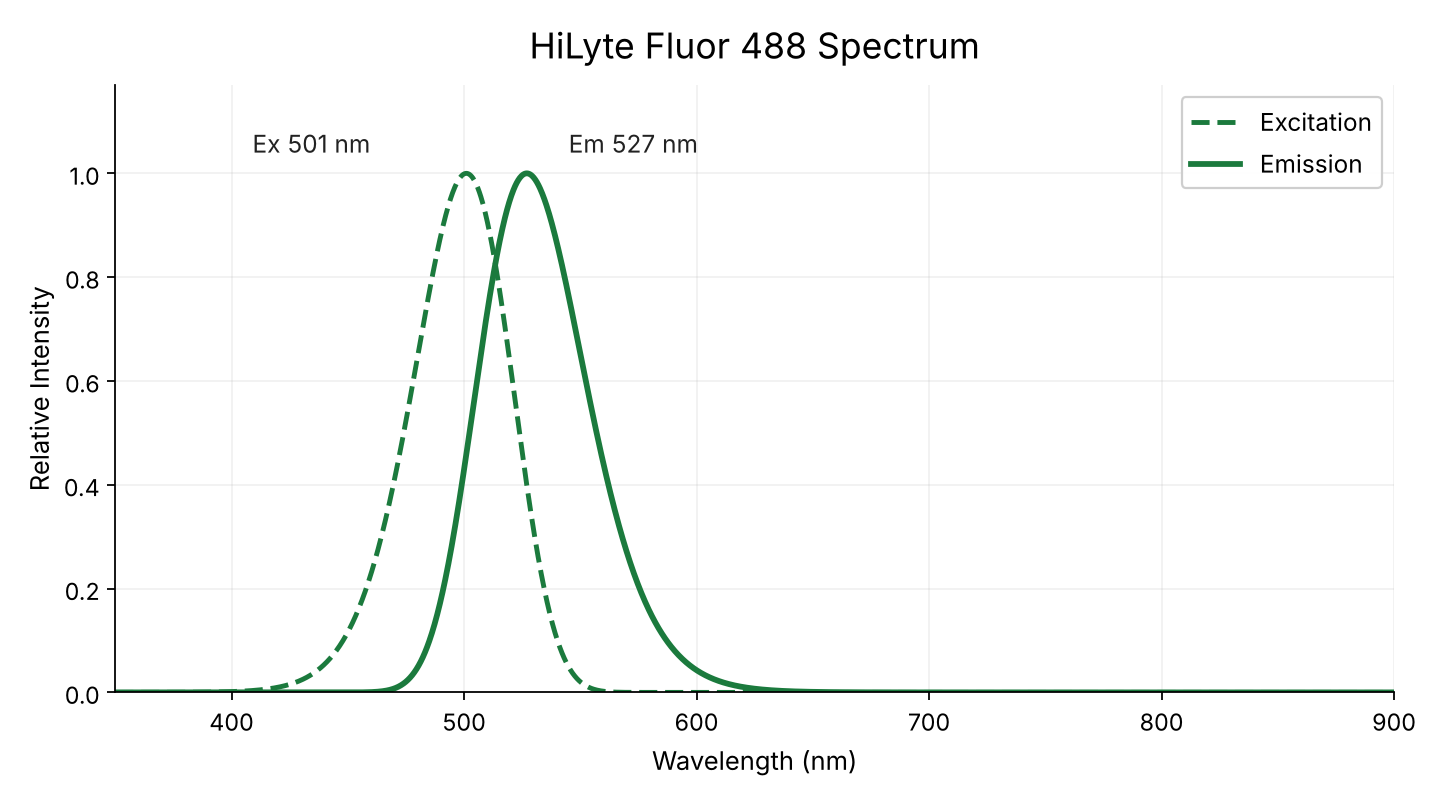
HiLyte Fluor 488 is a green label for the 488 nm line, reported with excitation and emission maxima near 501 and 527 nm.3 It is an alternative to fluorescein in the same channel, with better photostability and less pH sensitivity than FITC or FAM.
| Excitation maximum | 501 nm |
| Emission maximum | 527 nm |
| Laser line | 488 nm |
| Dye class | Fluorescein-channel dye |
| Excitation / emission | About 501 / 527 nm3 |
| Filter set | Standard FITC or GFP configuration |
| Reactive form | NHS ester (succinimidyl ester); maleimide for cysteine |
| Linkage | Amide, or thioether to cysteine |
| Why it is chosen | Green channel without fluorescein's pH behaviour |
The reason to move off fluorescein in the green channel is almost always pH or photobleaching rather than wavelength. HiLyte Fluor 488 keeps the channel and the filter set while reducing both, which makes it a drop-in substitution in an established assay rather than a redesign.
In practice the green channel offers a cost ladder rather than a single right answer: FITC and FAM are the economical options, HiLyte Fluor 488 and ATTO 488 sit in the middle, and Alexa Fluor 488 is the most characterised and the most expensive. Which is correct depends on whether the experiment is limited by budget, by pH, or by photobleaching.
Published maxima differ slightly between sources, with some quoting 497/525 nm and others 501/527 nm.3,4 The difference is immaterial on a standard FITC filter set but worth noting if filters are being chosen narrowly.
| Situation | Choice | Why |
|---|---|---|
| Green channel, existing FITC filters | HiLyte Fluor 488 | Same channel, less pH dependence than fluorescein |
| Lowest cost green label | FITC or FAM | Adequate for endpoint work at neutral pH |
| Best characterised green dye | Alexa Fluor 488 | pH 4-10 flat, brightest and most photostable2 |
| FRET donor | FAM with TAMRA | The established donor-acceptor pair for peptide substrates |
Tell us what the peptide has to do in the assay as well as its sequence. Where the dye sits often matters more to the result than which dye it is, and a label placed in a binding motif can remove the activity being measured.