


Alexa Fluor 488 occupies the same channel as FITC and FAM, with excitation and emission maxima of 495 and 519 nm, but it answers both of fluorescein's weaknesses: conjugates are brighter and more photostable, and the fluorescence is insensitive to pH between 4 and 10.2
| Excitation maximum | 495 nm |
| Emission maximum | 519 nm |
| Laser line | 488 nm |
| Dye class | Sulfonated rhodamine |
| Excitation / emission | 495 / 519 nm — essentially the same as fluorescein2 |
| Filter set | Any FITC or GFP configuration |
| Reactive form | NHS ester; maleimide for cysteine |
| pH dependence | Insensitive between pH 4 and 102 |
| Relative to fluorescein | Brighter and more photostable conjugates2 |
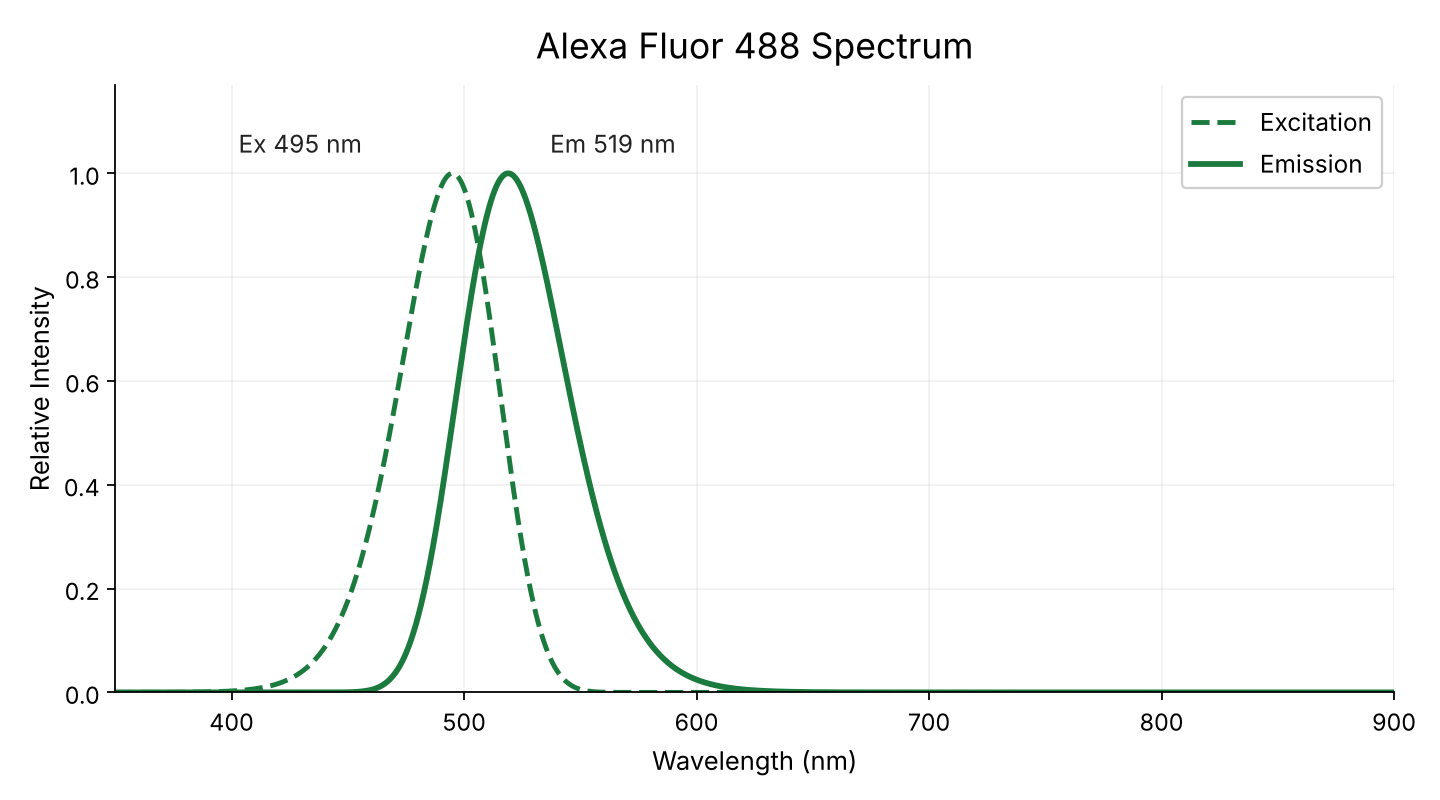
Fluorescein is dim below pH 7 because of its ionisable phenol, with a pKa of 6.4, and it photobleaches relatively quickly.1 Alexa Fluor 488 was designed as a fluorescein substitute and removes both problems while keeping the spectra, so no change of filter set or laser is needed.2 If a green peptide label has previously given a signal that drifted with buffer pH or faded during acquisition, this is the substitution to make.
This is the case where the choice is not a refinement. A cell-penetrating peptide taken up by endocytosis ends up in compartments well below pH 7. A fluorescein label loses signal there whether or not the peptide is still present, so a fall in fluorescence cannot be read as the peptide leaving. Alexa Fluor 488 is flat across that range, so what is measured is location rather than pH.2
It is more expensive than FITC or FAM, which is the honest reason most routine green labeling still uses a fluorescein. For an endpoint read at neutral pH, the cheaper dye gives the same answer. The case for Alexa Fluor 488 is quantitative imaging, long acquisitions, and anything involving acidic compartments.
| Situation | Choice | Why |
|---|---|---|
| Endpoint flow cytometry at neutral pH | FITC or FAM | Same channel at lower cost; the difference will not show |
| Endosomal or lysosomal tracking | Alexa Fluor 488 | Flat response from pH 4 to 102 |
| Quantitative or time-lapse imaging | Alexa Fluor 488 | Brighter and more photostable conjugates2 |
| Peptide to be stored for months | Alexa Fluor 488 or FAM | Amide linkage; avoids the FITC thiourea route3 |
Tell us what the peptide has to do in the assay as well as its sequence. Where the dye sits often matters more to the result than which dye it is, and a label placed in a binding motif can remove the activity being measured.