
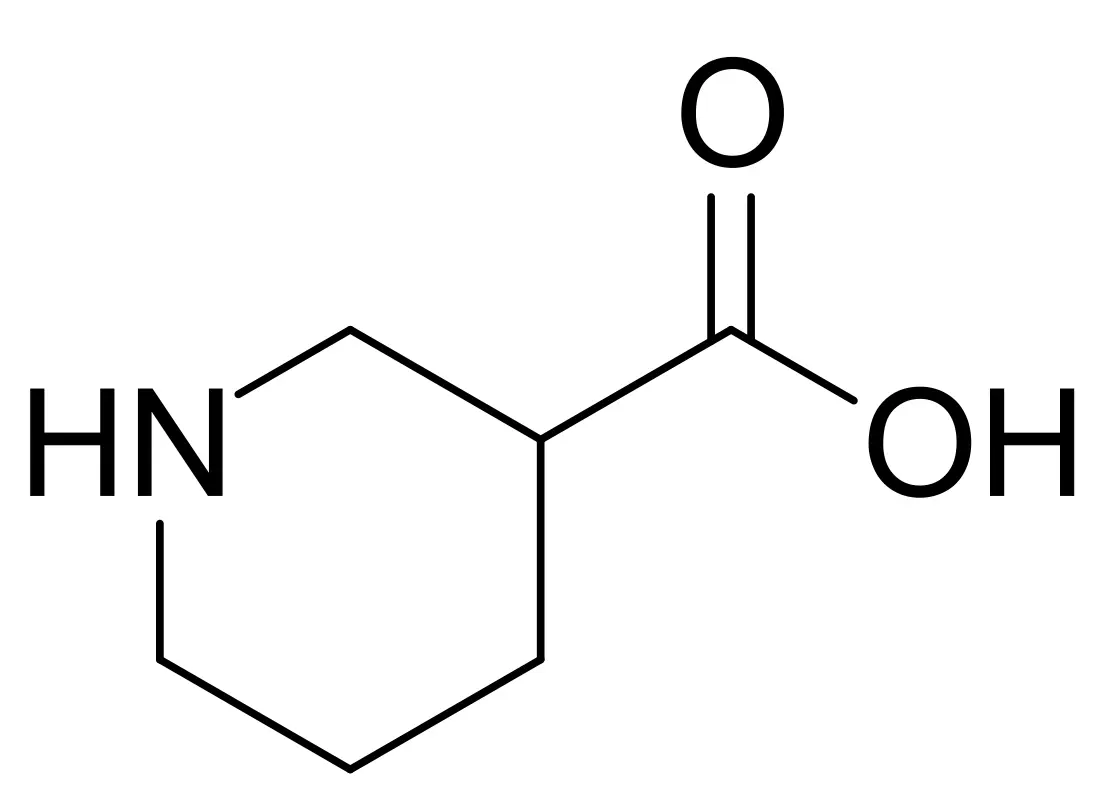
ipecotic acid (Nip) is a fascinating non-proteinogenic cyclic β-amino acid that has garnered significant interest in medicinal chemistry and peptide science. Defined as piperidine-3-carboxylic acid, this unusual amino acid features a six-membered saturated ring that incorporates both a secondary amine and a carboxylic acid functional group. Its unique structural architecture distinguishes it from the more well-known pipecolic acid, as the carboxylic acid group is positioned at the C3 position of the piperidine ring rather than at C2. This subtle yet critical positional difference endows Nipecotic acid with distinct conformational properties and biological activities, making it a valuable tool for peptide chemists and drug developers alike.
Key Takeaways
- Nipecotic acid (Nip) is a non-proteinogenic cyclic β-amino acid defined as piperidine-3-carboxylic acid, with the molecular formula C₆H₁₁NO₂.
- Its six-membered piperidine ring with the carboxylic acid at the C3 position provides a unique balance between conformational rigidity and functional versatility, making it attractive for the synthesis of diverse bioactive scaffolds.
- Nipecotic acid acts as a potent in vitro inhibitor of neuronal and glial GABA uptake, acting as a competitive inhibitor of GABA transporters and serving as a substrate for these transport carriers.
- In peptide synthesis, Nipecotic acid is incorporated as a building block using Fmoc- or Boc-protected derivatives, enabling the construction of β-peptide oligomers with distinct secondary structural preferences.
- Beyond its role as a GABA uptake inhibitor, Nip serves as a valuable precursor in the synthesis of CNS-active agents and as a versatile scaffold for fragment-based drug discovery.
Chemical Fundamentals of Nipecotic Acid
Structural Characteristics and Isomeric Forms
Nipecotic acid is formally defined as a piperidinemonocarboxylic acid where the carboxylic acid group is attached at the 3-position of the piperidine ring. The compound features a six-membered saturated ring containing one nitrogen atom, providing a rigid scaffold that influences the orientation of the carboxylic acid relative to the ring. The molecular formula is C₆H₁₁NO₂, with a molecular weight of 129.16 g/mol. The compound exists as a white to off-white crystalline solid at room temperature and is typically odorless.
Importantly, Nipecotic acid exists in two enantiomeric forms: (R)-nipecotic acid and (S)-nipecotic acid. The racemic mixture (RS)-nipecotic acid is often used in research applications. The stereochemistry at the C3 position significantly influences both the biological activity and the conformational behavior of peptides incorporating this residue. The compound has a logP of 0.071 and contains two hydrogen bond donors and two hydrogen bond acceptors, making it moderately hydrophilic and suitable for use in aqueous biological systems.
Find out more about peptide synthesis here.
Nipecotic Acid in the Context of Piperidine-Based Amino Acids
Nipecotic acid belongs to a family of piperidine-based amino acids that also includes pipecolic acid (piperidine-2-carboxylic acid) and isonipecotic acid (piperidine-4-carboxylic acid). Each of these positional isomers provides unique spatial and electronic properties. Pipecolic acid introduces a cyclic constraint that stabilizes secondary structures in peptides and modulates parameters such as lipophilicity and hydrogen bonding. Nipecotic and homonipecotic acids, with variations in chain length, enable fine-tuning of molecular flexibility, polarity, and binding affinity to biological targets. The piperidine ring allows selective substitution at multiple positions, extended by variations in stereochemistry and different patterns of protecting groups, facilitating targeted modulation of pharmacokinetic behavior and receptor selectivity.
Nipecotic Acid in Peptide Synthesis
Incorporation into Peptide Sequences
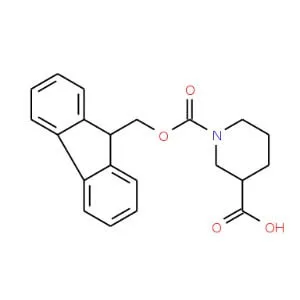
The incorporation of Nipecotic acid into synthetic peptides requires specialized protected derivatives, typically Fmoc- or Boc-protected nipecotic acid building blocks. Common commercially available derivatives include (R)-Boc-Nip-OH, (S)-Fmoc-HNip-OH, and branched derivatives such as (R)-Fmoc-Nip(3-Bzl)-OH. These protected monomers are essential for solid-phase peptide synthesis (SPPS), where the carboxylic acid group is activated for coupling to the growing peptide chain.
The synthesis of protected nipecotic acid monomers has been described in the literature, beginning with a resolution via co-crystallization with camphorsulfonic acid (CSA). The amino group is then protected as the tert-butyl carbamate (Boc), and the carboxyl group is protected as the benzyl ester (OBn). This approach yields Boc-(S)-Nip-OBn or Boc-(R)-Nip-OBn, which serve as building blocks for the synthesis of nipecotic acid oligomers.
Oligomerization and Secondary Structure Formation
Homooligomers of (S)-nipecotic acid have been studied by circular dichroism (CD) in methanol, revealing that these β-peptide oligomers exhibit distinct secondary structural preferences. Importantly, these structures are not stabilized by hydrogen bonds, representing a unique class of non-hydrogen-bonded secondary structures. This property makes Nipecotic acid oligomers valuable tools for studying the fundamental principles of peptide folding and for designing novel peptidomimetics with controlled three-dimensional architectures.
Applications in Peptidomimetic Design
Nipecotic acid has been successfully employed in the design of β-turn peptide mimetics. In one notable application, a series of β-turn peptide mimetics with a nipecotic acid heterocyclic scaffold was designed based on NMR analysis of the C-terminal γ-chain of fibrinogen. This work led to the development of potent GPIIb/IIIa (fibrinogen receptor) antagonists, demonstrating the value of Nipecotic acid as a conformationally constrained scaffold in drug discovery.
Chemical modifications of Nipecotic acid span multiple synthetic routes, including N-acylation, amide coupling (to enable incorporation into peptidomimetics), halogenation, and side-chain derivatization to expand electronic diversity. The modular nature of Nipecotic acid also makes it integral to fragment-based drug discovery and scaffold hopping strategies.
Biological Significance and Pharmacological Activity
Interaction with the GABAergic System
One of the most extensively studied biological activities of Nipecotic acid is its role as a potent inhibitor of γ-aminobutyric acid (GABA) uptake. GABA is the primary inhibitory neurotransmitter in the mammalian central nervous system, and its signaling is terminated by reuptake via specific GABA transporters (GATs). Nipecotic acid acts as a competitive inhibitor of the GABA transporter GAT-1, binding to the same site as GABA and blocking its reuptake.
The mechanism of action is believed to be competitive inhibition of the GABA transporter, with the GABA-bound structure revealing an interaction network bridged by hydrogen bonds and ion coordination for GABA recognition. In the presence of GABA or nipecotic acid, inward-occluded structures are captured, providing molecular insight into substrate recognition.
Structure-Activity Relationships
Extensive research has explored derivatives of Nipecotic acid to optimize GABA uptake inhibition. For instance, cis-4-hydroxynipecotic acid is known as a potent inhibitor of GABA uptake. Additionally, N-allenic spacer derivatives of nipecotic acid have been synthesized and evaluated as potential GABA uptake inhibitors. Another structurally related cyclic amino acid, guvacine, also acts as a GABA uptake inhibitor. These structure-activity relationship studies have guided the development of more selective and potent GABA transporter inhibitors for potential therapeutic applications.
Applications in CNS Drug Discovery
Nipecotic acid is a key synthetic intermediate in the production of central nervous system (CNS) agents, including anticonvulsants. For example, (R)-nipecotic acid moieties have been incorporated into compounds that are very active in inhibiting GABA reuptake, showing possible usage for analgesic chemotherapeutic treatment. The ability of Nipecotic acid derivatives to modify GABAergic neurotransmission in the CNS has positioned them as valuable tools for studying neurological disorders such as epilepsy, anxiety, and neuropathic pain.
Find out about high-speed RUSH synthesis.
Frequently Asked Questions (FAQ)
What is the difference between pipecolic acid and nipecotic acid?
Pipecolic acid (piperidine-2-carboxylic acid) has the carboxylic acid group attached at the C2 position of the piperidine ring, whereas nipecotic acid has the carboxylic acid group at the C3 position. This positional difference profoundly influences the conformational properties and biological activities of the two compounds, with pipecolic acid being a natural metabolite of lysine and nipecotic acid exhibiting potent GABA uptake inhibition.
Can Nipecotic acid be incorporated into synthetic peptides?
Yes, Nipecotic acid can be incorporated into peptides using solid-phase peptide synthesis (SPPS) with commercially available Fmoc- or Boc-protected derivatives. Common building blocks include (R)-Boc-Nip-OH and (S)-Fmoc-HNip-OH. The incorporation of Nip residues enables the construction of β-peptide oligomers and conformationally constrained peptidomimetics.
What is the primary biological activity of Nipecotic acid?
Nipecotic acid is a potent inhibitor of GABA uptake at neuronal and glial GABA transporters (GAT-1). It acts as a competitive inhibitor, binding to the same site as GABA and blocking its reuptake, thereby prolonging GABAergic signaling. It is also transported across the membrane as a substrate for the GABA transporter.
Are there natural sources of Nipecotic acid?
While primarily prepared synthetically, trace amounts of Nipecotic acid have been identified in certain marine organisms and plant species, such as some alkaloid-producing plants. The compound was first synthesized in the early 20th century during investigations into piperidine-based derivatives.
Where can I obtain Nipecotic acid-containing peptides for research?
Specialized custom peptide synthesis providers, including LifeTein, offer expertise in the synthesis of peptides containing Nipecotic acid and other unusual amino acids. Their services typically include a broad range of special amino acids and peptide modifications that can improve peptide stability, enhance binding selectivity, support structure-function studies, enable detection, or introduce chemical handles for downstream conjugation. Researchers should consult with their preferred provider to confirm the availability of specific Nip derivatives and to ensure appropriate synthetic strategies are employed.
References
Schaarschmidt, M. (2019). Synthesis and biological evaluation of nipecotic acid and guvacine derivatives with N-allenic spacers as potential GABA uptake inhibitors [Ludwig-Maximilians-Universität München]. https://doi.org/10.5282/EDOC.24367
Hoekstra, W. J., Maryanoff, B. E., Andrade-Gordon, P., Cohen, J. H., Costanzo, M. J., Damiano, B. P., Haertlein, B. J., Harris, B. D., Kauffman, J. A., Keane, P. M., McComsey, D. F., Villani, F. J., Jr., & Yabut, S. C. (1996). Solid-phase parallel synthesis applied to lead optimization: Discovery of potent analogues of the GPIIb/IIIa antagonist RWJ-50042. Bioorganic & Medicinal Chemistry Letters, 6(20), 2371–2376. https://doi.org/10.1016/0960-894x(96)00438-6