




Peptide–oligonucleotide conjugates are hybrid molecules in which a peptide domain is covalently linked to a nucleic acid component. These constructs are useful for delivery, uptake enhancement, targeting, intracellular trafficking, imaging, and related functional studies involving DNA, RNA, PMO, PNA, or other oligonucleotide-like systems.
Because peptides and oligonucleotides have very different chemical properties, the conjugation route often has to be chosen carefully. In many cases, direct linear synthesis of the full construct is impractical, and a post-synthetic ligation strategy is more realistic. LifeTein supports these projects using click-compatible and site-selective conjugation workflows.
| DNA–peptide | For delivery, capture, labeling, and diagnostic or screening workflows |
| RNA–peptide | Including modified RNA formats suitable for improved stability in research use |
| PMO–peptide | For delivery-oriented and functional screening projects |
| PNA–peptide | For stronger hybridization, delivery concepts, and advanced hybrid constructs |
| CPP–oligo | Cell-penetrating or localization-focused peptide domains attached to oligonucleotide payloads |
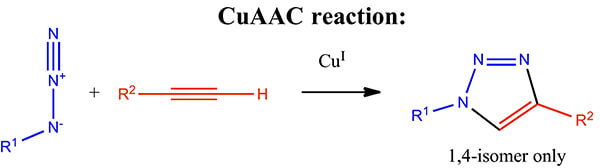
For many projects, click-compatible ligation is used after the peptide and oligonucleotide components are prepared separately. This is especially useful when the oligonucleotide is already modified with a suitable azide, alkyne, DBCO, tetrazine, or related handle. The exact chemistry depends on the construct architecture and whether copper-free or highly orthogonal ligation is preferred.
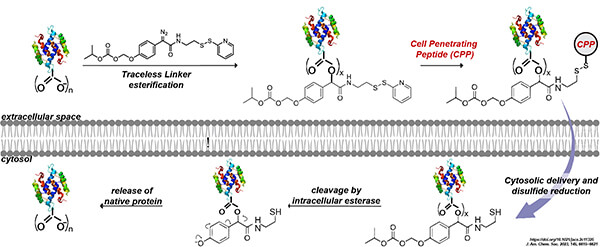
Linear Peptide–Oligonucleotide Conjugates
These include DNA–peptide, RNA–peptide, PNA–peptide, and PMO–peptide constructs used in cell screening, delivery research, and related in vitro or in vivo studies.
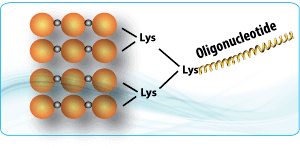
Multiple Antigenic Peptide–Oligonucleotide Conjugates
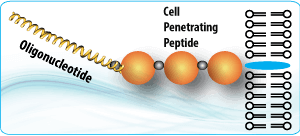
Cell-Permeable Peptide–Oligonucleotide Conjugates
Cell-penetrating peptides or peptides of choice can be conjugated to an oligonucleotide for drug-carrier and delivery-related applications.
Sample Data
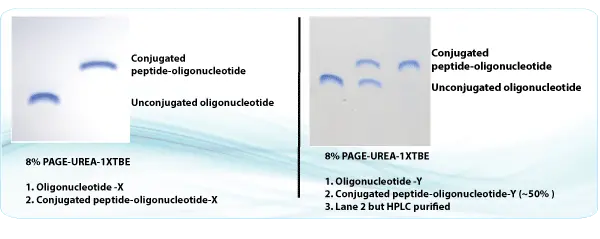
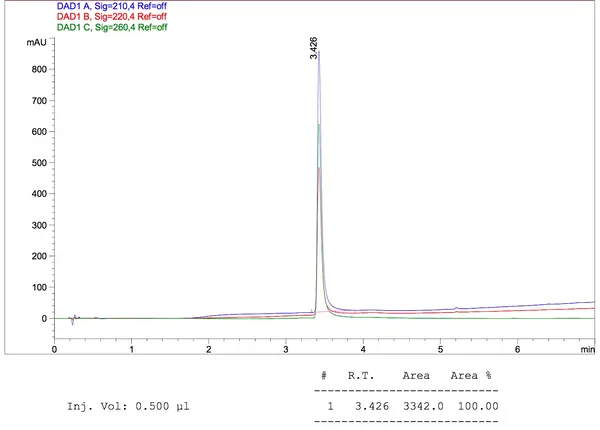
Need to discuss an oligo conjugation format?
We can review peptide–DNA, peptide–RNA, peptide–PNA, PMO–peptide, and CPP–oligo projects and help identify a practical ligation strategy.
Need a formal quotation?
