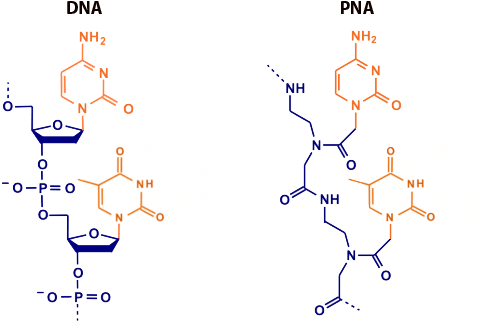
Peptide nucleic acids (PNAs) are synthetic DNA/RNA analogs in which the nucleobases are attached to a neutral polyamide backbone rather than a sugar-phosphate backbone. Because of this structure, PNAs can bind DNA or RNA targets strongly and sequence-specifically, while offering high resistance to nucleases and proteases.
LifeTein supports both standard PNA oligomer synthesis and more advanced PNA formats, including peptide–PNA conjugates, fluorescently labeled PNAs, click-ready constructs, and modified monomer designs for research, diagnostic, and delivery-related applications.
| Core formats | PNA oligomers, labeled PNAs, peptide–PNA conjugates, PNA FISH probes, and advanced functionalized constructs |
| Typical applications | Antisense studies, antigene strategies, PCR clamping, FISH probes, imaging, biosensors, and targeted delivery research |
| Available modifications | Fluorophores, quenchers, biotin, click handles, linkers, lipidation, peptide conjugation, and selected custom monomers |
| Advanced capability | CPP-PNA designs, pseudoisocytosine-containing constructs, dual-domain PNA designs, and click-ready azido/alkyne handles |
| Project support | Sequence review, solubility guidance, linker suggestions, and design discussion for specialized PNA applications |
For a broader decision guide, see When to Use PNA Instead of DNA or RNA.
Working out whether PNA fits your experiment? Our PNA Knowledge Center holds technical articles on each application, written for people designing a probe rather than browsing a catalogue:
LifeTein provides custom PNA oligo design, labeling, and conjugation, including unlabeled PNA oligomers, fluorescently labeled PNAs, peptide–PNA conjugates, and other specialized formats. Available labels and functional groups include fluorophores such as FAM, FITC, Alexa Fluor dyes, ATTO dyes, and cyanine dyes (Cy3, Cy5, Cy7); quenchers such as BHQ and Dabcyl; as well as biotin, maleimide, azide, alkyne handles, lipidation, and other custom modifications.
Excitation and emission maxima depend on solvent, pH and the conjugate itself, so treat the figures below as nominal values for selecting a filter set rather than as measurements for a specific construct.
| Dye | Ex (nm) | Em (nm) | MW | Notes |
|---|---|---|---|---|
| Alexa Fluor 488 | 490 | 525 | 699.7 | Bright, photostable, pH-insensitive over the usual working range |
| FITC or FAM | 495 | 519 | 389 | pH sensitive; signal falls in acidic compartments |
| Cyanine Cy2 | 492 | 510 | — | Green channel alternative to fluorescein |
| Cyanine Cy3 | 550 | 570 | — | Common FISH and FRET donor |
| Alexa Fluor 555 | 555 | 580 | 534.5 | Orange channel, good photostability |
| Rhodamine B | 570 | 590 | — | Classic orange-red fluorophore |
| Abberior STAR 635 | 635 | 655 | 911 | Suitable for STED and confocal imaging |
| Cyanine Cy5 | 650 | 670 | — | Far-red channel; low tissue autofluorescence |
| Silicon rhodamine (SiR) | 652 | 674 | 472.6 | Cell-permeable, used in multicolour live-cell imaging |
Choosing a dye is only part of the decision. Whether the probe needs one label, a fluorophore and quencher pair, or a dye built into the sequence depends on how it reports binding — and a guanine next to the label will cost you signal. See labelling PNA: fluorophores and quenchers.
These constraints matter most once the material is in your hands: see dissolving, storing and checking PNA for how to get a difficult sequence into solution and how to determine its concentration correctly.
For stocked or semi-standard examples, see PNA probes, inhibitors, and selected products.
| PMP01-25 | Peptide nucleic acid (PNA) PMP01-25: {GGCAAGTCTTCTTCGGA}-NH2 | $350, 50 nmol, In Stock |
| APP01-25 | Peptide nucleic acid (PNA) APP01-25: {GGCTCAACTCTGGACAG}-NH2 | $350, 50 nmol, In Stock |
| EcoPNA1169 | Peptide nucleic acid (PNA) EcoPNA1169: Biotin-{CAACACACAGTGTC} | $350, 50 nmol, In Stock |
| LT8195 | (KFF)3K-PNA: KFFKFFKFFK-CTCATACTCT | $450, 25 nmol, In Stock |
| Peptide-Conjugated Antisense PNA | (RXR)4XB-{O}-{gccatttgac} | $450, 50 nmol, In Stock |
| TelC telomere probe | CCCTAACCCTAACCCTAA; reverse complementary sequence: TTAGGGTTAGGGTTAGGG |
| TelG telomere probe | TTAGGGTTAGGGTTAGGG; reverse complementary sequence: CCCTAACCCTAACCCTAA |
| Pan-centromere CENPB probe | ATTCGTTGGAAACGGGA; reverse complementary sequence: TCCCGTTTCCAACGAAT |
| Human-only pan-centromere CENT probe | AAACTAGACAGAAGCATT; reverse complementary sequence: AATGCTTCTGTCTAGTTT |
Technical background for these probe types: measuring telomere length by PNA FISH, chromosome enumeration with centromere probes, identifying bacteria by PNA FISH, and hybridisation and wash conditions.
CPP |
Sequence |
Pen | RQIKIWFQNRRMKWKK-PNA |
Tat | GRKKRRQRRRPPQ-PNA |
47Tat57 | GGGGYGRKKRRQRRR-PNA |
Cationic | KKKK-PNA |
Lys | K-PNA-KKK |
Arg | RRRRRRRR-PNA |
H region | AAVALLPAVLLALLA-PNA |
PTD-4 | YARAAARQARA-PNA |
Tp-10 | AGYLLGKINLKALAALAKKIL-PNA |
SSBP(I) | PKKKRKV-PNA |
C-myc tag | EQKLISEEDLNA-PNA |
Tat-modified | RRRQRRKKR-PNA |
Which carrier to use depends on the target cell rather than the PNA sequence, and getting the conjugate across the membrane is not the same as getting it out of the endosome. See CPP–PNA conjugate design and endosomal escape for PNA conjugates.
To illustrate the complexity of our PNA platform, the following anonymized construct represents a confidential PNA–peptide conjugate format:
H-PKKKRKVKK-{TxJTxxJJ}-linker-{CxxxTCxxxT}-x-K(N₃)-NH₂
Key features of this construct
Background on the two chemistries in this construct: pseudoisocytosine and PNA triplex stability and click chemistry on PNA.
Application relevance
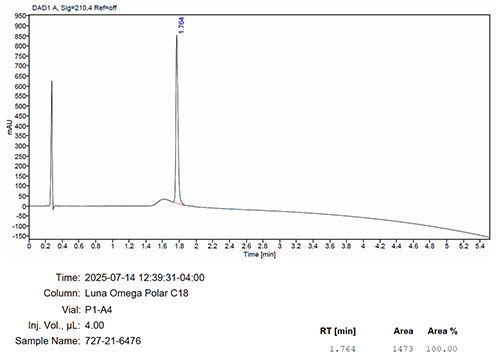
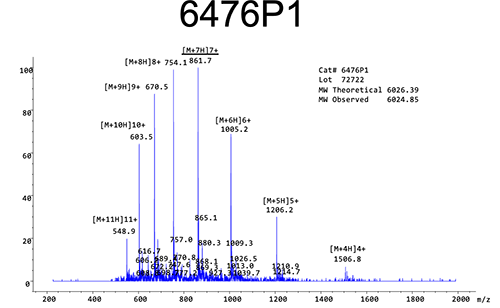
This case study shows a PNA synthesis with a fluorescent Cyanine Dye Cy5 modification at the N-terminus and an azido group at the C-terminus for downstream click chemistry.
Cys(Cy5)-{XXXXXX}-Lys(N3)-NH2, where X represents A, T, G, or C monomers. Fmoc-Lys(N3)-OH was used to introduce a side-chain azido group that remains suitable for selective downstream modification.
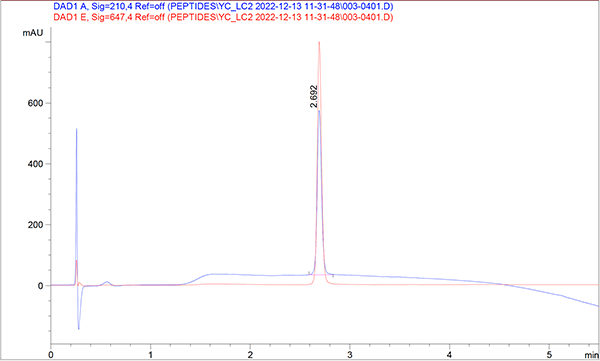
On choosing the label and the click handle for a construct like this, see labelling PNA and click chemistry on PNA, which covers whether to click on the resin or after cleavage.
You can contact us about sequence design, labels, peptide conjugation, click handles, solubility, or other PNA-specific requirements.
Need a formal quotation? Please use the online quote form below.
For the full index of our PNA technical articles, organised by application, see the PNA Knowledge Center.
Need help planning a PNA project?
We are happy to review standard PNA oligomers, peptide–PNA conjugates, fluorescent PNA probes, CPP-PNA constructs, and other advanced formats.