



This service covers advanced research concepts at the intersection of peptide nucleic acids (PNAs), RNA-cleaving DNAzymes, and PNA-assisted target recognition. It is not intended as a standard off-the-shelf product. Instead, it outlines research-use concepts that may be relevant for specialized custom synthesis or feasibility discussions.
| 8-17 DNAzyme | An established RNA-cleaving DNAzyme with a catalytic DNA core and target-binding arms |
| 10-23 DNAzyme | An established RNA-cleaving DNAzyme known for target-selective RNA cleavage at suitable junctions |
| PANDA systems | PNA-assisted DNAzyme systems that use PNA “openers” to expose regions of duplex DNA for downstream nicking or cleavage |
| PNAzyme concepts | Advanced artificial nuclease concepts in which a PNA recognition element is combined with a catalytic moiety or cleavage strategy |
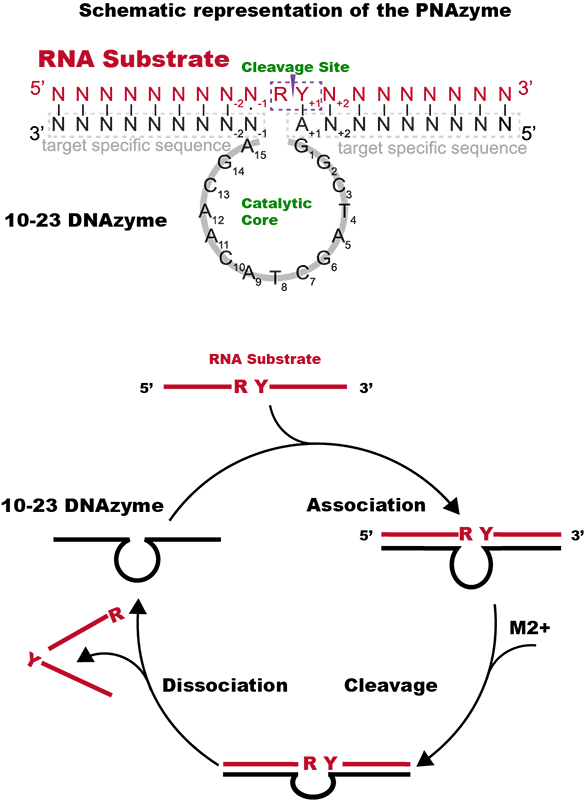
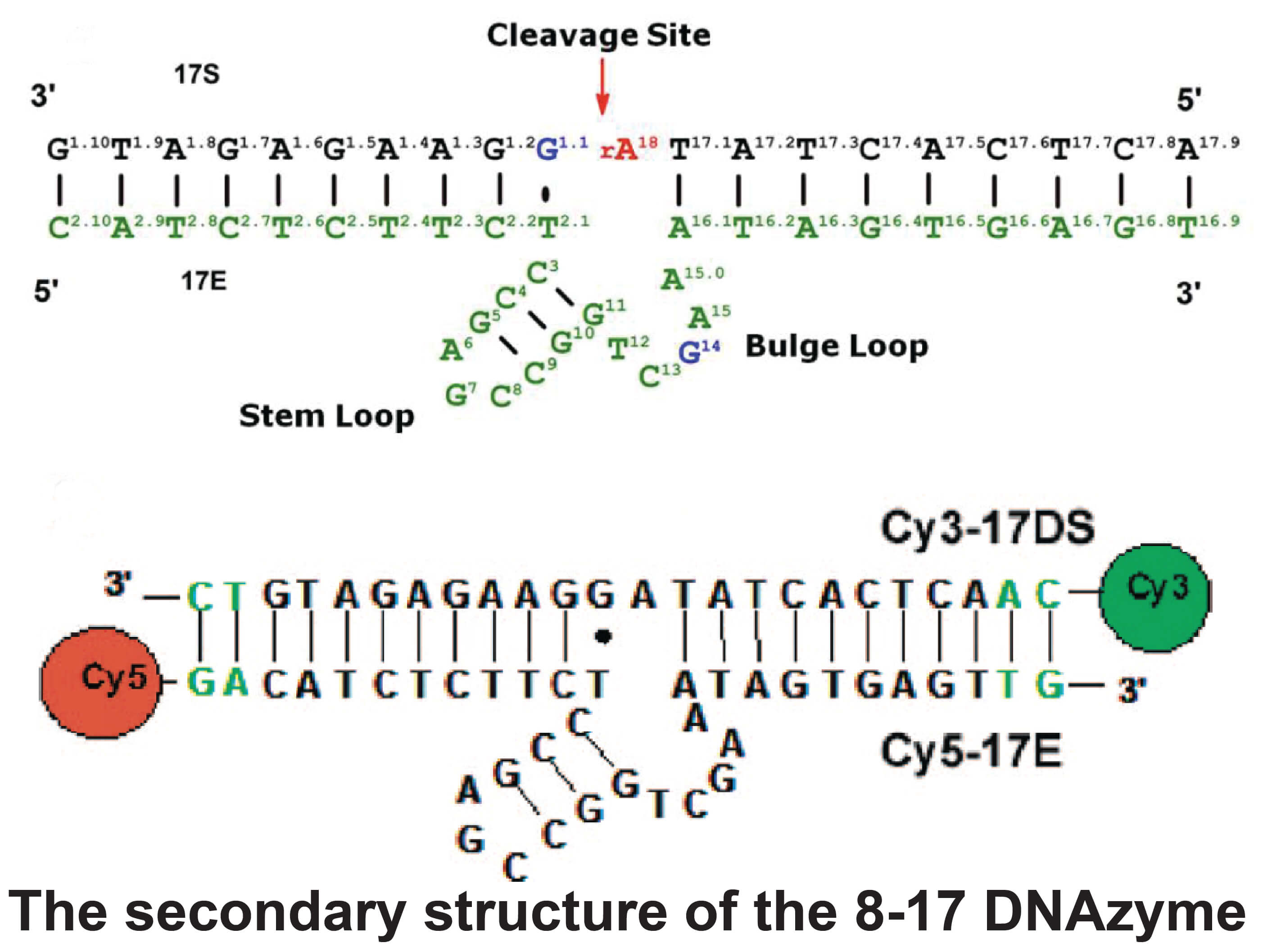
The 8-17 and 10-23 DNAzymes are two of the most widely discussed catalytic DNA molecules for sequence-selective RNA cleavage. In both cases, the catalytic DNA core is flanked by substrate-recognition arms that are designed to hybridize with a target RNA sequence. These systems are most appropriately understood as RNA-cleaving DNAzymes rather than as PNAs.
The 8-17 DNAzyme is a well-studied catalytic motif with broad relevance in nucleic acid catalysis, while the 10-23 DNAzyme is often discussed in gene-regulation and therapeutic research because of its target-selective RNA-cleavage behavior.
Schematic representation of the 10-23 DNAzyme
Schematic representation of the 8-17 DNAzyme
A separate concept uses PNA “openers” to invade or destabilize a selected duplex DNA region, exposing a local single-stranded target that can then be recognized by another cleavage-capable system. Published PANDA-style systems illustrate how PNA-assisted target opening can be paired with DNAzyme-based nicking or cleavage logic for highly specialized DNA manipulation workflows.
This is conceptually different from classical 8-17 or 10-23 RNA-cleaving DNAzymes. The role of PNA in such systems is not to replace the catalytic DNAzyme core, but to provide strong and selective target-opening behavior on duplex nucleic acid substrates.
The term “PNAzyme” is generally used for advanced artificial ribonuclease concepts that combine a PNA recognition element with a catalytic functionality. In the literature, this often refers to PNA-based constructs that induce or catalyze RNA cleavage through metal-chelating or other engineered catalytic designs, rather than simply meaning 8-17 or 10-23 DNAzymes.
From a custom synthesis standpoint, these concepts are relevant because they may require:
LifeTein can support projects involving PNA synthesis, peptide–PNA conjugates, fluorescent PNA probes, click-ready PNA formats, and related custom constructs used in advanced nucleic acid research. Depending on the project, that support may include modified PNA monomers, peptide delivery domains, azido or alkyne handles, and other research-use features.
For standard PNA synthesis and conjugation, see our main PNA page. For design guidance, see custom PNA oligo design, labeling, and conjugation. For a broader decision guide, see When to Use PNA Instead of DNA or RNA.
Working on a PNA-assisted DNAzyme concept?
We are happy to discuss custom PNA synthesis, PNA–peptide constructs, modified monomers, or specialized PNA-related research formats relevant to advanced DNAzyme or PNAzyme studies.