
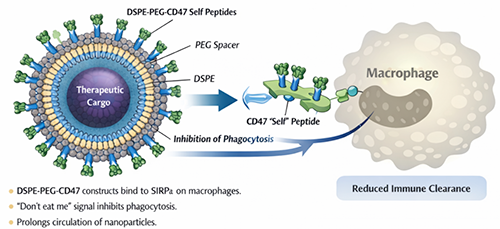
CD47-derived peptides are used in self-signaling, SIRPα binding, macrophage uptake reduction, and nanomedicine surface engineering. These formats are especially relevant for researchers studying the CD47–SIRPα axis as either an immune checkpoint pathway or a biomimetic stealth strategy for nanoparticles, liposomes, and related delivery systems.
The peptide sequence family built around GNYTCEVTELTREGETIIELK is commonly used as a CD47-derived self peptide. Depending on format, the same biological concept can be applied to binding studies, fluorescence imaging, nanoparticle decoration, or conjugation workflows.
| Native peptides | Mechanism studies, receptor binding, control peptide formats |
| FITC-labeled peptides | Imaging, flow cytometry, uptake studies, particle tracking |
| DSPE-PEG conjugates | Lipid nanoparticle and liposome stealth surface engineering |
| Conjugation-ready formats | Cys- or maleimide-bearing formats for nanoparticle or protein coupling |
| Product | Main Use | Link |
| CD47 peptide | General CD47/SIRPα pathway research | View Product |
| CD47 self peptide | Minimal self-peptide motif for receptor and nanoparticle studies | View Product |
| FITC-Ahx-CD47 peptide | Fluorescence-based binding and tracking studies | View Product |
| DSPE-PEG2000-CD47 self peptide | LNP and liposome stealth engineering | View Product |
Research Use Only. Not for human or therapeutic use.