



LifeTein provides custom synthesis services for difficult polyglutamine-rich peptides, repetitive peptides, and aggregation-prone long peptides. PolyQ-containing sequences are technically challenging because repeated glutamine residues can promote strong hydrogen bonding, resin aggregation, incomplete coupling, deletion impurities, and difficult purification.
Recent Capability Highlight
LifeTein successfully synthesized a confidential long repetitive peptide containing an extended polyglutamine region and an alanine-rich region. The full client sequence is not disclosed, but analytical HPLC and LC-MS data are shown below to demonstrate successful synthesis and characterization.
| Peptide type | Polyglutamine-rich peptides, repetitive peptides, long difficult peptides, aggregation-prone peptides |
| Representative challenge | Confidential peptide containing more than 20 consecutive glutamine residues and a repetitive alanine-rich region |
| Analytical confirmation | Purity analysis by analytical RP-HPLC and molecular weight confirmation by LC-MS |
| Applications | Huntington's disease research, spinocerebellar ataxia research, protein aggregation studies, intrinsically disordered protein research, and synthetic repetitive protein models |
| Confidentiality | LifeTein supports confidential client projects and can present analytical data without disclosing proprietary sequences |
Polyglutamine, also known as PolyQ, refers to a sequence region containing multiple consecutive glutamine residues. These motifs are biologically important in neurodegenerative disease research, especially Huntington's disease and several spinocerebellar ataxias. In synthetic peptide manufacturing, however, long glutamine repeats can be very difficult to assemble and purify.
The difficulty is not only peptide length. A 60–80 amino acid peptide with a long repetitive Q-rich region may be more challenging than a longer peptide with a more balanced amino acid composition. During solid-phase peptide synthesis, repetitive glutamine residues can promote aggregation of the growing peptide chain on resin, reduce reagent access, and increase the risk of incomplete coupling and deletion products.
LifeTein recently completed a difficult custom synthesis project involving a long repetitive peptide with a polyglutamine-rich segment and an alanine-rich segment. To protect client confidentiality, the complete peptide sequence is not shown. Instead, the key technical features and analytical results are provided.
| Sequence disclosure | Confidential; full sequence not displayed |
| Approximate length | Long peptide, greater than 70 amino acids |
| Difficult region | Extended polyglutamine repeat region with more than 20 consecutive Q residues |
| Additional challenge | Repetitive alanine-rich region and sequence redundancy |
| Final QC | Analytical HPLC and LC-MS confirmation |
Confidentiality Note: The full peptide sequence is intentionally not shown. The sequence is described only by its general features, including a long polyQ tract and repetitive alanine-rich segment.
For difficult repetitive peptides, analytical confirmation is essential. Closely related deletion impurities can be difficult to separate, and the target product must be confirmed by both chromatographic purity and molecular weight analysis.
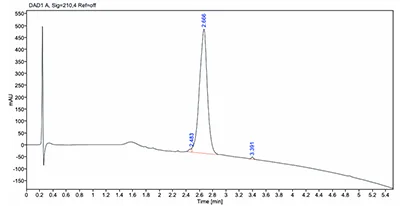
Analytical RP-HPLC profile of a confidential polyQ-rich repetitive peptide synthesized by LifeTein.
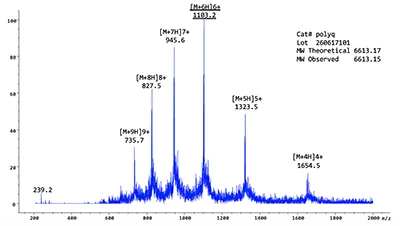
LC-MS analysis confirmed the expected molecular weight of the full-length target peptide.
Synthetic polyglutamine peptides are useful research tools for studying protein aggregation, neurodegenerative disease mechanisms, intrinsically disordered protein behavior, and repeat-sequence biology.
Every difficult sequence requires technical review. Depending on the peptide length, repeat structure, solubility, terminal modifications, and desired purity, LifeTein may adjust the synthesis and purification workflow to improve the chance of success.
PolyQ peptides are part of LifeTein's broader difficult peptide synthesis capabilities. We also support:
Need a quote for a difficult polyQ peptide?
Send us your sequence, desired purity, target quantity, terminal modifications, and intended application. LifeTein will review the synthesis risk and recommend a practical production strategy.
