Product Name | Recombinant Streptavidin (r-SA) |
Catalog Number | LT12009 |
Purity | ≥ 95% |
Packing Details | 10 mg |
Physical Appearance | Freeze-dried powder |
Mol. Wt. | 16.5 kDa |
Resources | Escherichia coli |
Activity | ≥ 12 U/mg protein (Determined by modified Green Method) |
Storage | -20°C |
Shelf Life | 3 years |
Images | 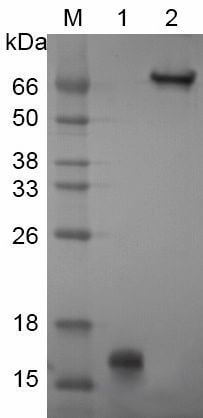
M: Protein Marker
Lane 1: Recombinant Streptavidin subunit
Lane2: Recombinant Streptavidin homotetramer |
Notes | It is recommended that the product is reconstituted with sterile water into a final concentration of 1 mg/ml. Store the reconstituted product in aliquots at -20°C. Avoid multiple freeze-thaw cycles and exposure to frequent changes in temperature.
The use of strong acids and bases, strong oxidants, and high concentrations of organic solvents should be avoided to prevent denaturation. |
Product Description | Streptavidin is a homotetrameric protein with a molecular weight of 55 kDa. It is found in the culture broth of Streptomyces avidinii. Like avidin, one mole of streptavidin can bind 4 moles of biotin with an affinity virtually unmatched in nature. Streptavidin lacks the carbohydrate side chains present in avidin and has an isoelectric point close to neutrality. For this reason, it undergoes less nonspecific binding than avidin. Streptavidin has been extensively applied in various biological applications, such as ELISA, IHC, TRFIA, quantitative PCR, isolation of single-stranded nucleotides, purification of biomolecules, and monoclonal antibody production. |
Scientific Background | Recombinant Streptavidin (r-SA) is a 12-residue synthetic peptide with the sequence Ser-Thr-Arg-Glu-Pro-Thr-Ala-Val-Ile-Asp-Ile-Asn. These sequence-derived properties describe the reagent chemically; no specific receptor, enzyme, pathway, disease association, or biological activity is assigned without product-specific experimental evidence. |
Research Applications | - LC-MS/HPLC analytical method development
- sequence-specific assay controls
|
Experimental Notes | Sequence-derived chemical properties support reagent selection and experimental planning but do not establish biological function. Solubility, aggregation, adsorption, conjugation efficiency, and assay performance should be validated under the intended experimental conditions. |