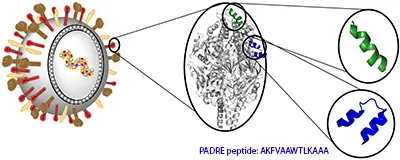
PADRE peptide AKFVAAWTLKAAA

Product Name
PADRE peptide AKFVAAWTLKAAA
Product Quantity
4mg
Catalog Number
LT8198
Molecular Weight
1347.63
Formula
C65H102N16O15
Sequence
AKFVAAWTLKAAA, Ala - Lys - Phe - Val - Ala - Ala - Trp - Thr - Leu - Lys - Ala - Ala - Ala
Purity
>95%
Product Description
PADRE Peptide AKFVAAWTLKAAA

The PADRE peptide (AKFVAAWTLKAAA) is a synthetic universal epitope designed to bind with high affinity to multiple MHC class II molecules, particularly HLA-DR, making it a powerful tool in immunotherapy and vaccine development.

As a Pan DR-binding epitope, PADRE is used to stimulate CD4+ T cells, initiating a strong immune response by enhancing antigen presentation to the immune system. Its ability to activate T cells and serve as an immune adjuvant has made it instrumental in the development of vaccines targeting infectious diseases and cancers.

PADRE's versatility lies in its ability to bind to 15 of the 16 most common HLA-DR alleles, overcoming the challenges posed by human MHC polymorphism. This peptide has been employed as an adjuvant in various therapeutic and prophylactic vaccines, increasing their potency by triggering innate immune responses, such as the activation of Toll-like receptors (TLRs).

As a result, PADRE enhances the effectiveness of vaccine formulations while allowing for large-scale production. Additionally, PADRE is being investigated for its role in cancer immunotherapy and the treatment of diseases such as toxoplasmosis in certain individuals with the HLA-A*03 allele.

Scientific Background

PADRE peptide AKFVAAWTLKAAA is a 13-residue synthetic peptide with the sequence Ala-Lys-Phe-Val-Ala-Ala-Trp-Thr-Leu-Lys-Ala-Ala-Ala. The sequence has a relatively high hydrophobic-residue fraction that can influence aqueous solubility and surface adsorption. These sequence-derived properties describe the reagent chemically; no specific receptor, enzyme, pathway, disease association, or biological activity is assigned without product-specific experimental evidence.

Research Applications
  • LC-MS/HPLC analytical method development
  • sequence-specific assay controls
Experimental Notes

Sequence-derived chemical properties support reagent selection and experimental planning but do not establish biological function. Solubility, aggregation, adsorption, conjugation efficiency, and assay performance should be validated under the intended experimental conditions.

  • -2 Units in Stock
Ask a Question

$250.00

Add to Cart: