Product Name | Nuclear receptor subfamily 1 group I member 2 |
Product Quantity | 50 ug |
Catalog Number | LTCY-0003 |
Expression System | SF9 Insect Cells |
Uniprot ID | O75469 |
QC |
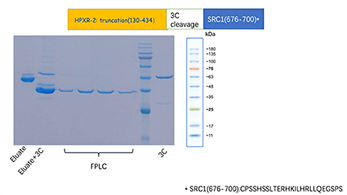
SDS-PAGE, FPLC profile, Crystallization trial tested |
Gene Source | Homo sapiens (Human) |
Expression Construct | MSERTGTQPL GVQGLTEEQR MMIRELMDAQ MKTFDTTFSH FKNFRLPGVL SSGCELPESL QAPSREEAAK WSQVRKDLCS LKVSLQLRGE DGSVWNYKPP ADSGGKEIFS LLPHMADMST YMFKGIISFA KVISYFRDLP IEDQISLLKG AAFELCQLRF NTVFNAETGT WECGRLSYCL EDTAGGFQQL LLEPMLKFHY MLKKLQLHEE EYVLMQAISL FSPDRPGVLQ HRVVDQLQEQ FAITLKSYIE CNRPQPAHRF LFLKIMAMLT ELRSINAQHT QRLLRIQDIH PFATPLMQEL FGITGSSSSG GTCPSSHSSL TERHKILHRL LQEGSPSAAA
 | |
Product Description | Full length in fusion with segment of Nuclear Receptor Coactivator. |
Scientific Background | Nuclear receptor subfamily 1 group I member 2 is a synthetic peptide defined by the sequence and modifications listed in the product specification. No specific receptor, enzyme, pathway, disease association, or biological activity is assigned to this peptide without product-specific experimental evidence. |
Research Applications | - LC-MS/HPLC analytical method development
- sequence-specific assay controls
|
Experimental Notes | Sequence-derived chemical properties are provided to support reagent selection and experimental planning. They do not establish a biological function. Solubility, aggregation, adsorption, conjugation efficiency, and assay performance should be validated under the intended experimental conditions. |