


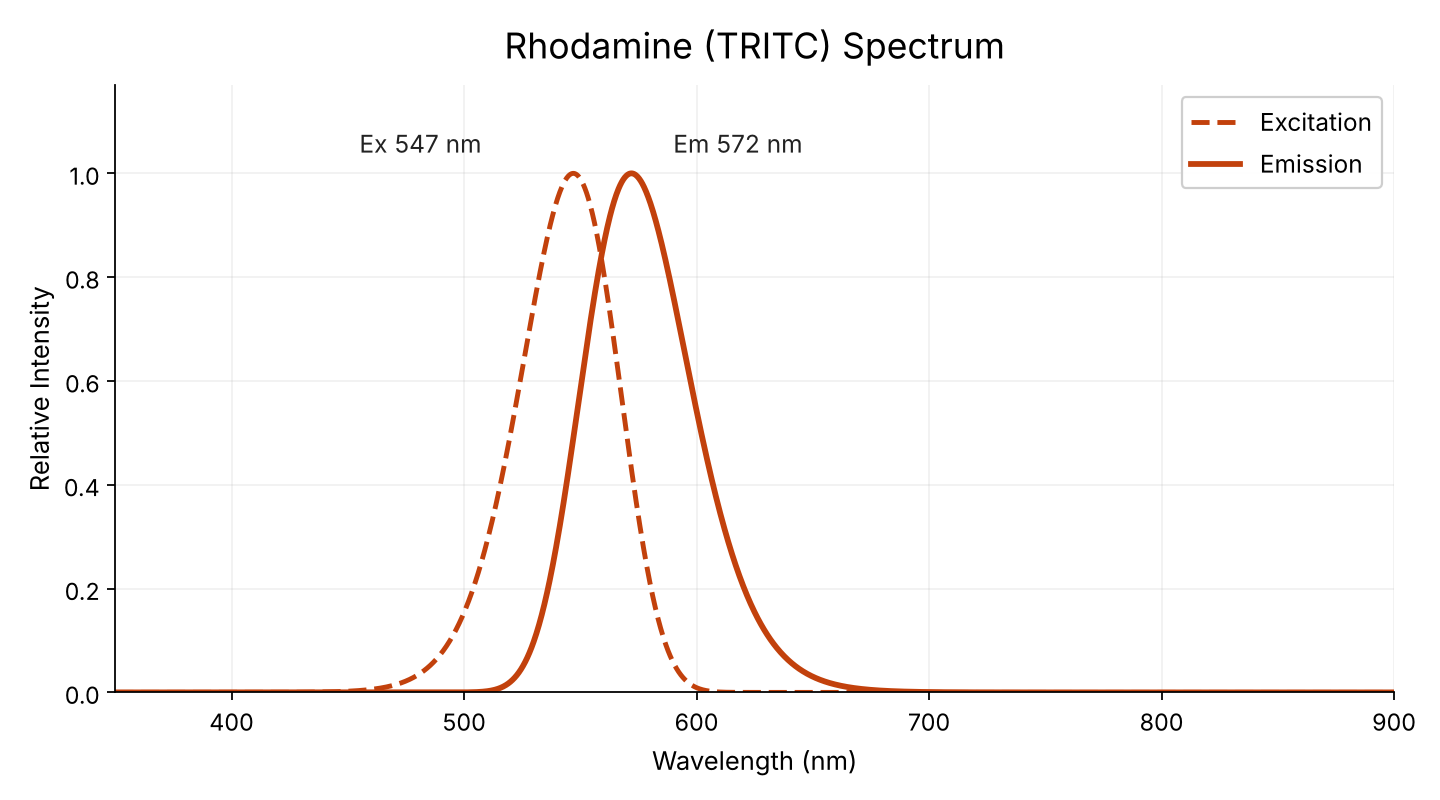
Rhodamine is a dye class rather than a single compound. For peptides the usual member is TRITC, tetramethylrhodamine isothiocyanate, which labels amines directly; TAMRA is the same fluorophore supplied as a carboxylic acid for coupling through an amide.
| Excitation maximum | 547 nm |
| Emission maximum | 572 nm |
| Laser line | 543 nm, 561 nm |
| Dye class | Rhodamine (xanthene) |
| Excitation / emission | About 547 / 572 nm, varying with the derivative3,4 |
| Filter set | TRITC or Cy3 configuration |
| Reactive form | Isothiocyanate (TRITC) or carboxylic acid / NHS ester (TAMRA) |
| Linkage | Thiourea for TRITC; amide for TAMRA |
| pH dependence | Low, unlike the fluoresceins1 |
TRITC and TAMRA give the same colour, and the difference is the chemistry. TRITC carries an isothiocyanate and forms a thiourea, exactly as FITC does — and the same caution applies, because a thiourea on a peptide's α-amino group is the arrangement that allows acid-driven Edman cleavage of the first residue.5 A spacer prevents it. TAMRA is coupled as an acid or an activated ester and gives an amide, with no such route, which is why most peptide orders for an orange label are filled with TAMRA.
Rhodamines keep their brightness across the pH range that defeats fluorescein, and they sit in a channel that separates cleanly from both green and far-red labels.1 They are the standard acceptor opposite a fluorescein donor in FRET substrates.
Reported maxima for TRITC range from about 541 to 557 nm depending on the source, solvent and derivative.3,4 That spread is larger than it looks when filters are chosen narrowly. Confirm against the conjugate rather than a generic table.
| Situation | Choice | Why |
|---|---|---|
| Orange label on a peptide you will keep | TAMRA | Amide linkage, no N-terminal degradation route5 |
| Direct amine labeling of a protein or carrier | TRITC | Isothiocyanate reacts without activation |
| N-terminal TRITC on a peptide | TRITC with an Ahx or β-Ala spacer | Prevents the acid-driven Edman cleavage5 |
| Brighter orange with higher water solubility | Cy3 or sulfo-Cy3 | Cyanines are brighter and can be sulfonated |
Tell us what the peptide has to do in the assay as well as its sequence. Where the dye sits often matters more to the result than which dye it is, and a label placed in a binding motif can remove the activity being measured.