

Need a quote?

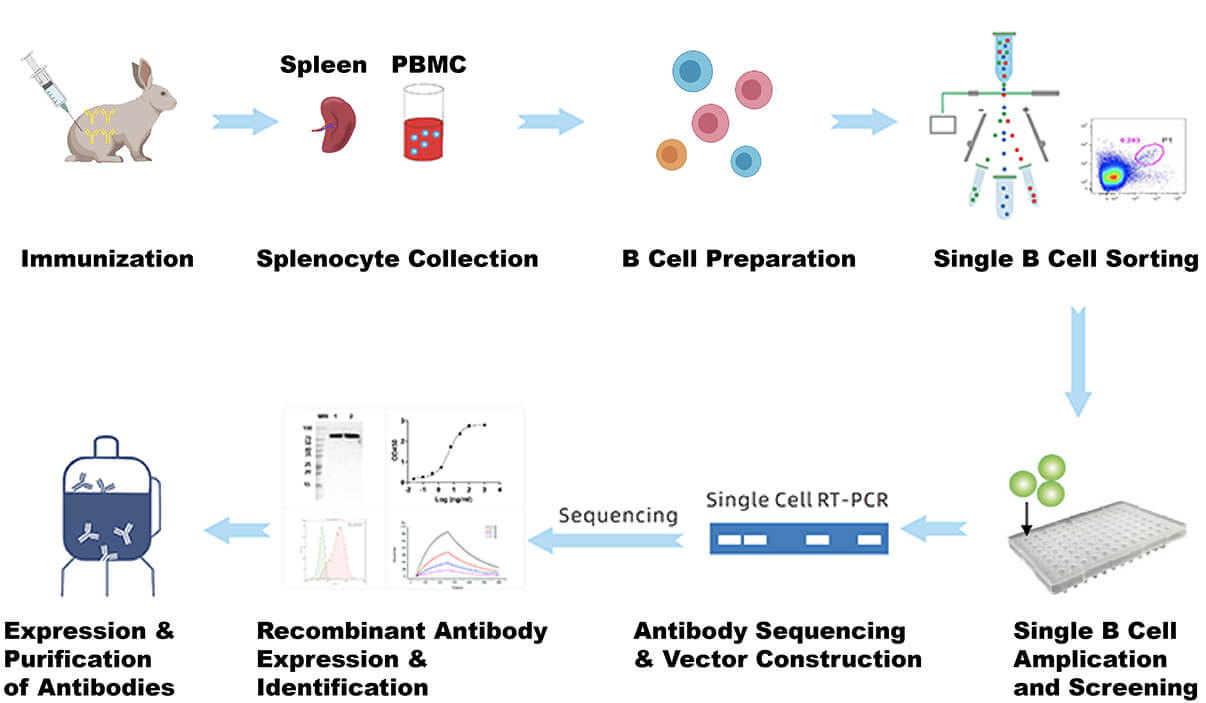
LifeTein provides rabbit monoclonal antibody services through the SIngle Monoclonal B cell Antibody (SIMBATM) workflow, which is based on antigen-specific single B cell screening, recovery of antibody variable regions, recombinant expression, and clone validation. This service is especially relevant for difficult epitopes, modified targets, peptide antigens, and projects where rabbit monoclonal antibodies may offer stronger performance than standard mouse monoclonal approaches.
The service positioning here is intended to reflect current single-B-cell rabbit monoclonal workflows used in the industry, including immunization, antigen-specific B-cell selection, VH/VL recovery, recombinant expression, and screening.
| Main concept | Antigen-specific single B cell screening followed by VH/VL recovery and recombinant antibody expression |
| Main immunogens | Peptides, conjugated peptides, haptens, recombinant proteins, and selected specialized immunogens |
| Main output | Validated recombinant monoclonal antibody candidates plus sequence information for selected clones |
| Typical strength | Useful for difficult epitopes, PTM sites, small molecules, rare epitopes, and peptide-driven targets |
| Phase | Service | Description | Typical Timeline |
|---|---|---|---|
| Phase I | Immunization and primary screening | Immunization, bleed monitoring, ELISA or related screening, and selection of the strongest responding animal. | ~6–9 weeks |
| Phase IIa | Single B cell screening | Antigen-specific B cell selection and primary screening of candidate populations. | ~2 weeks |
| Phase IIb | VH/VL recovery and construct generation | Recovery of antibody genes from selected positive cells and preparation for recombinant expression. | ~2 weeks |
| Phase III | Recombinant expression and validation | Expression of selected rabbit mAb candidates, validation screening, and selection of final clones for delivery. | ~3 weeks |
Actual timelines and deliverables depend on antigen behavior, screen performance, and final clone selection.
Best fit for SIMBATM
This service is best positioned for researchers who want recombinant rabbit monoclonal candidates from a single-B-cell style workflow, especially for difficult peptide targets, phospho-sites, modified epitopes, or small-molecule-related immunogens.
References using synthetic peptides and antibodies from LifeTein. See search results page from the Google Scholar.
The polyclonal antibodies recognizing CENH3 protein and kinetochore protein KNL1 were generated by LifeTein.
Polyclonal rabbit antibodies to Ll-Bhp-1 were commercially produced using recombinant Ll-Bhp-1 and purified by protein A affinity chromatography (LifeTein, Somerset, NJ, USA).
LifeTein produced a series of snake venom antibodies. Venom species used for rabbit IgG production: Tiger, Brown, Black, Death adder, and Taipan. The snake venoms were used for immunization of rabbits to generate polyclonal antibodies.
Protein A purified rabbit IgG specific for each venom species (Table 1) were purchased from a commercial supplier (Lifetein, Somerset, NJ, USA).
LifeTein designed and synthesized a series of peptides: CENH3, MIS12 and NDC80. The peptides were used for immunization of rabbits to generate polyclonal antibodies.
... The peptide synthesis, immunization, and antibody purification were performed by LifeTein...
...antibodies in rabbits using the service of Lifetein, LLC (Somerset, NJ...
LifeTein helped designed and synthesized a series of phosphorylated peptides. Then the peptides were used for phospho-specific antibody productions. The phospo-specific antibodies by LifeTein were confirmed to react with the epidermal growth factor receptor (EGFR). The Hung's lab showed that AGO2-Y393 phosphorylation mediates EGFR-enhanced cell survival and invasiveness under hypoxia. These findings suggest that modulation of miRNA biogenesis is important for stress response in tumour cells.
... The following peptides were chemically synthesized for antibody production in mice (Lifetein), Elisa verification (Lifetein) and peptide competition assay in immunohistochemistry (IHC)... Supplementary information