Product Name | Fructose-1,6-bisphosphatase 1 |
Product Quantity | 50 ug |
Catalog Number | LTCY-0002 |
Expression System | E. Coli |
Uniprot ID | P09467, https://www.uniprot.org/uniprot/P09467 |
QC | SDS-PAGE, FPLC profile, Crystallization trial tested |
Gene Source | Homo sapiens (Human) |
Expression Construct | | MADQAPFDTD VNTLTRFVME EGRKARGTGE LTQLLNSLCT AVKAISSAVR KAGIAHLYGI AGSTNVTGDQ VKKLDVLSND LVMNMLKSSF ATCVLVSEED KHAIIVEPEK RGKYVVCFDP LDGSSNIDCL VSVGTIFGIY RKKSTDEPSE KDALQPGRNL VAAGYALYGS ATMLVLAMDC GVNCFMLDPA IGEFILVDKD VKIKKKGKIY SLNEGYARDF DPAVTEYIQR KKFPPDNSAP YGARYVGSMV ADVHRTLVY.1LYPANKK SPNGKLRLLY ECNPMAYVME KAGGMATTGK EAVLDVIPTD IHQRAPVILG SPDDVLEFLK VYEKHSAQ | |
Product Description | 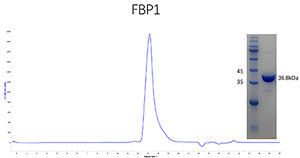
Subject to complex allosteric regulation. The enzyme can assume an active R-state or an inactive T-state. Intermediate conformations may exist. AMP acts as an allosteric inhibitor. AMP binding affects the turnover of bound substrate and not the affinity for substrate. Fructose 2,6-bisphosphate acts as a competitive inhibitor. Fructose 2,6-bisphosphate and AMP have synergistic effects. Catalyzes the hydrolysis of fructose 1,6-bisphosphate to fructose 6-phosphate in the presence of divalent cations, acting as a rate-limiting enzyme in gluconeogenesis. Plays a role in regulating glucose sensing and insulin secretion of pancreatic beta-cells. Appears to modulate glycerol gluconeogenesis in the liver. Important regulator of appetite and adiposity; increased expression of the protein in the liver after nutrient excess increases circulating satiety hormones and reduces appetite-stimulating neuropeptides and thus seems to provide a feedback mechanism to limit weight gain. |
Scientific Background | Fructose-1,6-bisphosphatase 1 is a synthetic peptide defined by the sequence and modifications listed in the product specification. No specific receptor, enzyme, pathway, disease association, or biological activity is assigned to this peptide without product-specific experimental evidence. |
Research Applications | - LC-MS/HPLC analytical method development
- sequence-specific assay controls
|
Experimental Notes | Sequence-derived chemical properties are provided to support reagent selection and experimental planning. They do not establish a biological function. Solubility, aggregation, adsorption, conjugation efficiency, and assay performance should be validated under the intended experimental conditions. |