

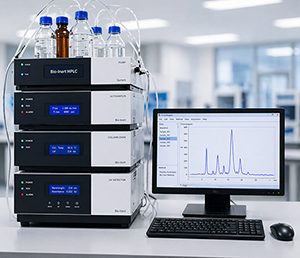
LifeTein supports peptide purification and analytical workflows with bio-inert HPLC capabilities designed for challenging biomolecules, including modified peptides, peptide conjugates, labeled peptides, acidic peptides, and other samples that can be affected by metal-surface interactions.
For many peptide workflows, cleaner peak shape, improved recovery, lower carryover, and stronger run-to-run consistency are critical for both purification and QC. Bio-inert flow paths help minimize non-specific interactions that may otherwise reduce sensitivity or compromise reproducibility.
A bio-inert HPLC system is designed so the sample flow path minimizes exposure to active metal surfaces. Depending on the system configuration, this may involve inert materials, inert coatings, or biocompatible wetted surfaces that help reduce unwanted analyte interaction during injection, separation, and detection.
This is especially important for peptides and other biomolecules that may adsorb to conventional metal surfaces. Such interactions can lead to sample loss, distorted peak shape, longer conditioning requirements, inconsistent recovery, and less reliable impurity profiling.
Peptides containing acidic, phosphorylated, or otherwise interactive functional groups can show non-specific adsorption to metal surfaces. Bio-inert systems help reduce this risk and support stronger analyte recovery.
Lower interaction with active surfaces can improve peak symmetry, reduce tailing, and make chromatograms easier to interpret during purification, identity confirmation, and impurity monitoring.
More consistent surface behavior can improve run-to-run precision, which is useful for peptide mapping, method transfer, process development, and QC environments where reproducibility matters.
Bio-inert configurations can reduce the conditioning burden often seen with difficult biomolecules, helping methods become ready faster and reducing concern about residual sample effects between runs.
| Higher confidence | Reduced risk of analyte loss from surface interaction can help improve confidence in purity assessment and impurity detection. |
| Improved recovery | Bio-inert conditions are especially valuable for low-abundance, modified, or adsorption-prone peptide species. |
| More reliable data | Cleaner separations and more consistent peak response can support method development, analytical troubleshooting, and lot evaluation. |
| Broader compatibility | Useful across peptide purification, analytical HPLC, mapping, and other bioseparation workflows where biocompatibility is important. |
Bio-inert HPLC workflows are often valuable for adsorption-sensitive or difficult-to-analyze samples, including:
If your project involves modified peptides, peptide conjugates, or difficult analytical challenges, please send us your sequence, target purity, quantity, and any known analytical concerns.
| Method 1 |
Obtain a quote online: Online Quotation Form |
| Method 2 | Complete the Quotation Form and send it by fax to 1-888-791-1618 or email it to peptide@lifetein.com. We typically respond within 24 hours on business days. |
Questions about purification, method feasibility, or a difficult peptide?
Contact LifeTein at 1-888-791-1618 or email peptide@lifetein.com.