
LifeTein now offers Surface Plasmon Resonance SPR binding analysis as an add-on service for custom peptide projects.
SPR is a real-time, label-free technology used to measure biomolecular interactions. For peptide researchers, SPR can help confirm whether a synthetic peptide binds to a customer-supplied antibody, protein, receptor, enzyme, or other target molecule.
By combining LifeTein’s custom peptide synthesis capability with SPR-based binding validation, researchers can move from peptide design and synthesis to quantitative binding analysis in one streamlined workflow.
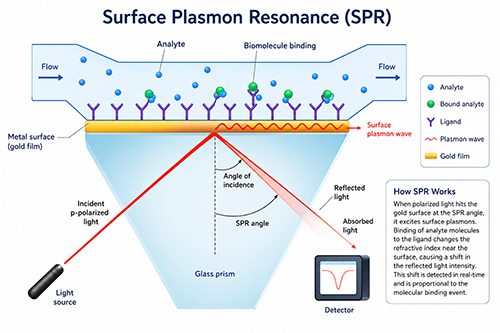
Surface Plasmon Resonance detects molecular binding events by monitoring changes near a sensor chip surface. One binding partner is immobilized on the chip, while the other molecule flows across the surface. Binding and dissociation are recorded in real time as sensorgram curves.
SPR can provide important binding parameters, including:
Peptides are widely used in antibody development, epitope mapping, receptor binding studies, therapeutic peptide discovery, vaccine research, and biomarker validation. However, peptide binding activity often needs to be confirmed after synthesis.
LifeTein’s SPR service is designed for customers who need quantitative peptide-target binding data after peptide synthesis.
| SPR Advantage | Benefit for Peptide Projects |
|---|---|
| Label-free detection | No fluorescent or enzymatic labeling is required. |
| Real-time monitoring | Association and dissociation can be observed directly. |
| Quantitative affinity | KD values help compare and rank peptide candidates. |
| Flexible assay design | Suitable for peptide-protein, peptide-antibody, and peptide-receptor interactions. |
LifeTein can synthesize and prepare many types of peptides for SPR analysis, including:
Depending on the target molecule and peptide design, SPR assay formats may include antibody versus peptide, protein versus peptide, or biotinylated target versus peptide. Both kinetic analysis and steady-state affinity analysis may be used depending on binding behavior.
| Assay Type | Typical Use | Readout |
|---|---|---|
| Antibody vs Peptide | Epitope validation and antibody binding confirmation | KD, Kon, Koff, sensorgram |
| Protein vs Peptide | Target engagement and receptor binding | KD and kinetic fitting |
| Biotinylated Protein vs Peptide | Oriented capture using streptavidin chip | Kinetic or steady-state affinity analysis |
| Multiple Peptides vs Same Target | Lead peptide ranking | Affinity comparison and response ranking |
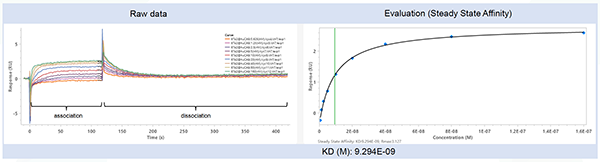
Option 1: LifeTein synthesizes the peptide.
Customers provide the antibody, recombinant protein, receptor, enzyme, or other target molecule. LifeTein synthesizes and purifies the peptide before coordinating SPR binding analysis.
Option 2: Customer supplies both binding partners.
Customers may provide both the peptide and the target molecule. Sample suitability will be reviewed before the SPR assay is started.
For best results, please provide peptide sequence, purity, molecular weight, solubility information, buffer condition, target concentration, storage buffer, and any known binding information.
Each SPR project may include:
Typical SPR service turnaround time is approximately 1 week after sample receipt and assay confirmation. Peptide synthesis turnaround depends on peptide length, modification type, purity requirement, and project complexity.
| Service | Price |
|---|---|
| SPR binding analysis, one peptide-target pair | Get a quote for the promotional price. |
| Additional peptide against the same target | Custom quote |
| Peptide synthesis + SPR validation package | Custom quote |
| Rush service, if available | Additional charge |
Send us your peptide sequence and target molecule information. LifeTein will help design a peptide synthesis and SPR validation workflow for your research.