| |
|
|
Custom Peptide Synthesis Services
1. Please click here to receive a custom peptide synthesis service quote now!

2. If you have a quote number already, please click here to place a peptide synthesis service order now!

LifeTein®, the custom peptide synthesis service company, has developed proprietary PeptideSynTM technology. This technology provides a platform for continuous peptide synthesis using Fmoc and Boc chemistry and a proprietary solid support resin. This is one of the many reasons why LifeTein® can offer such competitive custom peptide synthesis prices.
- Features
- Modifications
- FAQs
- Case Studies
Features and Benefits
- FREE aliquot is available. Why aliquot?
- Peptide quantities from mg to kg
- Sequence lengths of 5-120 amino acids
- Peptide purity levels including crude, desalted, >75%, >85%, >95%, 98%, and up to >99%
- Comprehensive peptide modifications. Click here to see the full list of modifications
- Fast turnaround: Most synthesized peptides can be delivered within 2-3 weeks
- Peptide library service options
- Stringent analytical specifications including free HPLC and MS analysis
- Peptides are sealed to prevent oxidation. Why seal peptides?
- Large capacity: We have the capacity to produce 5,000 purified peptides monthly. These range from crude to highly pure and complex peptides.
- Ensured quality: Peptide synthesis projects are carried out by Fmoc and Boc chemistry under the strictest quality control based on HPLC and by mass spectrometry. 95% of all projects are finalized in 2-3 weeks to guarantee the on time delivery.
- Data protection: All sequences supplied to LifeTein® are considered the confidential property of the customer. LifeTein® hereby disclaims any rights whatsoever to any intellectual property or know-how provided by the customer, including materials or any peptide sequences. At the completion of the project, all synthetic peptides meeting the purity criteria will be sent to the customer.
|
Peptide Synthesis Modifications:
Please click here for the full list if modifications and introduction!
Modification Examples:
Chemically synthesized peptides carry free amino and carboxy termini. Please state your preference for N-terminal acetylation or C-terminal amidation when placing your order. It is impossible to perform these modifications after synthesis. Both services are free of charge.
1. N-terminal acetylation / C-terminal amidation (free of charge): More details for N-terminal acetylation and C-terminal amidation
Chemically synthesized peptides are delivered with free amino and carboxy termini.
Simple N-terminal acetylation and/or C-terminal amidation increases the stability of the peptide by allowing the peptide to closely mimic the native protein. In this way, these modifications may increase the peptide's biological activity.

Advantages:
- The altered peptide ends are uncharged, so modified peptides more closely mimic the native protein. This increases their ability to enter cells. We recomend these modifications for intracellular, in-vivo assays and in-vitro functional studies.
- The modifications increase the metabolic stability of the peptides and their ability to resist enzymatic degradation by aminopetidases, exopeptidases and synthetase. The modified peptides can then be used as substrates in enzyme assays.
- Amidation not only enhances the activity of peptide hormones, it also prolongs their shelf life.
- The changes reduce the influences of charged C or N termini during ELISA binding assays.
Please click here for the full list if modifications and introduction!
2. Fluorophores: More details for fluorescent modifications
- We offer a full range of dye labeling options for the N terminus, C terminus or Lys side chain: Biotin, FITC, 5-FAM, Dansyl, TMR, Luciferin, Dnp, and PyBA.
- We recommend N terminus modification (Click here for details): Usually, dyes such as Biotin and FITC can be introduced at either N terminus or C terminus. We recommend the N terminus modification because this allows a higher success rate, a shorter turnaround time, and easier operation.
- Click here to see our comprehensive list of fluorophores including absorption and emission peak values.
Please click here for the full list if modifications and introduction!
3. Disulfide bridges
Disulfide bridges reduce peptide flexibility, increasing rigidity and decreasing the number of possible conformations. Such conformation constraints are important for biological activity and structural stabilization. The effective formation of disulfide bridges includes proper management of cysteine, the protection of this residue, and the methods for protecting group removal and cysteine pairing.
- We offer successful strategies for peptide synthesis involving intramolecular and intermolecular disulfide bridges.
- We host a full range of cyclic peptide synthesis options: triple disulfide bridges, same or different intermolecular disulfide bridges, amide cyclic peptide at the termini or side chains, and thioester cyclic peptides.
4. Phosphorylation
- We offer phosphorylation on pSer, pTyr, pThr or D-pSer, D-pTyr, D-pThr.
- Phosphorylation is available in two sites, three sites, four sites and five sites such as NDEpSpTDYEpSERQpTD
5. Other modifications: We also offer methyl amino acids, MAPs, and carrier protein modifications such as BSA, OVA, KLH, D-amino acid peptides, and other unusual peptides. Please click here for the full introduction to our modification services.
|
Frequently Asked Questions: Peptide Synthesis
Please click here to see more FAQs
- Why is the peptide delivered at room temperature?
Peptides are shipped at room temperature and are highly stable at lyophilized form in sealed vials. Peptides should not be kept in solution for long-term storage. See more details about handling and storage of synthetic peptides.
- How should I dissolve peptides?
The solubility of a peptide is determined mainly by its polarity. Acidic peptides can be reconstituted in basic buffers and basic peptides in acids. Hydrophobic peptides and neutral peptides containing large numbers of polar uncharged or hydrophobic amino acids should be dissolved in a small amounts of organic solvent. See more details on how to dissolve synthetic peptides.
- What is peptide purity?
Peptide purity is the amount of the target peptide as determined by HPLC at 214 nm, where the peptide bond absorbs. Water and residual salts are not detected via UV spectrophotometer. Other impurities found in the content can include deletion sequences (shorter peptides lacking one or more amino acids of the target sequence), truncated sequences (generated by the capping steps that are used to avoid the formation of deletion peptides), and incompletely deprotected sequences (generated during synthesis or the final cleavage process).
Peptide purity does not include any water or salts in the sample. TFA results from HPLC purification. The free N terminus and side chains such as Arg, Lys and His all form trifluoroacetates. Therefore, small amounts of TFA may contaminate the peptides. Peptides are usually delivered as trifluoroacetates (TFA) containing residual water. Even in lyophilized peptides, varying amounts of noncovalently-bound water still exist.
- Is a spacer required for fluorescent modification?
Usually, dyes such as Biotin and FITC can be introduced either N-terminally or C-terminally. We recommend N terminus modification for its higher success rate, shorter turnaround time, and easy of operation. This is because the peptides are synthesized from C terminus to N terminus. N terminus modification is the last step in the SPPS protocol. Thereafter, no further specific coupling steps are required. The C terminus process requires additional steps and is usually more complex.
Most dyes are large aromatic molecules. The incorporation of such bulky molecules may help to prevent interactions between the label and the peptide. This will help maintain peptide conformation and biological activity. It is recommended that flexible spacers such as Ahx (a 6 carbon linker) be included to render the fluorescent label more stable. Otherwise, FITC could easily link to a cysteine thiol moiety or the amino group of lysine at any position.
Please click here to see more FAQs. |
Cell-penetrating Peptide Synthesis
The process of introducing drugs into cells has always proved a major challenge for scientists. However, cell-penetrating peptides (CPPs) have the ability to enter a cell's plasma membrane independent of a membrane receptor. They are usually small peptides at 10–30 residues in length. The sequences of amino acids are often positively charged.
Tat, the transcription activator of the human immunodeficiency virus type 1 (HIV-1) viral genome was shown to enter cells in a non-toxic and highly efficient manner. Tat became known as the first cell-penetrating peptide.
CPPs have demonstrated themselves to be capable of delivering biologically active cargo to the cell interior. Attached to a CPP, therapeutic cargo could be delivered to an intracellular target, thus overcoming the entry restrictions set by the plasma membrane.
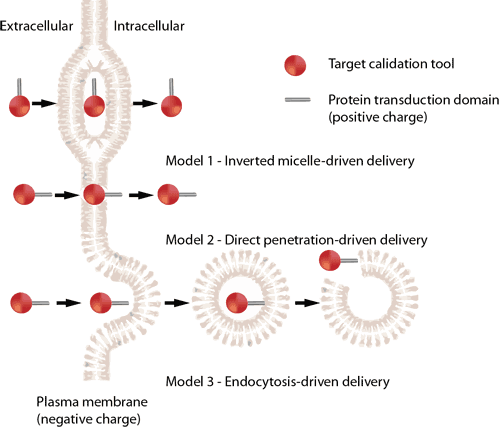
There are three proposed routes of CPP entry: Model 1: The inverted micelle model. Model 2: The direct penetration (pore formation) mechanism. Model 3: An endocytic mechanism of uptake. Source: Cell-penetrating peptides and their therapeutic applications, Victoria Sebbage, BioscienceHorizons, Volume 2, Number 1, March 2009.
Since the discovery of Tat, the number of known peptides with cell-penetrating capabilities has grown. The following table shows a selection of currently known CPPs, their origins and sequences.
Name |
Origin |
Sequence |
Tat family |
|
|
Tat (48-60) |
HIV-1 protein |
GRKKRRQRRRPPQQ |
Oligoarginine |
Tat derivative |
Rn |
Penetralia family |
|
|
p-Antp |
Antermapedia homeodomain |
RQIKIWFQNRRMKWKK |
plsl |
Igl-1 homeodomain |
RVIRVWFQNKRCKDKK |
Chimeric CPPs |
|
|
Transportan |
Galanin-mastoparan |
GWTLNSAGYLLGKINLKALAALAKKIL |
| MPG peptides |
|
|
P-beta |
gp41-SV40 |
GALFLGFLGAAGSTMGAWSQPKKKRKV |
P-alpha |
gp41-SV40 |
GALFLAFLAAALSLMGLWSQPKKKRRV |
Pep-1 |
Trp-rich motif-SV40 |
KETWWETWWTEWSQPKKKRRV |
Peptide Synthesis Case Studies
Incomplete deprotection and amino acid-coupling reactions can cause complications for certain processes. Longer reaction time and increased reagent strength could solve this problem. However, in some extreme cases, these methods are not sufficient and the protecting group cannot be removed efficiently. The side chains of some sequences render them prone to self-association by hydrogen bonding. This leads to aggregation and to the formation of beta-sheet-like secondary structures that can halt peptide synthesis.
LifeTein's optimized protocol and PeptideSyn technology provide a method for circumventing the problem of difficult sequences. The technology can change the peptide structure by protecting some of the peptide amide bonds, giving rise to peptides containing tertiary amides at periodic intervals. This leads to better preservation of the peptide chain and to more efficient deprotection and coupling reactions.
Case 1: Solid-phase synthesis of a peptide with formation of both disulfide bridges on a solid support.
A 14 amino acid peptide (molecular weight: 1981.53) with 4 phosphorylation sites at 95% purity was delivered in 3 weeks: xxxpSpTxxxpSxxxpTx
HPLC Results:

MS Results:

Case 2: Client requested a very hydrophobic 68 amino acid peptide (85% purity) with FITC modification at the N terminus. The peptide was successfully synthesized in 4 weeks.
HPLC Results:

MS Results:

|
How to estimate prices and place orders for custom peptide synthesis:
Please fax our order form to 1-888-791-1618 or email us at peptide@lifetein.com.
1. You can use the following table to estimate peptide synthesis price. Please inquire for more pricing information:
Custom Peptide Synthesis Price Table (Prices are per amino acid and valid for peptides of up to 30 residues. Get quote for peptide of 30 to 120 residues. )
| Quantity |
Purity |
| Crude |
>85% |
>95% |
| 1-4 mg |
$3.20 |
$9.00 |
$11.56 |
| 15-20 mg |
$4.76 |
$15.30 |
$20.40 |
| 40-50 mg |
$6.46 |
$19.89 |
$27.20 |
| 70-80 mg |
$7.82 |
$26.69 |
$35.70 |
| 1000 mg |
$28.05 |
$79.90 |
$105.40 |
Click here to see the list of peptide modifications
- Our standard peptide synthesis package includes a certificate of analysis, HPLC and MS reports.
- Amino Acid Analysis and N Elemental Analysis are available at competitive prices.
- Free peptide aliquoting services are available.
- Solubility tests are available.
- Discounts will be offered for large orders.
- The turnaround time for regular peptide synthesis services is 2-3 weeks.
- Shipping price: $25.00 (U.S.); $30.00 (Canada); $45.00 (International).
2. Quotations
- Method 1: Obtain a quote. Please use the online quotation form:
- Method 2: Please complete the Quotation Form for the peptide you
would like to purchase and either fax it to 1-888-791-1618 or email it to peptide@lifetein.com. We will send you a quote within 24 hours.
3. Place an Order
- Method 1: Place your order online if you already have a quote number:

- Method 2: Please sign the quote form we issue to you, and either fax it to 1-888-791-1618 or email it with your Purchase Order, if any, to peptide@lifetein.com. We will confirm your order within 24 hours.
|